



Understanding Hand Pumps: How They Work and Their Uses
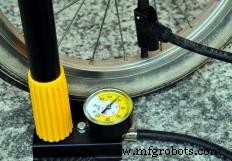
A hand pump is a pump that uses power supplied by the user's own muscles for its operation. The most common types of hand pumps are those used to pump water and air, though water pumps have become increasingly more automated over the years. Hand pumps for air remain very popular, especially when inflating things like athletic balls and bicycle tires.
The air hand pump works by drawing air into the pump and then forcing it through the nozzle and into the desired object. Air is drawn in via one of two ways. The first way is for the air to sucked in when the pump handle is pulled upward. The other way, for a bulb hand pump, is simply to squeeze and release the bulb. The bulb naturally fills up with air as it is squeezed.
The hand pump may not be able to deliver as much air pressure as is required for some inner tubes and therefore should only be used with things it is recommended for. Automated pumps are able to provide much more pressure for products that demand it. Still, the air hand pump can be used for many applications and may be more convenient, or at least the preferred option, for many of them.
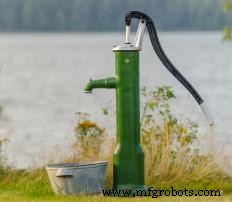
The hand water pump is a truly simple device that uses the power of suction to draw water up from an underground well. As the hand is pushed down, the fulcrum causes the piston rod to go up, thus taking with it the piston and its sealing O-rings. That upward suction causes a check valve at the bottom of the pump, often referred to as a foot valve, to open and draws water. When the piston goes back down, that pressure causes the check valve to close, thus trapping the water above the piston (through the use of another check valve). This cycle repeats itself as long as the hand pump is in use.
While most water pumps operated by hand are considered relics of years that have already passed, they may still be in use, especially as a backup when electricity is not available. They may also be used in more rural areas of Third World countries as a primary source of water. So despite the fact they have mainly disappeared from the public consciousness, they still may provide the only access to clean water in some areas.
The hand pump is usually a cheap device, which can be operated with very little experience. The only thing that may take a little skill is the priming of a water pump. Other than that, most pumps can be operated by most people, even if they are of limited mechanical abilities.
Industrial equipment
- Understanding Jockey Pumps: Essential Pressure Maintenance for Fire Sprinkler Systems
- Turbine Pumps Explained: Design, Operation, and Applications
- Understanding Discharge Pressure: Key to Pump Performance
- Understanding the Water Pump Pulley: Function, Importance, and Replacement Tips
- Understanding Multistage Pumps: Function, Uses, and Benefits
- Understanding Submersible Pumps: How They Work and Their Key Benefits
- Understanding Radial Hydraulic Pumps: Design, Applications, and Benefits
- What Is a 3-Stage Pump? A Comprehensive Guide
- Understanding 1-Stage Pumps: Design, Function, and Industrial Applications
- Decoding 'N' in Pump Calculations: Its Role and Significance