



Anti‑Lock Braking Systems (ABS): How They Keep You Safe
Every driver has experienced the sudden need to slam the brakes—an unnerving moment that can end in a collision if the wheels lock.
Modern vehicles counter this danger with anti‑lock braking systems (ABS), now a standard feature on almost all new cars and motorcycles. ABS preserves traction, allowing drivers to maintain steering control while braking.
In this article we explain what ABS is, how it operates, its safety impact, and why automotive technicians need in‑depth knowledge of the system.
What Are Anti‑Lock Braking Systems (ABS)?
When brakes are applied hard, wheel rotation can cease, causing the wheels to lock. A locked wheel can lose traction, making the vehicle skid and reducing steering capability. ABS prevents this by keeping the wheels from locking during hard braking.
When Was ABS Invented?
Initial experiments began in the 1950s on rail cars and aircraft, followed by motorcycle prototypes that aimed to curb skidding. By the 1960s the technology appeared on the first four‑wheel‑drive Formula One car. Mercedes‑Benz and Daimler refined the system for production cars, unveiling it on a test track in 1978.
Since then ABS has become ubiquitous, dramatically improving road safety worldwide.
How Do Anti‑Lock Brakes Work?
Below is a concise breakdown of the key components that enable ABS.
A Breakdown of the Anti‑Lock Braking System
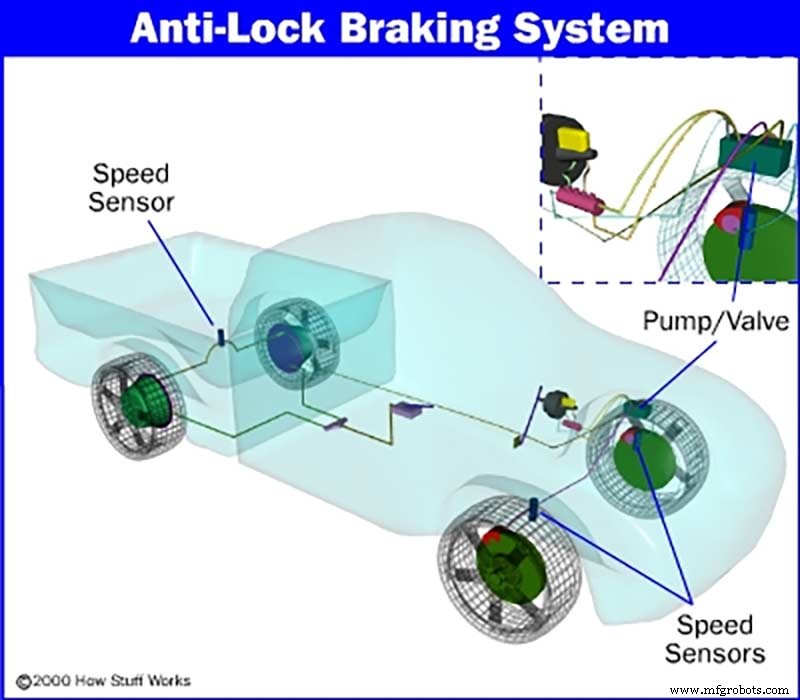
Image Credit: How Stuff Works
- Speed sensors – detect wheel rotational speed.
- Valves – situated in the brake lines, they modulate hydraulic pressure.
- Pump – pressurises the brake fluid that powers the calipers or drums.
- Controller – processes sensor data and commands the pump to pulse the brakes.
ABS systems differ slightly across manufacturers, but all share the same principle: when a sensor flags impending wheel lock, the controller pulses the brakes—reducing and restoring pressure—to keep the wheels spinning and traction intact.
How Effective Are Anti‑Lock Brakes?
A 2009 U.S. Department of Transportation study found:
- ABS cuts overall crash‑involvement rates by 6 % for passenger cars and 8 % for light‑truck vehicles.
- Fatal collisions involving pedestrians, bicyclists, or animals drop by 13 % for cars and 14 % for light trucks.
- Fatal involvements on wet, snowy, or icy roads decrease by 12 % for passenger cars.
The Insurance Institute for Highway Safety (IIHS) reports that motorcycles equipped with ABS experience a 31 % lower fatal‑crash rate than identical models lacking the feature.
While ABS significantly improves safety under normal conditions, its effectiveness can be reduced on surfaces like ice, snow, or gravel. Drivers should therefore exercise extra caution during extreme weather, maintaining a safe following distance and allowing ample stopping time.
What Automotive Technicians Need to Know
Technicians must grasp every component of modern vehicles—including ABS—to diagnose, maintain, and repair them safely. While on‑the‑job training is common, many employers favor candidates who have completed a formal program, such as UTI’s Automotive Technology course.1
Over 51 weeks, students learn engine service, electronic systems, powertrains, transmissions, and a dedicated brake‑system module that covers ABS diagnostics and repair.7
Graduates gain access to a range of career paths: dealerships, repair shops, rental agencies, or even racing teams. If you enjoy hands‑on problem solving, this field offers a rewarding career.
Train for a Career in the Auto Industry
UTI’s Automotive Technology program is offered at 11 campuses nationwide. Classes start every three to six weeks, so you can accelerate your career timeline.
To learn more, visit our program page and request information to connect with an Admissions Representative today. Meanwhile, explore these resources:
- Automotive Courses
- Automotive Careers
- Auto Tech Traits
- Auto FAQs
Industrial equipment
- What Are Bi‑Fold Hinges? Features, Benefits, and Applications
- Deck Screws Explained: Types, Benefits, and How They Compare to Wood Screws
- What Are Split Washers? A Deep Dive Into Vibrational Locking Fasteners
- Set Screws Explained: Design, Differences, and Applications
- Spring‑Energized Seals: Design, Function, and Industrial Benefits
- Industrial Braking Systems in Mining: Types, Applications, and Best Practices
- Hydraulic Systems Explained: Fundamentals and Real-World Applications
- Clean Agent Fire Suppression Systems Explained: Safe, Residue-Free Protection for All Fire Classes
- Understanding Hydraulic Control Systems: Principles, Functions, and Applications
- How Anti-lock Braking Systems (ABS) Work: A Comprehensive Guide