



Reciprocating Compressor Systems: Engineering Breakdown, Classifications & Industrial Applications
What Is a Reciprocating Air Compressor?
A reciprocating air compressor is a positive displacement machine that compresses air using a piston-driven cylinder. As the piston moves downward, air enters through the suction valve; on the return stroke, the air is compressed and discharged at elevated pressure.
Why it matters: This simple, robust mechanism delivers high pressure (up to 500+ psig) with precise volumetric control ideal for intermittent duty, backup systems, and high-pressure industrial processes.
Operational impact: Properly maintained, a reciprocating air compressor offers reliable performance with straightforward serviceability. Misapplied or poorly maintained, it suffers rapid efficiency loss, valve wear, and thermal stress.
How Does a Reciprocating Air Compressor Work?
The compression cycle follows four mechanical stages:
- Intake: Piston descends, suction valve opens, atmospheric air fills the cylinder.
- Compression: Piston rises, valves close, air volume decreases, pressure and temperature increase.
- Discharge: Pressure exceeds line pressure plus valve spring force; discharge valve opens, compressed air exits.
- Re-expansion: Residual air in clearance volume expands before next intake stroke.
Key technical insight: Volumetric efficiency depends on valve timing, piston ring seal, and interstage cooling. A 10% drop in efficiency can increase specific power (kW/CFM) by 15–20%.
Practical tip: Monitor discharge temperature and motor amperage. Rising trends often signal valve wear or cooling issues before failure occurs.
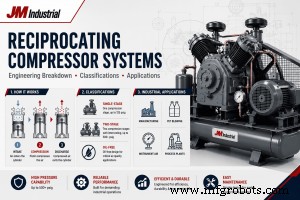
Single-Stage vs. Two-Stage Reciprocating Air Compressor
Selection guidance: Choose single-stage for 100 psig or less intermittent use. Select two-stage when pressure exceeds 125 psig or duty cycle exceeds 60%. Two-stage units reduce specific power by 10–15% at elevated pressures.
Oil-Lubricated vs. Oil-Free Reciprocating Air Compressor
Decision rule: If your process tolerates trace oil with filtration, oil-lubricated offers lower total cost of ownership. If air purity is non-negotiable, specify oil-free and budget for more frequent ring inspections.
Where to Use a Reciprocating Air Compressor: Application Guide
A reciprocating air compressor excels in these industrial scenarios:
- High-pressure, low-flow processes: PET bottle blowing (350–500 psig), gas boosting, leak testing
- Intermittent duty cycles: Maintenance shops, batch processes, backup instrument air
- Capital-constrained projects: Lower upfront cost vs. rotary screw for equivalent pressure
- Remote or portable applications: Skid-mounted, diesel-driven units for field service
- Retrofit or expansion: Adding peak capacity without replacing base-load screw compressors
Avoid using reciprocating compressors for: 24/7 base-load service, large continuous flows exceeding 2,000 CFM, or environments requiring ultra-low maintenance.
How to Size a Reciprocating Air Compressor
Follow this four-step method to avoid undersizing or overspending:
Step 1: Calculate Actual Demand Required CFM = Peak Tool Demand × (1 + Leakage Factor 0.10–0.15)
Step 2: Correct for Ambient Conditions Corrected CFM = Rated CFM × (P_actual / 14.7) × (520 / T_actual_Rankine) (Applies at altitude or high ambient temperature)
Step 3: Match to Compressor FAD Select a unit where Free Air Delivery (FAD) at operating pressure meets or exceeds your corrected demand. Never size on piston displacement alone.
Step 4: Add Buffer Include 10–15% capacity reserve for future expansion or demand spikes.
Example: Plant needs 100 CFM at 100 psig, 85°F ambient, sea level. Required = 100 × 1.15 = 115 CFM Assuming 85% volumetric efficiency: Minimum displacement = 115 / 0.85 ≈ 135 CFM Select a reciprocating air compressor rated 140 CFM FAD or higher at 100 psig.
Performance Factors That Impact Reliability
Maximize uptime and efficiency by controlling these variables:
- Valve Condition: Fouled or fatigued valves reduce FAD by 10–25%. Inspect every 4,000–6,000 hours.
- Cooling Efficiency: Dirty fins or scaled water jackets raise discharge temperatures, accelerating oil breakdown and ring wear.
- Lubricant Management: Use OEM-specified viscosity; change per operating hours, not calendar.
- Receiver Sizing: Minimum 1 gallon per CFM output stabilizes pressure and reduces load cycling.
- Inlet Air Quality: Restricted filters increase suction drop, reducing mass flow and raising motor load.
Pro tip: Log motor amperage and interstage temperature weekly. Trend analysis predicts failures before they cause downtime.
Common Mistakes to Avoid
- Using contractor-grade units for continuous plant service: Aluminum cylinders and light-duty bearings fail under more than 6 hours per day operation.
- Ignoring condensate drainage: Water in intercoolers causes hydraulic lock and cylinder corrosion. Drain daily or install auto-traps.
- Undersizing discharge piping: High velocity increases backpressure, reducing volumetric efficiency. Keep velocity below 20 ft/s.
- Skipping FAD verification: Many vendors quote displacement CFM. Demand certified FAD at your operating pressure.
- Mixing lubricant brands: Additive incompatibility causes sludge, blocked passages, and carbonized valves.
Quick Selection Checklist
Use this before procurement or replacement:
- Confirm required FAD at actual ambient conditions
- Match duty cycle to compressor class (standard vs. heavy-duty)
- Specify oil-lubricated or oil-free based on ISO 8573-1 air class
- Verify electrical supply matches motor LRC and starting method
- Size receiver tank at 1 gallon per CFM output or greater
- Install aftercooler and moisture separator for industrial service
- Document valve inspection interval (4,000–6,000 hours)
- Baseline amperage and temperature at commissioning
Conclusion
A reciprocating air compressor delivers high-pressure, intermittent-flow compressed air with mechanical simplicity and cost-effective capital deployment. Success depends on matching configuration to duty cycle, sizing for actual FAD rather than displacement, and maintaining valves, cooling, and lubrication on a condition-based schedule. Use the selection criteria and sizing method above to ensure reliable performance and controlled lifecycle costs.
FAQs
Q: What is the typical duty cycle for a reciprocating air compressor?
Standard industrial units handle 60–75% duty cycle. Heavy-duty cast-iron models can sustain 100% duty with proper cooling and maintenance. Avoid running contractor-grade units above 50% duty.
Q: How often should valve plates be inspected?
Inspect every 4,000–6,000 operating hours for industrial two-stage units. Single-stage or oil-free designs may require inspection at 2,000–4,000 hours due to higher thermal stress.
Q: Can a reciprocating air compressor run continuously?
Yes, but only heavy-duty, two-stage, water-cooled models designed for 100% duty. Continuous operation requires disciplined maintenance, adequate cooling, and oversized receivers to minimize cycling.
Q: What pressure can a reciprocating air compressor achieve?
Single-stage units reach up to 125 psig. Two-stage units cover 125–250 psig standard; specialized multi-stage units reach 500+ psig for PET molding, gas boosting, or testing applications.
Q: How do I reduce energy consumption?
Right-size the unit, maintain valve efficiency, clean cooling surfaces, fix air leaks, and operate at the lowest practical discharge pressure. Every 2 psig reduction saves approximately 1% energy.
Industrial equipment
- Pallet Jacks vs Tuggers: How They Differ and Which Is Right for Your Business
- Understanding Pulley Systems: How Simple Machines Transform Effort into Lifting
- From Music to Mastery: Patrick Sellers, UTI‑Graduated Porsche Technician
- Machine Bolts Explained: Types, Uses, and Installation Guide
- Optimizing Pressure Regulation in Compressed Air Systems
- Breaking Strength Explained: What It Is and Why It Matters
- Prevent Rust on Machinery During Shipping: A Step-by-Step Guide
- Revolutionizing Multi-Spindle Production: Otto Engineering’s Innovative Approach
- Flood Irrigation Explained: How It Works and Its Pros & Cons
- Maximize Safety and ROI: The Essential Guide to Preventive Maintenance for Industrial Equipment