



Mastering Embedded Coding: Proven Habits to Slash Errors and Boost Safety
Over the past decade, embedded software has grown from a few hundred thousand lines to more than 100 million in a typical vehicle. The shift to 32‑bit processors and abundant memory has unlocked unprecedented functionality—yet it has also amplified the risk of subtle bugs that threaten safety and security.
To stay ahead, developers must adopt a systematic approach that prevents errors before they enter the code base. Two primary error categories deserve special attention:
- Coding errors – e.g., out‑of‑bounds array access. These are detectable through static analysis.
- Application errors – only caught when the software’s behavior is validated against its requirements.
Implementing a rigorous coding standard, such as MISRA C/C++, coupled with requirement‑driven testing, offers a powerful “ounce of prevention.” This strategy reduces debugging time, tightens schedules, and ultimately protects your ROI.
Why Prevention Matters
Human mistakes are inevitable—engineers rush, overlook details, or misinterpret complex data flows. But when software grows in size and interconnectivity, these simple slip‑ups can cascade into critical failures. A disciplined coding standard helps detect and eliminate many of these pitfalls before they surface.
In the C/C++ ecosystem, roughly 80 % of defects stem from misuse of just 20 % of the language. By banning or restricting the problematic constructs, a standard dramatically raises code quality.
Consider the undefined behavior that arises when a signed integer is right‑shifted. Depending on the compiler, the result can differ, leading to inconsistent program behavior. Likewise, a function that reads a circular buffer may return values in an unexpected order on some compilers. These nuances are highlighted in the figures below.
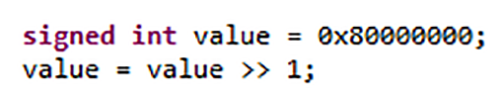
Figure 1. Compiler‑dependent behavior in C/C++ constructs. Source: LDRA
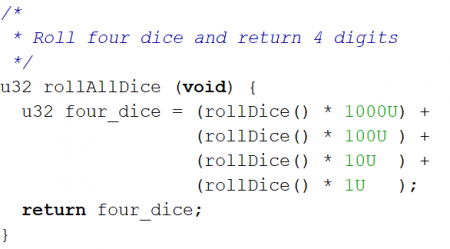
Figure 2. Unspecified behavior in a circular buffer example. Source: LDRA
Leveraging MISRA C/C++
MISRA, first published in 1998 for the automotive industry, remains the gold standard for embedded C/C++ coding. It specifies:
- Why each rule exists, with detailed exceptions.
- Clear examples of undefined, unspecified, and implementation‑defined behavior.
- Guidance on which rules are “Decidable” (tool‑verifiable) and which are “Undecidable.”
In 2016, MISRA expanded to address security‑critical code, adding 14 new directives. For instance, Directive 4.14 explicitly prohibits constructs that can lead to undefined behavior, thereby tightening security posture.
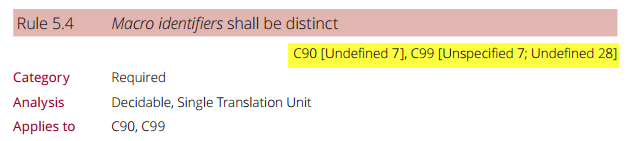
Figure 3. MISRA guidance on undefined and unspecified behavior. Source: LDRA
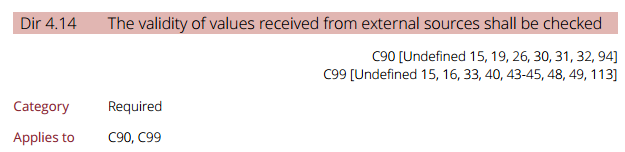
Figure 4. Directive 4.14’s role in preventing undefined behavior. Source: LDRA
From Code to Application: The Role of Requirements and Testing
Even flawless code can fail if it does not meet its intended purpose. Requirements traceability and unit‑level testing are essential to verify that the software behaves as designed.
Bidirectional traceability links each function back to its low‑level requirement and up to system‑level objectives. This mapping exposes missing or superfluous features early.
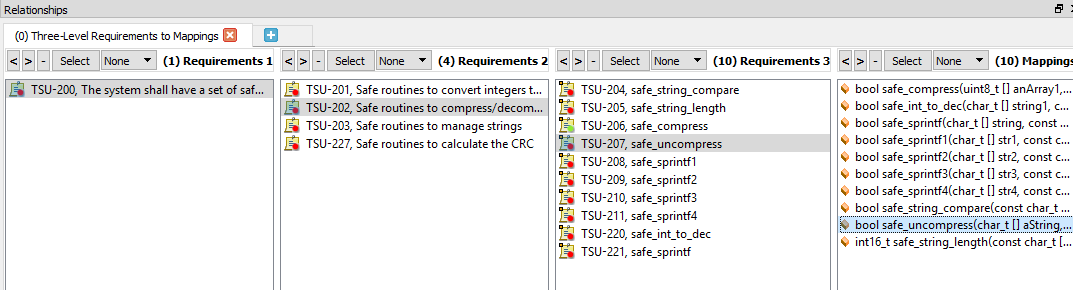
Figure 5. Bidirectional traceability from function to system requirement. Source: LDRA
Once low‑level requirements are defined, test cases naturally emerge. Running these tests—ideally with automated unit test tools—confirms that the code fulfills its contract.
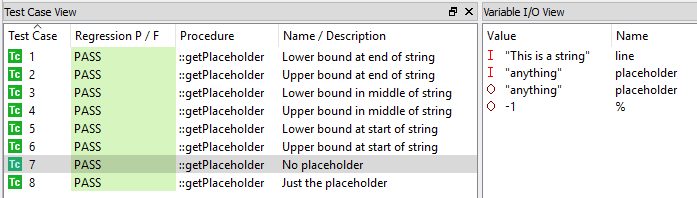
Figure 9. Automated unit testing results. Source: LDRA
Adopting New Coding Habits
Modern embedded development demands a holistic approach:
- Implement a proven coding standard (MISRA, CERT, etc.).
- Track metrics—defect density, code coverage, compliance rates.
- Enforce requirement traceability and automated regression testing.
These practices deliver cleaner, more maintainable code, simplify feature addition, and reduce long‑term maintenance costs—benefits that resonate across both safety‑critical and non‑critical domains.
Adopting these habits isn’t optional if you aim for a competitive edge. The difference between a codebase that needs constant firefighting and one that evolves smoothly is often just a disciplined process.
Original article from EDN.
Embedded
- What Is Coding? A Practical Guide to Languages, Workflows, and Common Challenges
- Text Strings: A Hidden Vulnerability in Embedded Software
- Ensuring Reliable Timing in Safety‑Critical Multicore Embedded Systems
- Pixus Introduces Rugged 6U OpenVPX Faceplates with Enhanced Structural Integrity
- Kontron Unveils COM HPC: A New High‑Performance Embedded Computing Standard
- Mipsology’s Zebra Turns GPU AI Code Into FPGA Accelerators With One Command
- Privafy and Micron Introduce Embedded SECaaS for IoT Data in Motion
- GE Digital Unveils Predictive Asset Management Software, Shifting Maintenance from Reactive to Proactive
- Leveraging DevOps to Overcome Embedded Software Challenges
- Epicor Software Announces New CEO Stephen Murphy Following Joe Cowan's Retirement