



CEVA‑XC12: Powering 5G’s Demands with Ultra‑Efficient DSP
5G – the fifth generation of mobile networks – is rapidly moving from concept to reality. While initial deployments began in 2020, the standards are still evolving, and many specifications remain in flux.
But what exactly does 5G promise? The NGMN Alliance outlines several key performance indicators that any 5G standard must satisfy:
- Data rates of tens of megabits per second for tens of thousands of users.
- Data rates of 100 megabits per second for metropolitan areas.
- 1 Gb per second simultaneously to many workers on the same office floor.
- Several hundreds of thousands of simultaneous connections for wireless sensors.
- Spectral efficiency significantly enhanced compared to 4G.
- Improved coverage.
- Enhanced signaling efficiency.
- Significantly reduced latency.
In short, 5G will unify a vast ecosystem of users—from massive IoT deployments to bandwidth‑hungry mobile broadband—and will support new applications that LTE simply cannot handle—VR, V2X, e‑Health, and mission‑critical services—while remaining compatible with existing LTE infrastructure.
Take V2X, for instance. In vehicle‑to‑vehicle scenarios, autonomous cars must exchange real‑time safety messages—such as “I’m approaching the intersection; please yield”—with millisecond latency. Such use cases illustrate the stringent fidelity and latency requirements that 5G must deliver.
These demands translate into unprecedented processing requirements. 5G must support peak data rates up to 20 Gbps with a target latency of 1 ms, leveraging techniques like Massive‑MIMO and 3‑D beamforming. Conventional LTE‑Advanced Pro DSPs simply cannot meet this performance gap.
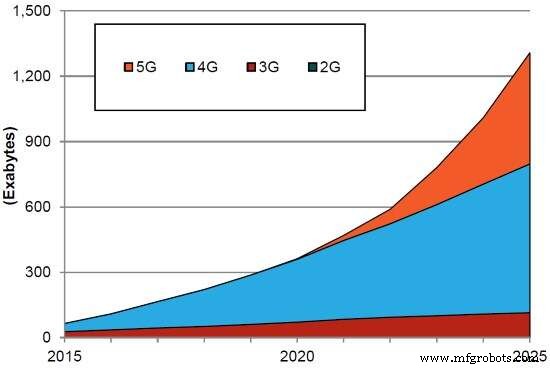
Mobile data traffic by technology (Source: CEVA/ABI Research)
According to ABI Research, 5G mobile data traffic is expected to represent 40% of total data traffic and have 500 million subscribers by 2025. 3G and 4G usage will continue to grow linearly, while 5G is projected to rise exponentially.
To address this gap, CEVA has unveiled the CEVA‑XC12 DSP core—a powerful, energy‑efficient engine engineered for multi‑gigabit modems. Its modular architecture allows customization for smartphones, base stations, small cells, macro cells, and cloud‑RAN deployments.
The XC12 supports the full spectrum of 5G frequencies—from 450 MHz up to 80 GHz—and is equally adept at LTE‑Advanced Pro, eMBB, LAA, MulteFire, LWA, V2X, Wi‑Fi 802.11ax, WiGig 802.11ad, FWA, and VR workloads.
Key technologies that underpin the XC12 include:
- A new micro‑architecture to meet very high frequency requirements and ultra‑low power consumption—capable of operating at 1.8 GHz in 10 nm and delivering 50% less power than its predecessor, the CEVA‑XC4500.
- Massive computation capabilities to maintain a high bit‑rate—equipped with quad‑vector processor engines approaching 1 tera operations per second (TOPs).
- High‑precision arithmetic—achieves optimal resolution with up to 256×256‑dimensional matrix processing.
- Specialized instructions to accelerate all baseband components—support for advanced 256 and 1024 QAM demodulation.
- Core streaming interfaces—allowing ultra‑low latency transfers between cores or accelerators.
- Control plane for massive‑user management and multi‑RAT systems—incorporates a scalar processing unit with a CoreMark/MHz score of 4.4 to handle the huge number of users required for LTE MTC and 5G IoT.
The XC12 also features a state‑of‑the‑art cache architecture and hardware coherency support for seamless multi‑core implementations. The CEVA‑XC12 DSP core is now available for licensing—click here for more information.
Embedded
- Cadence Launches HiFi 1 DSP: Ultra‑Low‑Power Audio Engine for Wearables & Hearables
- Vespel® – The High‑Performance Polyimide for Extreme Environments
- What 3D Printing Needs to Evolve: Top 3 Industry Demands Revealed at AMUG
- 2020 Supply Chain Evolution: Adapting to COVID-19 Challenges
- Siemens Mobile HMI Panels: Scalable, Reliable Industrial Interfaces
- Mobile EAM: A Real‑Time Maintenance App for Field Technicians
- Why Mobile Construction Cranes Beat Fixed Cranes: Top Benefits & Advantages
- Why Mobile Cranes Are a Game-Changer: Key Benefits and Advantages
- Ransomware Threats Targeting Design Engineers: Protect Your Projects
- Mobile Robotics: Advancing Automation on the Move