



Vespel® – The High‑Performance Polyimide for Extreme Environments
Why choose Vespel®? It is one of the most versatile engineering plastics available. When cost is secondary and performance is paramount—especially in harsh or vacuum environments—Vespel® offers unmatched strength, chemical resistance, and low friction.
Vespel® is a registered trademark of DuPont® and refers to a condensation‑type polyimide made from pyromellitic dianhydride (PMDA) and 4,4′‑diamino‑diphenyl‑ether (ODA).¹
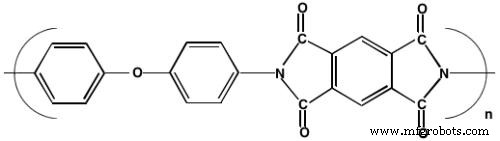
It is a staple in aerospace, semiconductor fabrication, and transportation. Virtually every Western jet engine incorporates Vespel® parts, and the material is also chosen for space hardware, reactor chambers, and vacuum systems where temperature extremes, radiation, and minimal outgassing are critical.
Applications include seal rings, valve seats, bushings, spacers, fasteners, bearings, wafer guides, brake assemblies, jet engine components, small motors, vacuum pumps, and anti‑lock braking systems.
Vespel® is sold in an unfilled grade (SP1) and in filled grades with graphite, PTFE/graphite, or molybdenum disulfide. This article focuses on the unfilled SP1 grade.
Thermal Performance
SP1 is semi‑crystalline, lacking a true melting point but also exhibiting no glass transition temperature below its decomposition point (>750 °F / 400 °C). It can continuously operate up to 500 °F (260 °C) and withstand brief excursions to 900 °F (482 °C) without loss of mechanical integrity. UL 94 V‑0 flammability and intrinsic flame retardancy make it safe for high‑temperature environments.
Mechanical and Tribological Properties
- Low coefficient of friction and lubricious surface reduce wear and improve fuel efficiency.
- Highest unlubricated pressure‑velocity (PV) limit of any engineered plastic: 0.29–3.5 MPa‑m/s.
- Excellent abrasion resistance and minimal particle generation—ideal for semiconductor clean rooms.
Weight and Dimensional Stability
SP1 has a specific gravity of 1.4, roughly half the weight of cast aluminum (2.8) and far lighter than titanium (4.5). This weight advantage translates directly into fuel savings in aerospace and automotive applications.
Chemical Resistance & Outgassing
SP1 resists a broad spectrum of organic solvents, acids, and industrial fluids. NASA flight approval confirms low outgassing: 1.09 % TML, 0.00 % CVCM, and 0.04 % WVR. The material also offers dimensional stability, minimal electrical and thermal conductivity, low creep, low water absorption, and radiation resistance.
For a deeper dive into Vespel® specifications, visit the DuPont® website.
______________________
¹ C₁₀H₂₆O₆ and C₁₂H₁₂N₂O
What’s your favorite engineering plastic? Share your experience with Vespel® in the comments below! Want to expand your knowledge? Download our free Plastic Engineering Glossary.

Resin
- Top 3 Plastic Engineering Innovations of the Week
- Plastic Recycling: From History to Future Outlook
- How Plastic Materials Are Revolutionizing Modern Construction
- 30 Inspiring Quotes to Motivate Plastic Engineers
- How Plastics Power Modern Medicine
- How Cryogenic Temperatures Affect High‑Performance Plastics: Expert Insights
- How Plastic Innovations Enhance Workplace Safety Across Industries
- Vespel® Polyimide: The Aerospace Material of Choice
- VR’s Proven ROI: Transforming Engineering Design, Training, and Collaboration
- Shaping Tomorrow: The Evolving Role of Maintenance Engineers in Modern Factories