



Spark Microsystems Introduces UWB Transceivers for Ultra‑Low Power, Low‑Latency IoT
While ultra‑wide band (UWB) has traditionally been marketed for precise ranging, Montreal‑based Spark Microsystems has re‑imagined the technology to power battery‑less IoT sensors with ultra‑low latency and consumption.
The company announced the SR1000 series, a pair of low‑power UWB transceivers that can deliver 1 kB of data in just 50 µs—over ten times faster than Bluetooth Low Energy (BLE) and at a power cost 40 × lower when operating at 1 Mbps. With a peak throughput of 10 Mbps, the SR1000 is well‑suited for bandwidth‑hungry applications such as video and high‑fidelity audio streaming.
These chips open the door for wireless solutions that today would require cables to meet strict latency and power budgets. Gaming peripherals, AR/VR headsets, smart‑home hubs and battery‑less sensors stand to benefit from the combination of low power, short delay and high data rates.
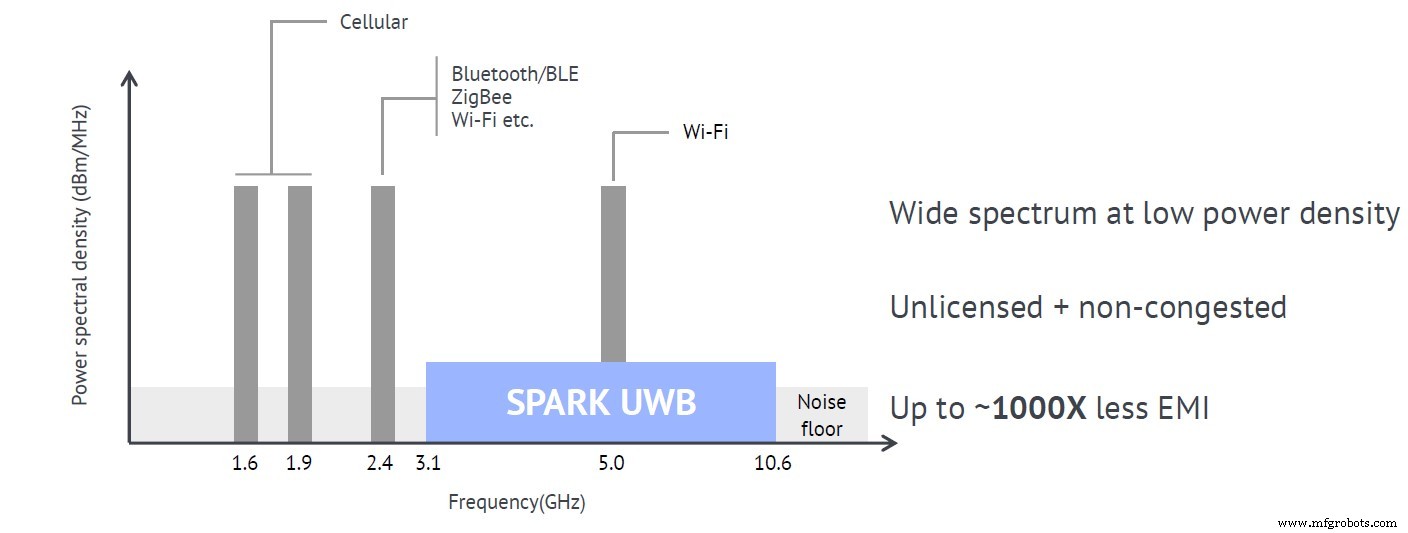
Unlike other protocols that crowd the licensed 2.4 GHz or 5 GHz bands, the SR1000 operates across the unlicensed 3.1 GHz‑10.6 GHz spectrum. By spreading energy over a wide band at a low density (–41.3 dBm/MHz), the UWB approach minimizes interference and improves coexistence with Wi‑Fi, Bluetooth and Zigbee devices.
Short‑Pulse Transmissions, Not Carrier Waves
Co‑founder and CTO Frederic Nabki explains that conventional radios rely on modulated carrier frequencies that demand complex startup circuitry and consume significant power. Spark’s design replaces the carrier with 2‑nanosecond pulses—so the transmitter and receiver can be toggled on and off in microseconds, eliminating long warm‑up times and reducing latency.
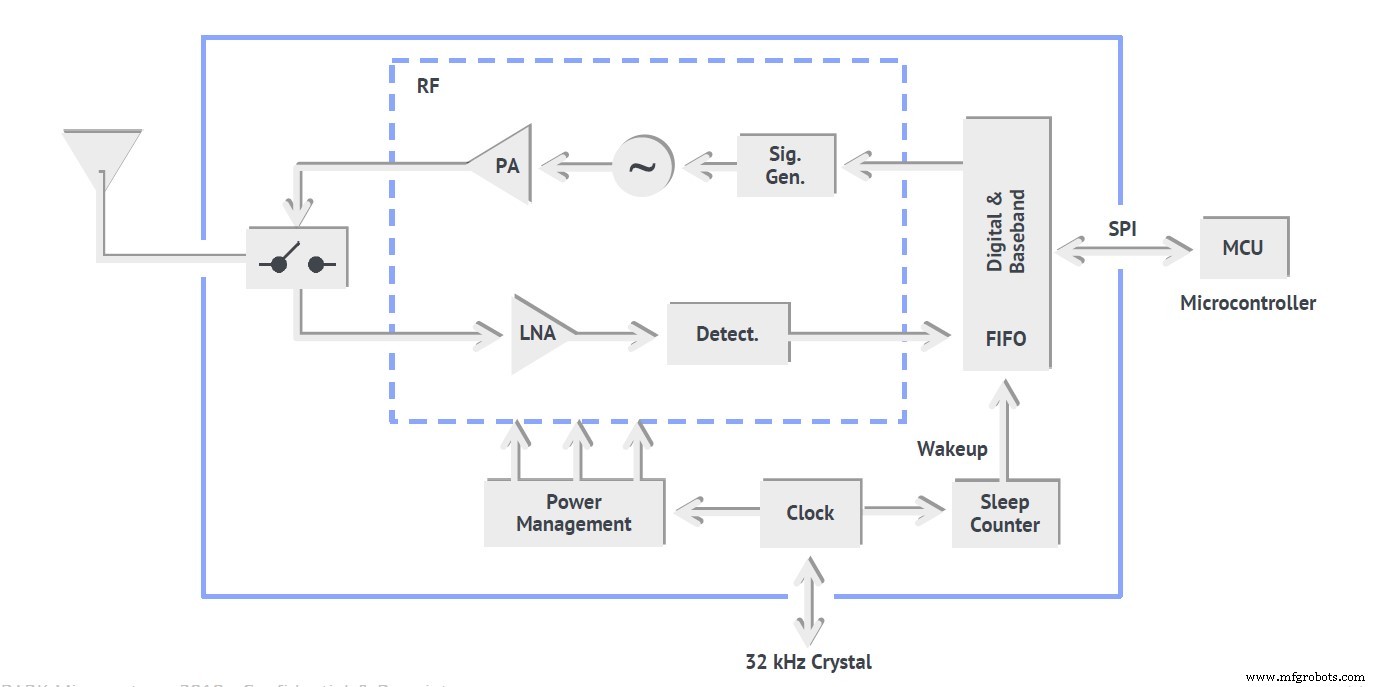
The short pulses necessitate a very wide bandwidth, but they also allow the system to operate on a low‑power 32 kHz quartz crystal, similar to those found in wristwatches. This choice cuts power consumption at both the transceiver and system levels.
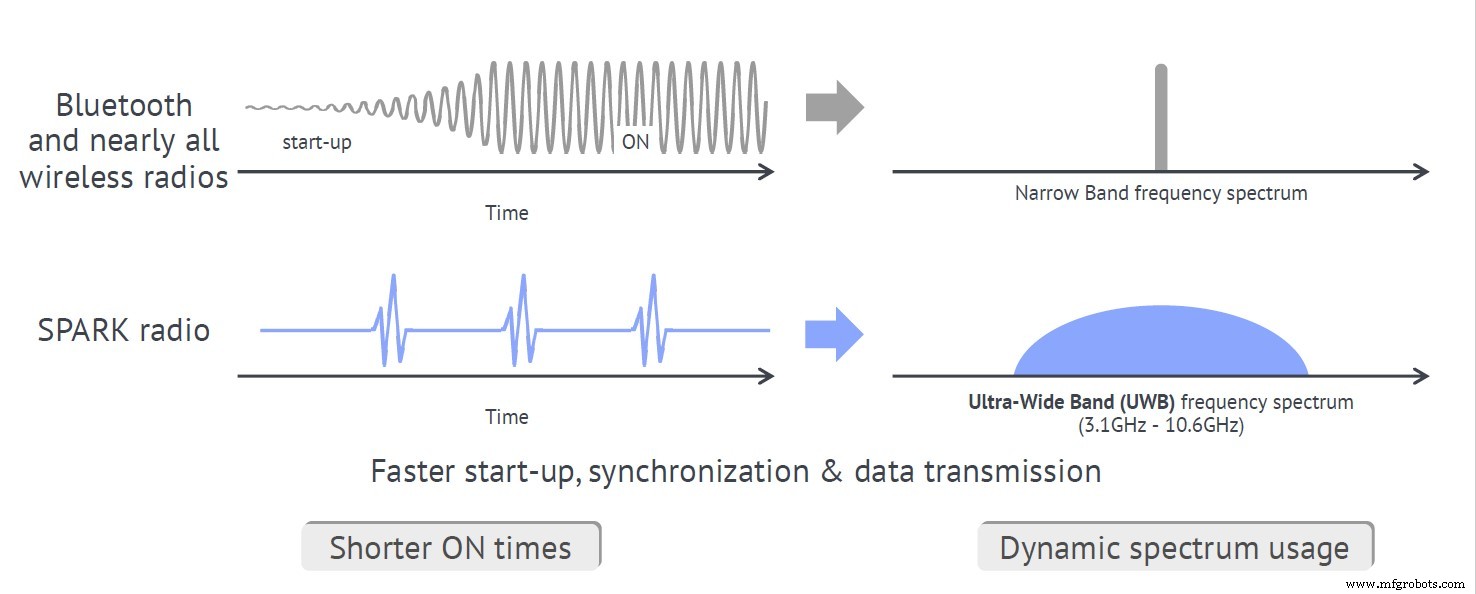
Nabki notes that the real challenge was synchronizing transmitter and receiver in 50‑µs cycles. By leveraging a low‑power crystal and custom timing logic, Spark achieved precise synchronization without the heavy reliance on carrier stabilization.
Coexistence is another key advantage. The SR1000’s emissions are roughly 1,000 × lower than Wi‑Fi and 100 × lower than Bluetooth, so other radios perceive it as background noise rather than interference. Spark has also built proprietary rejection techniques to guard against narrow‑band interference from Wi‑Fi 6 and cellular signals.
Currently, the SR1000 series consists of two pin‑identical variants: the SR1010 for the 3.1 GHz‑6 GHz band and the SR1020 for 6 GHz‑9.5 GHz. Both support ranging, positioning and low‑latency data links. Evaluation boards and reference designs are available to accelerate prototyping.
Beyond Ranging: Ultra‑Low Power Data Transfer
Nabki highlights that while UWB is often associated with positioning, the true promise lies in data communication. The SR1000 can transmit a few microwatts of power while delivering 10 Mbps, making it ideal for continuous, battery‑less sensing.
CEO Fares Mubarak emphasizes the power and latency gains: “We’re 40 × lower in power than BLE, 20 × lower than Bluetooth 5.2, and 60 × lower in latency. Our 50 µs airtime for 1 kB outperforms any existing standard.” He also notes that the UWB’s time‑of‑flight accuracy can reach 30 cm at very low power, with a second‑generation chip expected to push that to 10 cm.
Potential applications span gaming, where sub‑millisecond latency improves responsiveness; audio, where sub‑5 ms latency delivers uncompressed sound; smart homes, where battery‑less motion and door sensors reduce maintenance; and automotive, where long‑life tire‑pressure and key‑fob systems can be realized.
As UWB adoption grows—driven by Decawave, NXP and Apple’s U1 chip—Spark’s approach offers a markedly lower‑power, higher‑bandwidth alternative that could set a new standard for personal‑area and body‑area networking.
Embedded
- Understanding Low‑Power Wireless Sensor Networks: Driving Efficient IoT Solutions
- u‑blox Launches SARA‑R5 LTE‑M/NB‑IoT Modules: 5G‑Ready, Ultra‑Secure, Low‑Power for Long‑Term IoT Deployments
- Industrial IoT: From Data Capture to Real‑Time Decision Making
- Beginner’s Guide: Setting Up, Debugging, and Using a Plasma Cutter
- Arduino-based Wireless Magnetic Data Transfer with Infineon 3D Sensor
- Unlocking Enterprise Value: Expanding AIOps Use Cases
- Harnessing Analytics to Elevate Customer Experience in Manufacturing
- 10 Essential Tips for Designing Low‑Noise Amplifiers
- Wireless Power Transfer: Fundamentals and Benefits
- Data Buses Explained: How They Drive Efficient Computer Data Transfer