



LMD’s V‑Sensor: A Calibration‑Free, Clinical‑Grade Blood‑Pressure Monitor Built Into Smartphones
For nearly 120 years, the only accurate, non‑invasive way to measure blood pressure without constant recalibration has been the Riva‑Rocci cuff, devised by Scipione Riva‑Rocci in 1896. Leman Micro Devices (LMD) has created a modern variant of this technique that can be embedded directly into smartphones.
LMD’s V‑Sensor platform measures systolic and diastolic pressure, along with other vital signs such as body temperature, heart rate, respiratory rate and oxygen saturation. It represents the next wave of medical devices that integrate seamlessly with mobile phones, delivering clinically precise readings that matter in everyday life.
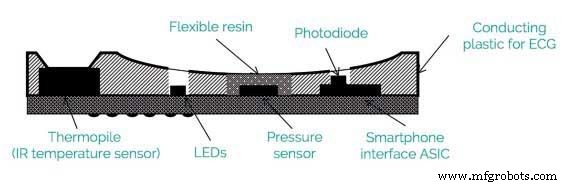
 Hardware setup (Image: Leman Micro Devices)
The smartphone will become an even more vital part of the IoT ecosystem as a frontline medical tool. LMD’s goal is to deliver quick, accurate blood‑pressure readings—ISO‑compliant and calibration‑free—directly to users. By making blood‑pressure monitoring accessible outside clinical settings, the technology could improve hypertension prevention and treatment worldwide.
Temperature, pulse, respiration and SpO₂ are routinely measured in hospitals; LMD’s sensor brings the same functionality to the palm of your hand. When combined with the phone’s accelerometer or camera, these data can reveal a wide range of cardiovascular metrics.
The Physics Behind the Measurements
Continuous home monitoring of biomedical parameters has the potential to encourage healthier lifestyles and early disease detection. LMD leverages proven science—such as the Riva‑Rocci principle—and modern sensor technology to deliver these measurements.
The V‑Sensor’s pressure sensor measures blood pressure using a fingertip‑based adaptation of the Riva‑Rocci method. Traditionally, cuff‑based devices gauge pressure by inflating a cuff around the arm; LMD replaces the bulky cuff with a small, flat sensor that the user presses against the fingertip, simplifying the process.
A smartphone with V‑Sensor
Body temperature is traditionally measured via infrared forehead scans. The V‑Sensor’s thermopile captures heat radiation from the fingertip to estimate temperature accurately. Heart‑rate, oxygen saturation and respiration are derived from a pulse‑oximeter built into the device, a technology that has been clinically validated since 1972.
“We have combined established, mature science with modern technology,” says Chris Elliott, founder and director of Leman Micro Devices. “This gives patients and clinicians measurements they can trust, delivered in a device they carry every day.”
Elliott explains that hypertension—often called a “silent killer”—claims about 9 million lives annually. By embedding a cuffless, calibration‑free blood‑pressure monitor in every phone, LMD aims to enable early detection and potentially save countless lives.
The Technology
LMD’s system comprises the V‑Sensor hardware, the e‑Checkup software algorithm, and cloud‑based diagnostic support. All components meet CE, FDA, and CFDA Class IIA/II medical‑device standards, as well as GDPR and other privacy regulations.
The V‑Sensor is a 15 mm long module that sits on the phone’s back, curved to match a fingertip. It houses a pressure sensor, a conventional pulse‑oximeter (LEDs and photodiode), and a thermopile. An application‑specific IC orchestrates the LEDs, digitises sensor outputs and communicates with the phone’s processor.
Users hold the phone naturally, with the index finger resting on the recessed sensor and the thumb on the front screen. The e‑Checkup app guides the user to adjust pressure by pressing harder or softer; the entire measurement takes about one minute and requires no external accessories.
Accuracy is benchmarked against ISO 81060‑2, with an average error of <5 mmHg and a standard deviation of <8 mmHg. Measurements can be taken anywhere, anytime, in under 60 seconds, following on‑screen instructions.
Beyond blood pressure, the V‑Sensor records body temperature, oxygen saturation, heart rate and breathing rate. When paired with the phone’s accelerometer, it can even compute advanced cardiac metrics like left‑ventricular ejection time and valve timing.
A health‑economics study using a Markov model projected that a smartphone with a V‑Sensor could add six months of life expectancy for a young user and three months for an older user.
>> This article was originally published on our sister site, EE Times Europe.
Embedded
- Blood Pressure Monitor: Design, Manufacturing, and Future Trends
- Blood Pressure Sensor: How It Works & Key Applications
- Revolutionizing Health Monitoring: Sensor‑Based Vital Sign Measurements
- Infineon Unveils XENSIV DPS368: Ultra‑Compact, High‑Precision Barometric Pressure Sensor
- MAXREFDES220# – Cuffless Blood Pressure Monitoring with Optical Sensors
- Bosch BMP390: 50% More Accurate Altitude Sensor for Smartphones, Wearables, and Indoor Navigation
- Cuff‑less, Clinically Accurate Blood‑Pressure Device in a Pocket‑Sized Keyfob
- Precision Pressure & Airflow Measurement Device with Analog Sensor
- Advanced Liquid Metal Wearable Pressure Sensor for Precise Health Monitoring
- Biodegradable Implantable Sensor Enables Real‑Time Monitoring of Bodily Functions