



Microchip Launches CoaXPress 2.0 Chips for 12.5 Gbps Machine Vision on a Single Cable
For machine‑vision‑driven production lines, the bottleneck is often the speed of image capture. Microchip Technology has answered this challenge with a single‑chip physical‑layer interface that merges power delivery, video, control, and link‑integrity testing into one solution, fully compliant with the new 12.5 Gbps CoaXPress 2.0 standard.
In close collaboration with the Japan Industrial Imaging Association (JIIA) and key industrial partners, Microchip refined its EQCO125X40 family to unlock the full potential of the CoaXPress specification on the factory floor. The devices combine an equalizer, cable driver, and clock‑data‑recovery (CDR) into a single low‑latency, low‑power chip, enabling camera and capture‑card manufacturers to transmit high‑resolution video, control signals, and up to 13 W of power over one coaxial cable.
This integration streamlines system design, maximizes throughput, and simplifies deployment across high‑volume bottling, food inspection, and industrial imaging environments.
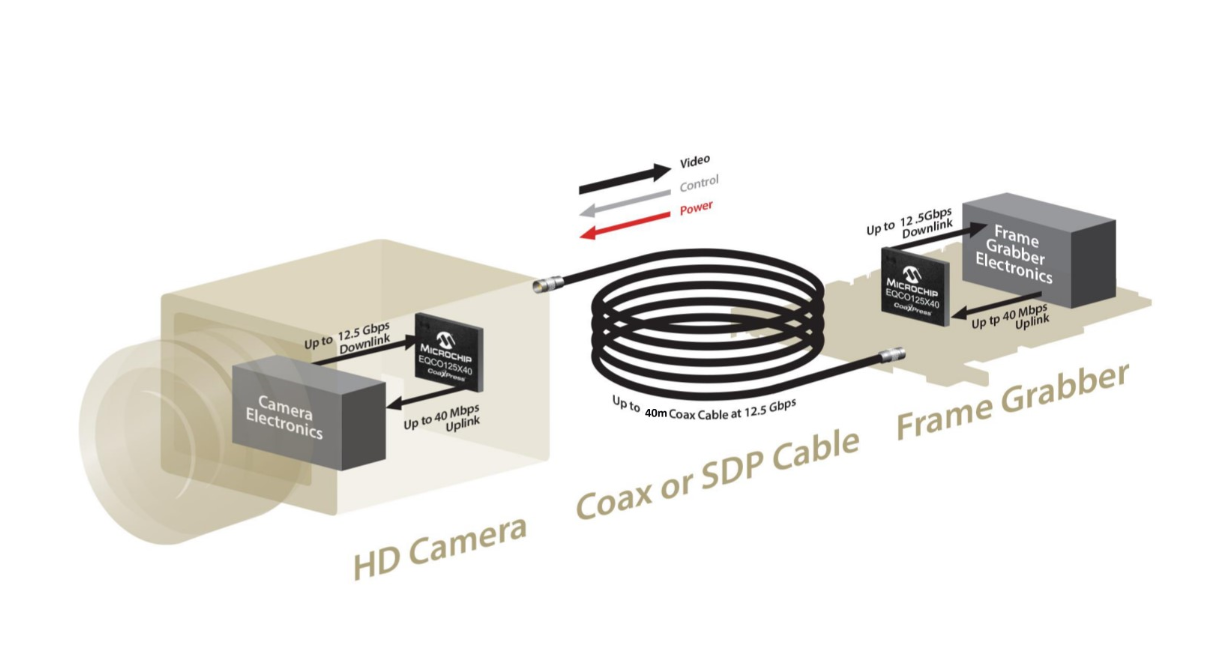
The EQCO125X40 series is the first commercial implementation of the CoaXPress 2.0 spec. It is backward compatible, integrates CDR at every speed level, and incorporates a camera‑side clock to meet real‑world operational demands. The result is a 4–8× boost in processing throughput, quadruple the achievable cable distance, reduced power consumption, and near‑zero latency.
Design tolerance and flexibility are further enhanced: the chips lock on all frequencies at any speed, eliminate the need for multiple channels by delivering 12.5 Gbps over a single cable, and broaden cabling options. The integrated CDR improves jitter performance, while the on‑camera low‑frequency clock recovery removes the requirement for separate FPGA clock programming. Real‑time link‑integrity testing is built in, allowing continuous verification of cable health before and during operation.
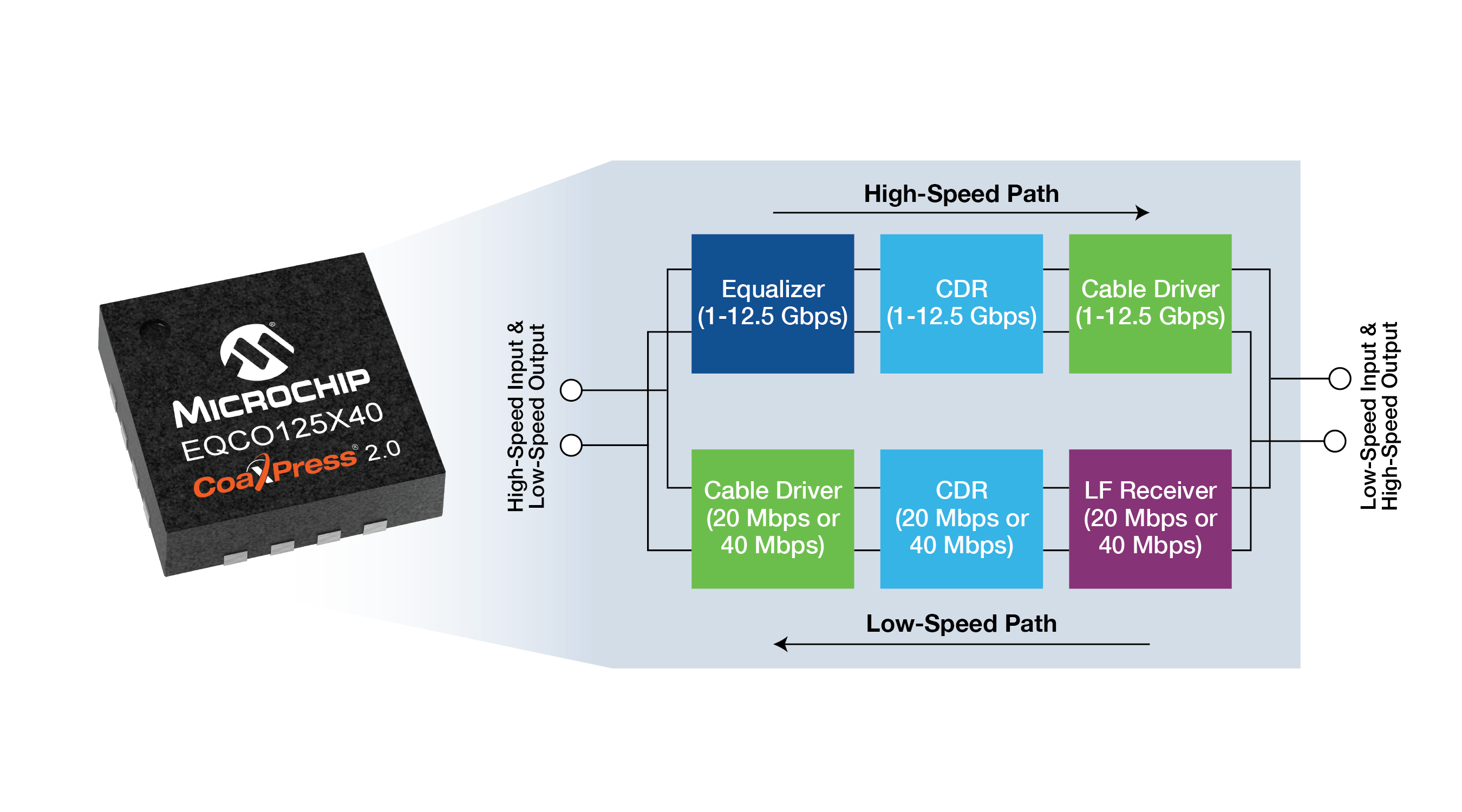
“The integrated CDR lets our customers relax their designs, as it cleans up many complexities that would otherwise need to be handled manually,” says Zeph Freeman, Microchip’s marketing manager. “The low‑frequency clock signal we added removes the need to retrieve a clock from the frame grabber, and the link‑integrity test feature is highly valued by users.”
Latency and timing accuracy are critical on fast production lines; the chip’s performance in these areas is a key differentiator. Freeman also noted that the device can function as a cable repeater, extending connectivity by an additional 35–40 m.
For capture‑card designers, the new family simplifies and reduces the cost of developing robust, high‑performance products. The chips support pre‑setup and real‑time cable‑quality tests and can be scaled to 50 Gbps across multiple cables.
Active Silicon CTO Chris Beynon praised the compact, low‑component‑count equalizer solution, highlighting its ability to perform real‑time cable‑margin testing that detects aging or worn cables before errors arise.
With Microchip’s CXP devices, manufacturers can achieve the same throughput from two camera ports that previously required four. The real‑time low‑frequency clock at the camera side delivers more precise timing, and the chips can also act as repeaters, further extending link distances. “We support a doubling in data throughput while keeping system costs the same,” notes Andre Jacobs, Adimec marketing and sales director.
Sachio Kiura, chairman of the Japan Industrial Imaging Association, expressed enthusiasm: “We’re excited to see Microchip bring low‑power, high‑performance CoaXPress 2.0 solutions that fully comply with the latest specification.”
Beyond industrial inspection, Microchip anticipates its CoaXPress 2.0 family will transform traffic monitoring, surveillance, medical inspection systems, and embedded vision solutions. The family sits within a broader portfolio, including 12 Gbps PolarFire FPGAs that natively support CoaXPress with minimal developer effort, delivering low‑power, low‑latency, small‑footprint solutions.
CoaXPress is an open, royalty‑free, asymmetric, high‑speed serial communication standard for machine vision, industrial inspection, and traffic monitoring. It connects high‑performance cameras to capture cards via standard 75 Ω coaxial cables, transmitting data, video, still images, camera control, triggering, and up to 13 W of power over a single cable up to 100 m, using BNC, micro‑BNC, or HD‑BNC connectors.
CoaXPress 2.0, ratified last year, raises the transfer rate to 12.5 Gbps for cables up to 40 m and supports up to 40 Mbps bidirectional communication, enabling higher frame rates or resolutions for next‑generation imaging systems.
Evaluation boards for the transmitter, receiver, and repeater variants of Microchip’s CoaXPress 2.0 family are available to aid development. The family includes a transmitter‑only camera‑side device and three single‑chip transceiver options, each in a 16‑pin QFN package and fully backward compatible with the 1.1 family.
Embedded
- Machine Vision Inspection: Essential Tools and Emerging Technologies
- Axiomtek IPS960‑511‑PoE: All‑In‑One Rugged Vision Controller for Industrial Inspection
- ADLINK Launches NEON‑1000‑MDX: A Turnkey Edge AI Smart Camera for Rapid Industrial Vision Deployment
- Arduino POV Clock: Build a Persistance‑of‑Vision LED Display
- Machine Vision: Driving Industry 4.0 and the Industrial IoT
- Machine Vision: The Driving Force Behind Modern Industrial Robotics
- SICK Presents Webinar: Customizing Machine Vision to Boost Industrial Automation
- Rad‑Hard CMOS Crystal Oscillator: 300 krad TID‑Resistant Clock for Space Electronics
- Synergizing Machine Vision and Robotics for Next-Gen Automation
- Enhancing Robotic Precision with Advanced Machine Vision