



CrossBar Pioneers ReRAM‑Based PUF Keys for Next‑Gen Hardware Security
CrossBar Inc. is expanding its portfolio into hardware security by leveraging its resistive RAM (ReRAM) technology to generate cryptographic Physical Unclonable Function (PUF) keys.
CEO Mark Davis explained in an EE Times interview that this shift marks a departure from CrossBar’s traditional focus on non‑volatile semiconductor memory, opening new markets for the company’s technology.
A PUF produces a unique digital fingerprint from a physical device in response to a specific challenge. While PUFs have long been used in microprocessors, the rise of online banking and the Internet of Things (IoT) has amplified the need for hardware‑based encryption, signatures, and authentication across ASICs, microcontrollers, and SoCs.
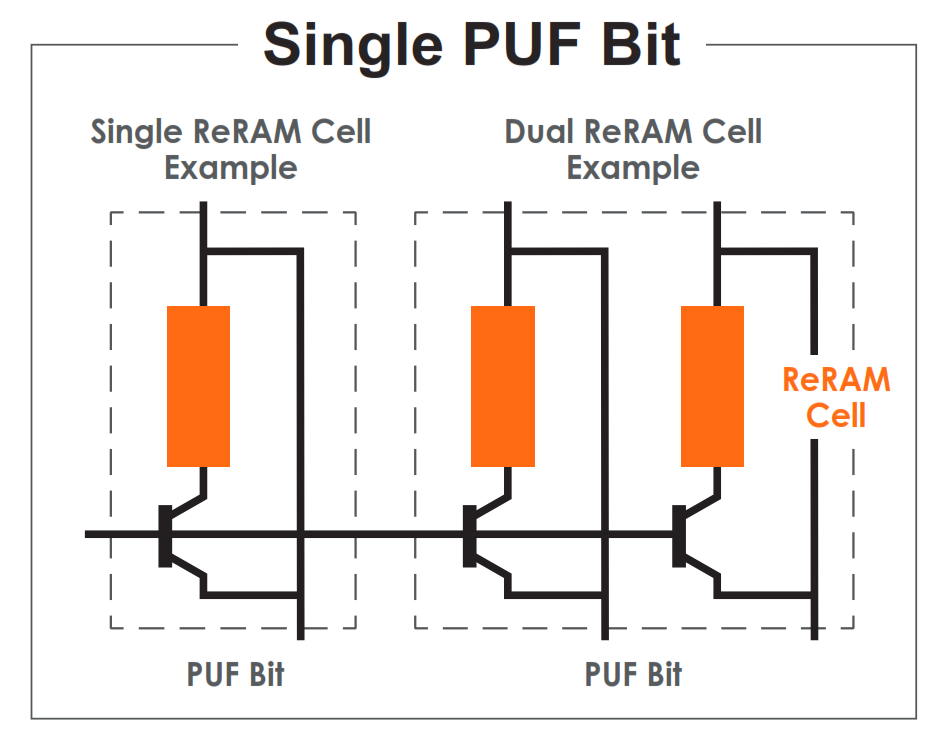
CrossBar ReRAM PUF keys can be built from a single or dual ReRAM cell, each cell representing one PUF bit. (Courtesy: CrossBar)
Unlike the conventional SRAM‑based PUFs, ReRAM delivers higher randomness, a markedly lower bit‑error rate, and superior resilience to invasive attacks. It also tolerates wide environmental variations without requiring heavy error‑correction schemes, making it more cost‑effective and “error‑free” in practice, Davis notes.
ReRAM PUFs are especially attractive for foundry nodes below 28 nm where embedded non‑volatile memory is scarce. Each PUF bit is read as a random 0 or 1; a chip with 256 ReRAM cells thus yields a 256‑bit key unique to that device.
Davis sees a strong market for these keys, given the explosion of connected, autonomous devices. “Hardware security is the most robust defense against the expanding attack surface,” he says. The keys enable secure identification, encryption/decryption, and authentication, all while remaining unclonable and meeting industry randomness standards.
Demand for memory‑embedded security is growing beyond IoT to include connected vehicles, where security underpins reliability and functional safety.
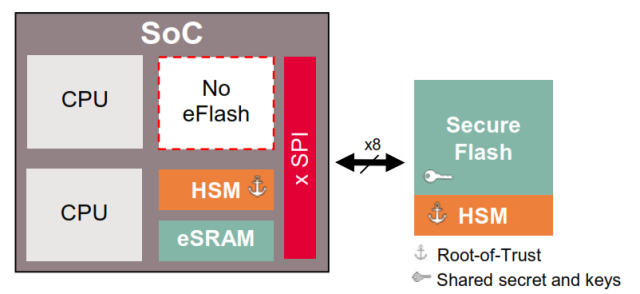
Infineon’s Semper Secure NOR flash serves as a hardware root‑of‑trust while performing diagnostics and data correction for functional safety. (Courtesy: Infineon)
Although the PUF market will be modest—typically a small component within a larger SoC—revenue opportunities exist, especially in high‑end chips where advanced security is critical. Jim Handy, principal analyst at Objective Analysis, estimates that a PUF might represent a fraction of a cent on a $30 chip but could find future applications in payment cards over the next decade.
Other memory technologies, such as EEPROM, also offer security features. Microchip’s 24CS512 I2C EEPROM, for instance, provides zone‑based write protection and a dedicated lockable ID page for safeguarding critical calibration data or MAC addresses.
Additional options include Infineon’s Semper Secure NOR flash, which offers up to eight configurable memory regions with distinct access levels and associated keys, and IP from Spansion and Cypress (now part of Infineon).
PUFs face challenges related to stability, which can be influenced by temperature and power supply variations. Ensuring consistent performance across devices remains essential.
Original source: EE Times
Related Contents:
- Basics of SRAM PUF and how to deploy it for IoT security
- A comparison of SRAM vs quantum‑derived semiconductor PUFs
- MCUs use PUF tech to fill private key security gap
- Emerging memory technologies ready to break out
- Edge AI challenges memory technology
For more embedded insights, subscribe to Embedded’s weekly email newsletter.
Embedded
- MAX32520: A Secure ARM Cortex‑M4 Microcontroller Leveraging ChipDNA PUF Technology
- MCUs Harness PUF Technology to Bridge the Private Key Security Gap
- PUFrt: First Quantum‑Tunneling PUF IP Enhances IoT Security with Unmatched Stability
- Adaptive ANC Solutions Deliver Superior Audio Performance
- Revolutionizing Relays: Menlo Micro & Corning’s Glass‑Based Micromechanical Switches
- Industry 4.0 Drives PCB Manufacturing Toward Real‑Time Traceability and AI‑Enabled Yield
- Extending Motor Life: Expert Maintenance Tips
- Gear System Insights: Backlash, Breathers, Oil Selection & Load Management
- Build an Arduino-Based Atari 2600 Adapter
- Master Countersinking: Pro Tips for Flathead Screws in Sheet Metal Fabrication