



OpenLicht: AI‑Driven Smart Lighting Prototype Transforms Room Illumination
The German research initiative OpenLicht has delivered an innovative smart‑lighting solution that leverages open‑source software, machine‑learning libraries, and affordable hardware to autonomously tailor room illumination to the occupant’s activities.
Current smart‑lighting products such as Philips Hue and Osram Lightify offer limited automation, typically requiring users to manually set schedules or control the lights via a smartphone app. Although programmable, these systems still depend on pre‑configured rules and do not adapt to the user’s behavior in real time.

 Today’s smart‑lighting systems still must be set up manually by the user. The OpenLicht project
has developed a prototype for a more intelligent lighting system (Image: Infineon Technologies/OpenLicht)
The OpenLicht project, launched in September 2016, aimed to shift that paradigm by integrating artificial intelligence and machine learning into smart lighting. “Our dual objectives were to advance AI‑based smart‑lighting research and to democratize cutting‑edge technology for startups and makers,” said project coordinator Juan Mena‑Carrillo, R&D manager for smart lighting at Infineon Technologies.
The recently concluded project was funded by the German Ministry of Education and Research (BMBF) with team members Infineon, Bernitz Electronics, Deggendorf Institute of Technology, and the Technical University of Dresden. Infineon and TU Dresden developed the machine learning application and algorithms. Deggendorf developed the graphical interface/app for the project, and Bernitz was in charge of the gateway and the communications among the system’s sensors and actuators.
Smart Prototype
The flagship outcome of the project is a fully functional prototype comprising an AI‑driven adaptive software stack, a user‑friendly graphical interface, and a Raspberry Pi‑based central gateway that orchestrates data processing and control tasks. The prototype automatically modulates lighting based on occupant position and activity—e.g., distinct settings for watching television versus reading—and learns individual preferences over time. It can also generalize to novel scenarios it hasn't encountered before.
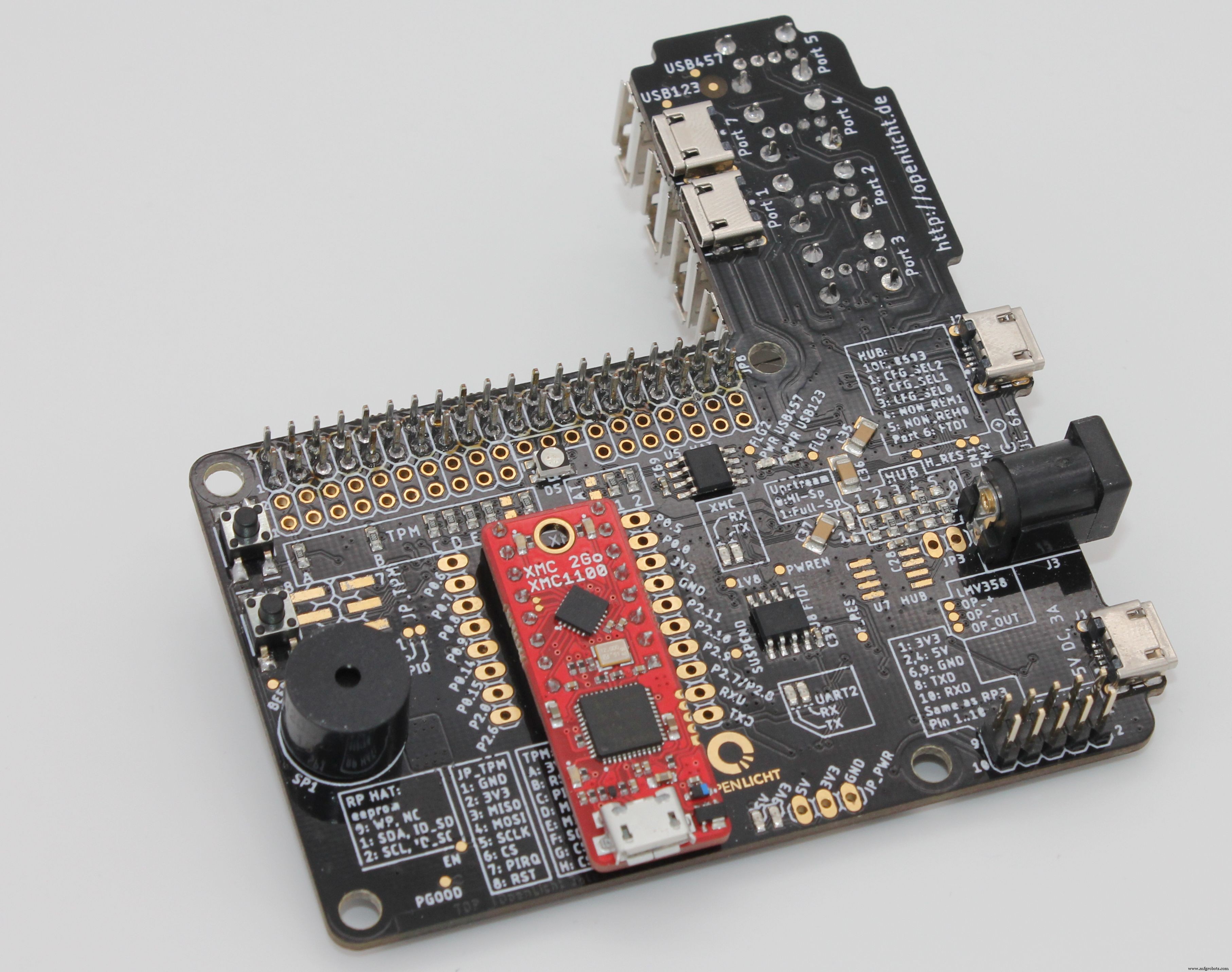
 The open‑source hardware gateway is based on a Raspberry Pi with an expansion board. There is also a miniaturized version, based on a microcontroller architecture, but it requires connection to an OpenLicht gateway (Image: Infineon Technologies/OpenLicht)
The prototype’s core is an open‑source smart‑home middleware built on openHAB, a vendor‑agnostic platform. Researchers crafted custom openHAB bindings for a suite of sensors—including pressure and radar modules—that detect occupancy and motion. Sensor data flow through these bindings into virtual “items”, which are then forwarded to the Encog machine‑learning framework.
A first neural network, trained on sensor streams, infers the occupant’s current activity. Its output is fused with real‑world lighting data and fed into a second, self‑learning neural network that continually adapts to the user’s preferences. The resulting lamp configuration is translated into actuator commands via openHAB bindings.
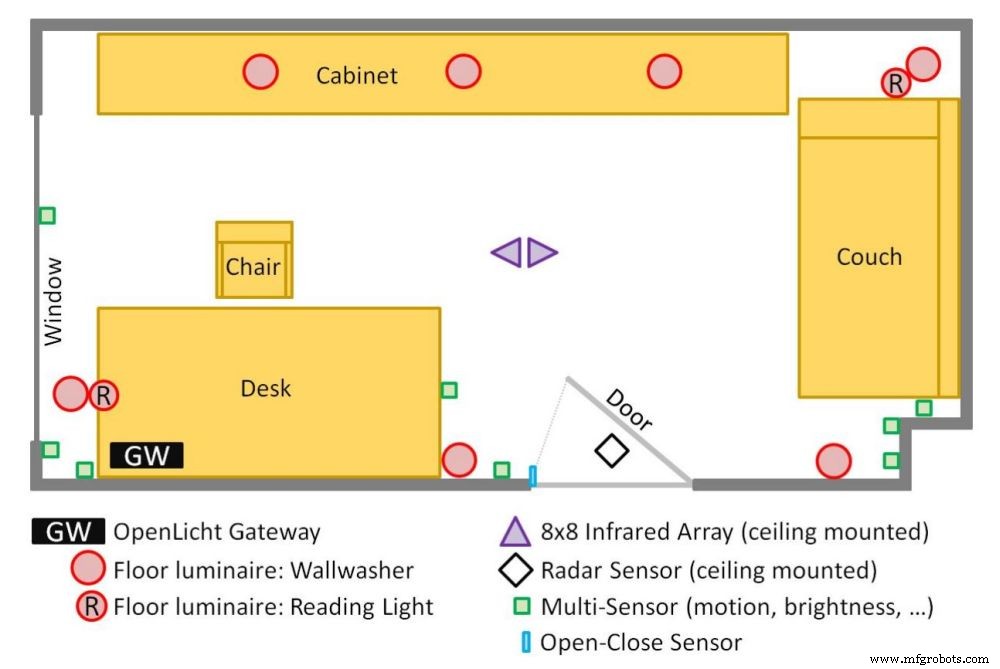
 The team set up a demo room to evaluate the prototype system and collect sensor data needed for training the neural network (Image: Infineon Technologies/OpenLicht)
“Users can still manually adjust lamp color and intensity via a UI, switch, dimmer, or remote control. When a manual override occurs, the system records the new setting, maps it to the detected activity and ambient light, and retrains the neural network—prioritizing the fresh data—to refine future predictions,” said Mena‑Carrillo.
Privacy Problem
Security and privacy were pivotal challenges. The team incorporated an Infineon‑derived Trusted Platform Module (TPM) to secure critical data and defend against tampering. After extensive user interviews, the team identified privacy concerns as a major barrier to smart‑home adoption. Consequently, OpenLicht employs edge AI, processing all sensitive data locally, thereby preserving privacy, accelerating response times, and reducing reliance on internet connectivity.
Open Source
OpenLicht’s ambition to democratize technology is reflected in its reliance on open‑source components. The software extends openHAB, integrates the open‑source Encog library, and is built on cost‑effective hardware. The entire codebase—including machine‑learning modules, knowledge base, and openHAB bindings—will soon be available on GitHub, enabling the industry and maker community to extend and enrich the platform.
“Our open‑source release will empower users to introduce new AI capabilities to their openHAB installations,” said Mena‑Carrillo. “These results now allow users to add such new AI functions and features to their openHAB systems.”
While the project met its primary objectives, the team acknowledges that further refinement is required for dependable operation across all scenarios. The open‑source nature of OpenLicht invites continued collaboration and evolution from the broader community.
>> This article was originally published on our sister site, EE Times Europe.
Embedded
- Sensor‑Based Project Ideas for Final‑Year Engineering Students
- Connect Raspberry Pi 3 to DHT11 Sensor and Upload Data to ThingsIo.ai Cloud
- Build a Windows IoT Core Rover with Raspberry Pi 2 – Beginner to Advanced Guide
- Custom Projects Boost Quality and Strengthen Competitive Advantage
- Build a Reliable Smart Energy Monitor with Arduino UNO – Step‑by‑Step Guide
- Build Your Own Arduino‑Powered Mars Perseverance Rover Replica – Step‑by‑Step Guide
- Build a Smart Arduino Vending Machine: A Complete DIY Mechatronics Guide
- OMIC R&D Secures $154K SMW-AUTOBLOK Robotics Project to Advance Manufacturing Innovation
- Advanced PCIe High-Speed Password Card PCB Design - Research & Innovation
- JW Machine: Precision CNC Contract Manufacturing Services