



Overcoming IoT’s Top Five Challenges: Continuity, Compliance, Coexistence & Cybersecurity – Part 2
 Sook Hua Wong of Keysight Technologies, Inc
In part 1, we examined one of IoT’s five critical challenges. In this second installment, we tackle continuity, compliance, coexistence, and cybersecurity.
2. Continuity
Continuity focuses on extending the battery life of an IoT device. For consumer products, a longer battery life can be a decisive competitive edge; for industrial systems, a 5‑ to 10‑year lifespan is often expected; and for medical implants, battery failure can be life‑threatening.
To meet these demanding requirements, IC designers implement deep‑sleep modes that draw only microamps, throttle clock speeds, and support low‑voltage operation. Standards bodies are also defining ultra‑low‑power profiles such as NB‑IoT, LTE‑M, LoRa, and Sigfox that limit active time while keeping power consumption minimal.
Product designers who integrate sensing, processing, control, and wireless subsystems must understand each peripheral’s power draw, then fine‑tune firmware and software to eliminate unnecessary wake‑ups. Robust measurement tools that reveal current consumption patterns are essential to validate these optimizations.
3. Compliance
Compliance guarantees that an IoT device meets radio standards and global regulatory requirements before it reaches the market.
Two main categories drive the testing process: radio‑standard conformance and carrier‑acceptance tests, and regulatory compliance tests such as RF, EMC, and SAR. Design teams often face tight product‑introduction deadlines while navigating constantly evolving regulations. Figure 3 illustrates the typical conformance and compliance testing matrix.
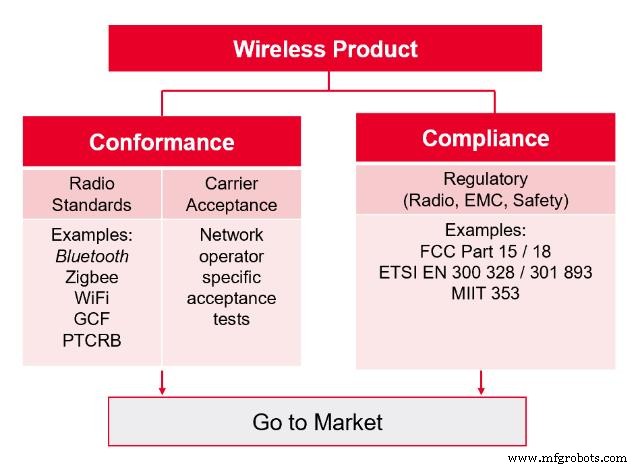
Figure 3: Conformance and compliance testing requirements of IoT devices.
In‑house pre‑compliance testing can catch issues early, reduce risk, and align measurements with the official lab test system. Automated test rigs cut testing time from days or weeks to hours, accelerating time‑to‑market.
4. Coexistence
Coexistence is the ability of a wireless device to perform reliably when other signals share the same spectrum. With billions of devices in circulation, radio congestion is a growing challenge.
Standard bodies have devised test methods to evaluate device behaviour in crowded environments. For example, Bluetooth® uses adaptive frequency hopping (AFH) to drop channels that suffer high collision rates (see Figure 4). Other techniques such as listen‑before‑talk (LBT) and cooperative collision avoidance (CCA) further improve throughput.
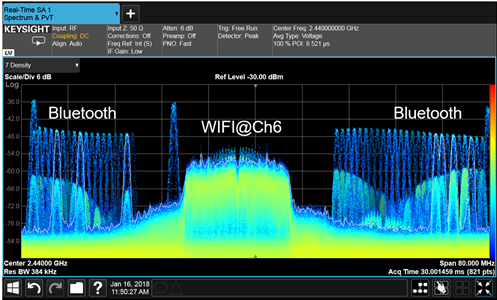
Figure 4: A Bluetooth device bypasses Wi‑Fi channel 6 to avoid interference.
For consumer wearables, brief delays are tolerable, but for industrial sensors or medical infusion pumps, lost control signals can have catastrophic consequences. Coexistence testing, guided by IEEE ANSI C63.27, helps manufacturers quantify risks and design mitigation strategies.
5. Cybersecurity
As IoT deployments extend into mission‑critical arenas, cybersecurity can no longer be an afterthought. Attacks may target the device itself, the wireless link, the cloud, or the application layer.
Traditional security tools focus on network and cloud layers, leaving endpoint and over‑the‑air (OTA) vulnerabilities largely unchecked. Even mature protocols like Bluetooth and WLAN harbor subtle implementation flaws that attackers can exploit.
IDC reports that 70 % of security breaches originate from endpoints[1]. Protecting these points requires proactive OTA testing against a continually updated threat database, coupled with anomaly monitoring to detect exploitation attempts.
By embedding robust security testing early in the design cycle, manufacturers can safeguard devices from both known and emerging threats.
Building a solid foundation through the 5Cs of IoT unlocks innovative applications across industries, yet it also presents unprecedented challenges that demand fresh thinking. Successful deployments hinge on designers’ deep understanding of these technical hurdles, careful attention to design and test considerations, and the right suite of measurement, validation, compliance, and manufacturing tools throughout the product lifecycle.
The author is Sook Hua Wong, Industry Segment Manager for general electronics measurement solutions at Keysight Technologies, Inc.
About the author
Sook Hua is an Industry Segment Manager at Keysight Technologies, based in Penang, Malaysia. She leads the strategic planning and marketing of Keysight’s IoT solution portfolio, driving growth in the general electronics segment.
Prior to this role, she served as product planner for the RF/Microwave power meter and sensor lines.
She earned a Bachelor of Electrical Engineering from the University of Technology Malaysia (1999) and a Master of Science in Electronic System Design Engineering from the University of Science Malaysia (2003). With 20 years at Keysight, including 15 years in the General Electronics Measurement Solution team, she brings extensive experience across manufacturing, product development, sales support, and marketing.
Internet of Things Technology
- Leveraging Blockchain for Trusted Industrial IoT Data: Case Study & Design Guidance (Part 2)
- Blockchain in Industrial IoT: Foundations and Applications – Part 1
- Top 3 Challenges in Preparing IoT Data for Industrial Success
- 5G’s Top Five Challenges: Navigating Spectrum, Cost, Coverage, Devices, and Security
- The Five Core Challenges of IoT: A Deep Dive into the 5 Cs – Part 1
- Future of Healthcare: Overcoming Challenges in Internet of Medical Things (IoMT)
- Navigating the Biggest Challenges to Achieve Industry 4.0 Success
- Overcoming the Challenges of Large Part Machining: Key Strategies and Solutions
- Top 5 Manufacturing Challenges of 2018: Key Insights & Solutions
- Mastering Industrial Vacuum Challenges: Expert Solutions & Best Practices