



SaaS Adoption Surges in Product Development: Key Hurdles & Opportunities – Part 2

Authored by Will Hastings, Research Analyst Manager at PTC, this second installment deepens the analysis of SaaS adoption in the product lifecycle management (PLM) and computer-aided design (CAD) sectors.
In the first part, we explored how the COVID‑19 pandemic accelerated interest in SaaS‑based CAD and PLM solutions. PTC’s survey of 150 leaders in engineering design, manufacturing design, and product lifecycle management highlighted several decisive trends:
- Respondents expressed a stronger preference for SaaS over on‑premises deployments for upcoming CAD or PLM solutions.
- More than one‑third of participants reported increased SaaS interest directly linked to pandemic‑induced operational shifts.
- SaaS outperformed on‑premises in 16 of 18 business drivers examined.
While adoption drivers were clear, the survey also uncovered significant barriers. This article examines those challenges—both technical apprehensions and behavioral inertia—and outlines how they can be addressed.
Key Concerns for SaaS Adoption
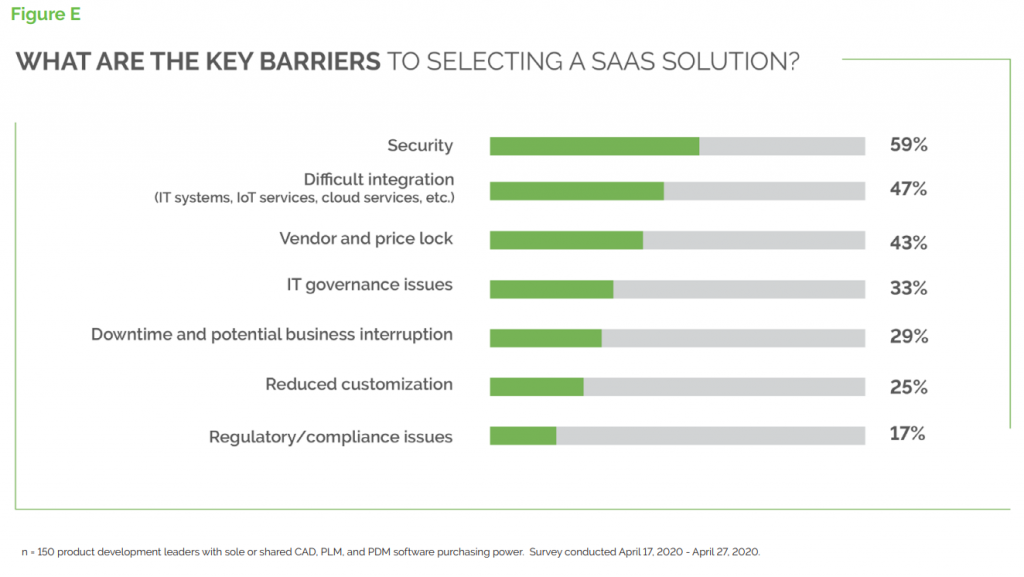
When evaluating the 18 business drivers, SaaS received higher scores than on‑premises in all but two categories: local accessibility and cyber security. The lower local accessibility rating reflects a widely understood limitation—SaaS requires an internet connection—but it does not appear to be a major obstacle. A follow‑up survey question identified “downtime & potential business interruptions” and “regulatory or compliance issues” as among the three least significant barriers (see Figure E).
Cyber security, however, remains a pivotal concern. Half of respondents felt that on‑premises and SaaS were equally capable of ensuring security, yet 59% cited security as the primary barrier to SaaS adoption (Figure E). Whether this anxiety stems from a lack of awareness about cloud security or from a conservative risk profile in engineering and manufacturing, further dialogue between vendors and customers is essential to bridge knowledge gaps.
A Necessary Shift in Adoption Behaviour
Perhaps the biggest hurdle is not the SaaS model itself but the entrenched nature of traditional CAD and PLM solutions. These systems often bind organizations to decades‑long data archives and user habits, making migration both logistically complex and culturally challenging.
SaaS offers solutions that mitigate these pain points—no installation is required, out‑of‑the‑box configurability is high, and services scale dynamically with business needs. Nevertheless, survey respondents still exhibited consumer behaviors rooted in traditional expectations.
PTC’s final question probed the triggers that prompt organizations to reassess their CAD solutions. Three behavioral archetypes emerged:
- Opportunistic (45%) – evaluated options on a project‑by‑project basis (25%) or in response to vendor releases (20%).
- Conservative (31%) – pursued new solutions at predetermined, time‑based intervals.
- Unstructured (23%) – lacked a formal strategy and rarely benchmarked against the market.
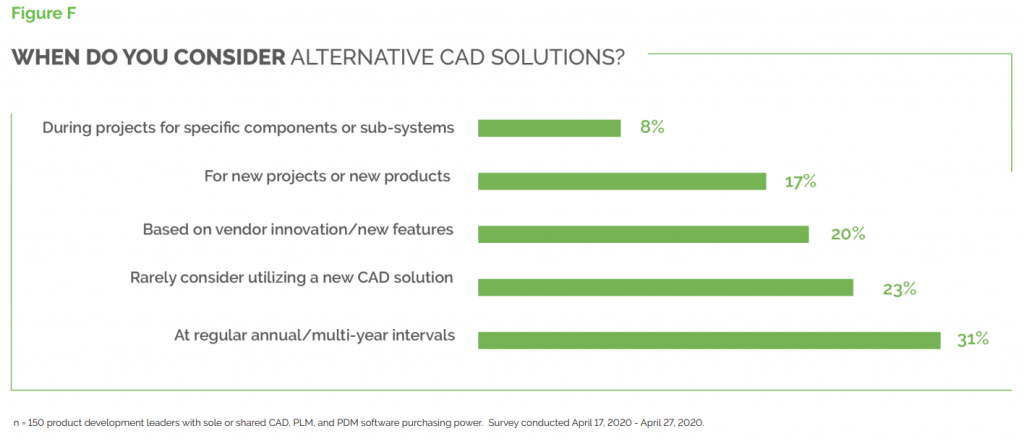
Historically, conservative or ad‑hoc strategies sufficed when innovation was driven by organizational strategy and human expertise rather than tooling. Today, disruptive technologies—generative design, 3D printing, augmented reality, AI, digital twins, and digital threads—reshape the CAD and PLM landscape. As market demand for rapid innovation grows and new tools become easier to adopt, companies must pivot toward a more opportunistic software adoption model, for which SaaS is often the most fitting choice.
Author: Will Hastings, Research Analyst Manager at PTC.
Click here for more on PTC’s perspective on SaaS in product development:
Internet of Things Technology
- Rapid Prototyping for Product Development: A Practical Guide
- Design for Manufacturing: A Strategic Blueprint for Cost Efficiency and Quality
- Future Outlook: Advancing Industrial IoT for Production Excellence
- Smart Cities: Environmental Benefits, Data-Driven Decisions, and Economic Growth – Part 2
- SaaS Adoption Hits a Tipping Point in Product Development – Insights from PTC
- Future of Healthcare: Overcoming Challenges in Internet of Medical Things (IoMT)
- Heated Apparel: The Leading Smart Textile Innovation, Experts Reveal
- How to Secure Authentic Proposals for IoT Product Development
- Top 5 SaaS Advantages that Empower Modern Manufacturers
- Mastering Design for Assembly (DFA): Key Principles & Best Practices