



LoRa Explained: Technical Foundations & Practical Applications
“What is LoRa?” is a question that can mean different things depending on the context. The term spans multiple layers of the wireless stack:
- Modulation scheme – a chirped, multi‑symbol radio waveform that encodes data with exceptional receiver sensitivity and low bit‑error rates.
- Hardware ecosystem – the LoRa chips, gateways, and supporting software that implement the modulation.
- Network layer – the IoT communication network built on top of the modulation for large‑scale deployments.
At its core, LoRa delivers longer range for low‑data‑rate applications by turning inexpensive chips into highly sensitive receivers. This advantage sets it apart from other comparable radio technologies.

LoRa vs. LoRaWAN
Many people use LoRa when they actually mean LoRaWAN. LoRaWAN is a MAC‑layer protocol built on top of Semtech’s LoRa modulation. While LoRaWAN excels in public, wide‑area networks—where all gateways operate on the same frequency band—it is less suited for private, industrial networks that require a single, tightly controlled network to avoid collision.
Is LoRaWAN the right choice for your IoT device?
Download our free white paper to compare LoRaWAN with alternative technologies and evaluate the pros and cons before you decide.
Because every gateway in a LoRaWAN network reports to a central server, the server selects which gateway responds to each transmission. In large deployments, a packet may be heard by multiple gateways; the server designates a single gateway to reply, while the others ignore the frame. This strategy prevents uplink and downlink collisions and ensures reliable communication. Read more about LoRaWAN here.
Interestingly, you can leverage the underlying LoRa modulation without adopting LoRaWAN. For example, Link Labs’ Symphony Link applies a proprietary MAC layer on Semtech chips, adding enterprise‑grade features such as secure cloud connectivity, robust interference handling, and high‑capacity multi‑user support. Many vendors offer similar custom protocols, so exploring these options can be worthwhile for industrial applications.
Technical Overview of LoRa
From a technical perspective, LoRa is a unique frequency‑modulated (FM) chirp. Semtech’s SX1272 and SX1276 transceivers use a fractional‑N phase‑locked loop to generate stable chirps. The core IP is detailed in the original LoRa patent, which also explains the ability to create long, constant‑ramp preambles for signal lock‑in. Unlike other modulations such as FSK or PSK, LoRa’s chirp format delivers extraordinary receiver sensitivity at very low cost.
Physical Layer (PHY)
Semtech acquired Cycleo SAS in 2012 for $5 million, bringing LoRa technology into its portfolio. The modulation’s key to high sensitivity lies in the demodulator’s ability to filter the continuous chirp. To “lock” onto a signal, a transmitter sends a long preamble—essentially a series of chirps—before the payload. Once the receiver detects this preamble, it switches to the reverse chirp that marks the preamble’s end and then decodes the data symbols. The following figure illustrates the preamble structure:
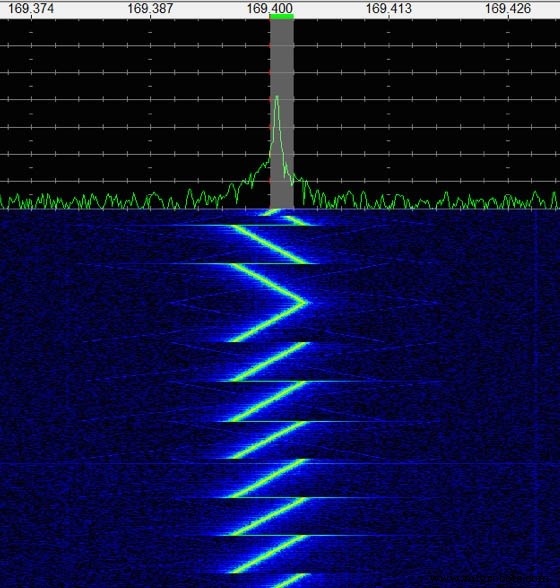
Figure 1. Semtech LoRa preamble
After the preamble, the payload is transmitted as a series of symbols. Each symbol is a chirp whose frequency sweep rate is defined by the spreading factor. Higher spreading factors produce slower chirps, extending range at the expense of airtime. The SX1301 gateway chip can demodulate multiple orthogonal chirp rates simultaneously, enabling large networks to coexist on the same frequency band. See the following figure for the data modulation format:
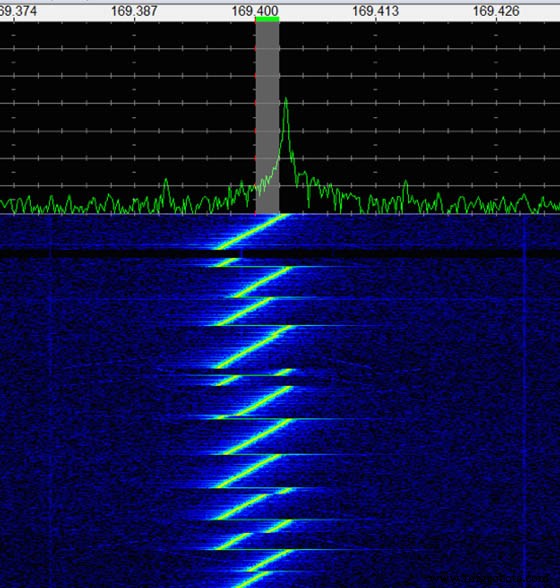
Figure 2. LoRa data modulation
Building a complete wireless system around LoRa involves more than the PHY layer. Layer‑2 and above—addressing, adaptive data rates, message retries, acknowledgments, and high‑capacity downlinks—are handled by network protocols such as LoRaWAN or custom stacks like Symphony Link. These protocols translate raw chirp signals into scalable, secure IoT networks.
Learn more about Link Labs’ Symphony Link system.
LoRa Alliance and LoRaWAN
The LoRa Alliance was created to standardize the MAC layer for LoRa devices. Its flagship protocol, LoRaWAN, is designed for operators who wish to use unlicensed spectrum to serve IoT endpoints. In contrast, Symphony Link, developed by Link Labs and its customers, focuses on the 915 MHz ISM band (ITU region 2) and offers performance that exceeds LoRaWAN in private, industrial scenarios.
Key characteristics of LoRaWAN include:
- Server‑driven MAC that minimizes collisions across many endpoints.
- Star‑of‑stars architecture: gateways act as transparent bridges between end‑devices and a central network server.
- Primarily uplink‑centric design; downlink messages are limited by duty‑cycle regulations.
- Gateway synchronization and adaptive data rate (ADR) management, typically updated every 24 hours.
- Layered security: EUI‑64 at the network level, EUI‑128 per device, and AES‑CCM (128‑bit) encryption/authentication.
- Compliance with ETSI 1 % and 10 % duty‑cycle rules on the 868 MHz band.
- Class B support with beacon polling from 1 s to 128 s intervals.
- Virtual channel capacity achieved by spreading data rates across frequencies.
- Antenna diversity across gateways for robust reception.
Real‑World LoRa Deployments
Companies worldwide use the LoRa/LoRaWAN stack for diverse IoT applications:
- Asset tracking – Ofo, a bike‑sharing service, attaches LoRa devices to bicycles, enabling real‑time location tracking across 180+ Chinese cities.
- Smart parking – PNI Sensor in Santa Rosa, CA, delivers live parking data via LoRaWAN, reducing congestion and emissions.
- Utilities & agriculture – Smart meters, irrigation monitoring, pest control, and building sensors leverage LoRaWAN for long‑range, low‑power connectivity.
- Custom LoRa deployments that avoid LoRaWAN for specialized security or capacity needs.
Choosing a LoRa‑Based Solution
LoRaWAN is an excellent option when you want to tap into carrier‑owned public networks. The market offers many hardware and network‑server vendors, giving you flexibility. However, deploying a LoRaWAN network can be complex and may not fit every scenario. If you require a tightly controlled, enterprise‑grade network, a custom protocol like Symphony Link might be preferable.
Prototyping is simplified by development kits:
- LoRaWAN starter kit – try the Multi‑Tech Systems dev kit for rapid network‑level testing.
- Custom protocol kit – purchase a Semtech dev kit to build your own LoRa stack.
Internet of Things Technology
- What Is LoRaWAN? A Technical Deep Dive
- Is LoRa the Ideal Connectivity Solution for Your IoT Device?
- LoRa FAQ: 14 Expert Answers to Your Most Common Questions
- Breakdown Maintenance Explained: Rapid Response & Cost Control
- Smart Manufacturing Explained: Leveraging Technology for Innovation and Profit
- Breakdown Maintenance: The Reactive Approach Explained
- Level of Repair Analysis (LORA): How to Optimize Maintenance Costs
- Understanding Breakdown Voltage: Definition, Importance, and Applications
- Choosing the Right Loader: A Guide to Wheel and Backhoe Loaders
- Key Drawbacks of Single-Acting Cylinders in Engine Design