



Low Power Wide Area Networks (LPWAN): Choosing the Right Technology for IoT
Low‑power, wide‑area network technology—commonly called LPWAN—allows devices to communicate over extensive geographic regions while transmitting only small data packets. Unlike traditional Wi‑Fi or cellular solutions, LPWAN is tailored for IoT sensors and controllers that need minimal power consumption and low data rates.
LPWAN’s first practical implementation came from the French company Sigfox, which identified a gap in cellular networks for low‑power, low‑data‑rate devices. By introducing a new communication paradigm, Sigfox enabled inexpensive chipsets, extended battery life, and limited data transmission—critical for machine‑to‑machine (M2M) and IoT applications.
Sigfox’s approach relies on ultra‑narrowband transmissions: 12‑byte payloads at 300 baud, using phase‑shift keying (DBPSK) or Gaussian frequency‑shift keying (GFSK). The long, slow messages achieve the long range that defines LPWAN.
Today, LPWAN is no longer dominated by a single vendor. The LoRa Alliance introduced LoRa, a chirp spread spectrum technology that operates on unlicensed spectrum. While LoRa itself is a physical layer, LoRaWAN—a protocol built on top of LoRa—provides the network stack.
Companies such as Link Labs have expanded the LPWAN ecosystem by building solutions on LoRa chips. Their flagship offering, Symphony Link, extends LoRa’s capabilities to meet industrial and enterprise needs.
Below, we compare Symphony Link to LoRaWAN, highlight Symphony Link’s advanced features, and discuss why many customers choose it for private networks.
Watch our webinar to learn more about which type of LPWAN technology is right for your use case.
Symphony Link vs. LoRaWAN
Symphony Link® is a wireless system developed by Link Labs for industrial and enterprise customers who require LoRa’s range combined with higher reliability and richer functionality.
LoRaWAN is a MAC‑layer protocol originally designed for mobile networks, primarily in Europe.
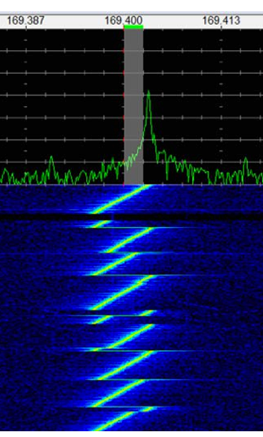
LoRa symbol encoding
Both Symphony Link and LoRaWAN use Semtech’s LoRa modulation scheme. LoRa, a chirp spread spectrum waveform, is employed at the physical layer (Layer 1) of both protocols.
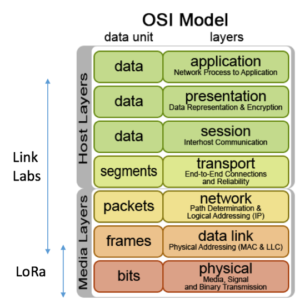
OSI data model
While LoRaWAN’s ecosystem is robust, it presents several limitations for private networks:
- High packet error rates. LoRaWAN’s asynchronous, ALOHA‑based design results in error rates above 50% in congested environments, making 100% message acknowledgment essential for many industrial use cases.
- Shared frequency channels. All gateways use identical channels, causing capacity contention even though messages are encrypted.
- OTA firmware updates are impractical. The required time, complexity, and impact on network performance make firmware upgrades via LoRaWAN unfeasible for large deployments.
- Limited multicast support. One‑to‑one encryption hinders efficient group control for applications like lighting systems.
- Duty‑cycle constraints. European ETSI limits of 1% restrict high‑throughput use cases and hinder base‑station capabilities.
- No repeater support. Duty‑cycle limits prevent repeaters, which are essential for cost‑effective coverage expansion.
- Static power and data‑rate control. LoRa’s limited dynamic range can cause nodes far from a gateway to suffer from link degradation, and adaptive data rate is server‑driven.
- Security concerns. Pre‑shared keys create potential vulnerabilities, and public network operators require a costly LoRa Alliance NetID.
LoRa Alliance continues to improve the technology, but for private networks, Symphony Link offers a superior alternative.
Reasons Customers Choose Symphony Link® Over LoRaWAN®
Guaranteed Message Receipt
Unlike LoRaWAN’s partial acknowledgment model, Symphony Link’s MAC confirms every uplink and downlink message, ensuring 0% packet error rate—critical for industrial sensors and control systems.
Over‑the‑Air Firmware Updates
Symphony Link enables secure OTA firmware upgrades, accelerating time‑to‑market and reducing maintenance costs.
No Duty‑Cycle Limits
In Europe, Symphony Link uses Frequency Hopping Listen‑Before‑Talk (FH‑LBT) and adaptive frequency agility, eliminating the 1% duty‑cycle restriction. In the 900 MHz band, devices can transmit up to 1 W without limitations.
Repeaters for Scalable Coverage
Symphony Link’s synchronous protocol allows low‑cost repeaters that extend network range without adding latency, ideal for expansive industrial sites.
Quality‑of‑Service Prioritization
Gateways enforce QoS tiers, ensuring critical alerts receive priority over routine telemetry.
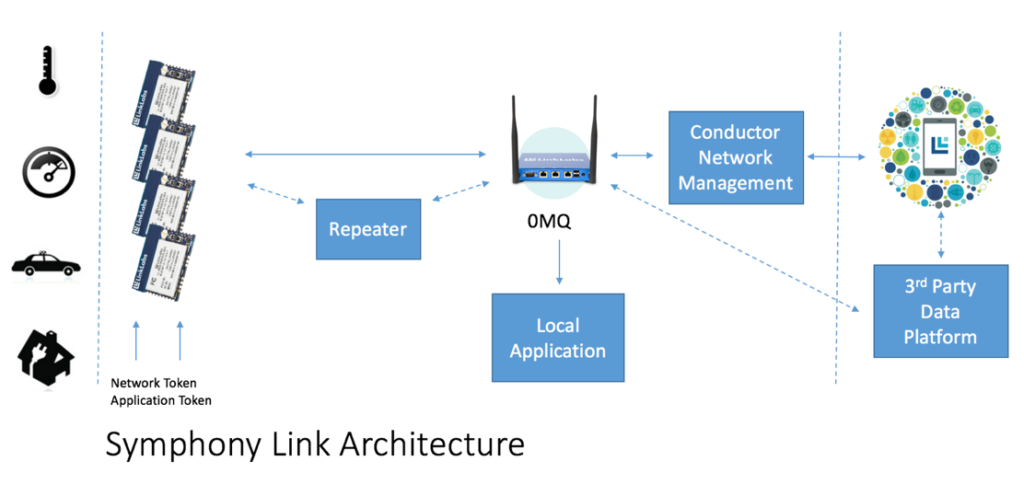
Simplified Device Configuration
All devices of a given type share the same host configuration, with key exchange handled by a PKI‑based Diffie‑Hellman AES system.
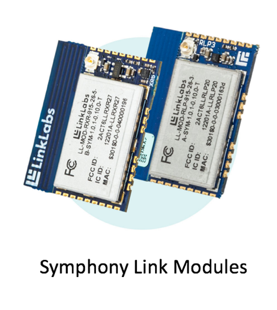
Real‑Time Power & Data‑Rate Control
Each transmission is preceded by a link budget calculation, enabling dynamic adjustment of power and spreading factor for optimal reliability.
Robust Security
Symphony Link’s PKI architecture ensures NSA‑grade security, preventing spoofing and guaranteeing infrastructure identity.
Interference Mitigation
Dynamic channel masks controlled by gateways reduce collisions. In the U.S., Symphony Link uses 28× more spectrum than LoRaWAN; in Europe, 7×.
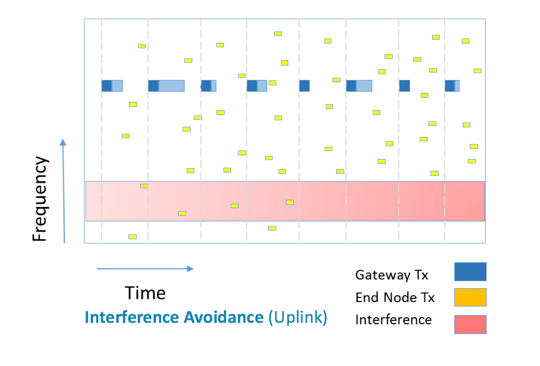
Higher Capacity
Asynchronous slotting and uplink/downlink coordination deliver over four times the capacity of LoRaWAN, with QoS further enhancing performance.
Multicast Capability
Symphony Link’s multicast session keys enable group control, essential for lighting, alarm systems, and other broadcast scenarios.
No Network‑ID Fees
Operating a Symphony Link network does not require a LoRa Alliance NetID, eliminating annual membership costs.
Additional features—such as time‑sync broadcast and edge timestamping—are available for specialized applications.
Symphony Link Protocol Overview
When a Symphony Link gateway powers on, it first scans the band to create an interference profile. It then selects a 500 kHz (125 kHz in Europe) channel for downlink and confirms no weak LoRa traffic is present. This channel selection is automatic but can be overridden via the network manager interface.
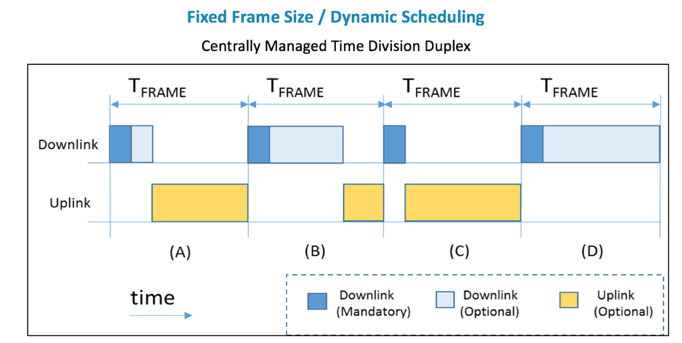
Every two seconds, the gateway transmits a beacon (frame header) containing:
- Network‑ID encrypted payload, securing the network.
- Uplink/downlink timing boundary to avoid collisions.
- Uplink channel frequencies for the upcoming frame.
- Quality‑of‑service level for that frame.
- Compressed acknowledgment packet covering all messages from the previous frame.
Every eight frames, an info block message updates nodes on regulatory power limits, gateway transmit power, firmware version, and listen‑before‑talk settings. This information allows nodes to calculate optimal power and spreading factor before each transmission.
Nodes wake, tune to the last known gateway frequency, process the frame header, and then transmit in the assigned uplink slot. The number of slots per message depends on payload size and the node’s QoS tier. Retransmissions are automatically handled for any missed slots.
Repeaters operate by inserting their own beacon, downlink, uplink, and transfer messages into the uplink portion of a normal frame, providing 3 dB additional range without compromising network performance.
Symphony Link Use Cases
- GPS Asset Tracking. Real‑time adaptive data rate ensures reliable communication for mobile assets such as golf carts.
- Demand Response. Smart hot‑water heaters receive instant control signals to reduce load during peak periods.
- Commercial Energy Monitoring. Pulse‑counting sensors across building panels can be monitored via a single access point.
Symphony Link uniquely supports:
- Lock control
- Demand response
- Industrial control systems
- Lighting control
- Alarm systems
- Physical security
Interested in Seeing How Symphony Link Could Solve Your Connectivity Challenge?
Link Labs has engineered solutions ranging from simple temperature probes to complex GPS‑accelerometer asset trackers. Schedule a free demo to explore how Symphony Link can meet your LPWA requirements—gateway setup, dev kit configuration in Symphony Conductor, integration steps, power budgets, and range.
Contact us today to discuss your specific needs.
Internet of Things Technology
- Low‑Power, Wide‑Area (LPWA) Networks: A Comprehensive Overview
- Understanding Low‑Power Wireless Sensor Networks: Driving Efficient IoT Solutions
- Selecting the Optimal Cellular IoT Technology
- u‑blox Launches SARA‑R5 LTE‑M/NB‑IoT Modules: 5G‑Ready, Ultra‑Secure, Low‑Power for Long‑Term IoT Deployments
- Building a Global IoT Network: Leveraging Sigfox and LPWA for Interoperability
- LoRa Technology Accelerates IoT Adoption, Transforming Everyday Life
- Why Scale Drives Profitability in NB‑IoT and LoRa Networks
- How to Choose the Right Low Power Wide Area Network Technology
- Harnessing BLE and Cellular LPWAN for Scalable IoT Deployments
- Low Power Factor Explained: Key Causes & How to Fix Them