



Accelerating AI at the Edge: The Crucial Role of Specialized Processors and Memory
AI is no longer just a buzzword—it’s a global imperative that drives the design of today’s computing platforms. While GPUs have powered the training of massive language models in data centres, the frontier of AI now lies on the edge, in power‑constrained devices such as IoT sensors, security cameras, and autonomous robots.
To transform billions of endpoints from mere cloud agents into autonomous, on‑device inference engines, we must optimise both compute and memory. The metric that truly matters is efficiency in tera‑operations per second per watt (TOPS/W).
Challenges to Real‑Time Edge AI
As foundation models grow to billions of parameters, the cost and energy footprint of data‑centre infrastructure rise sharply. Yet the demand for real‑time, low‑latency inference at the data source remains stronger than ever. Edge AI must therefore move beyond raw compute density and address the twin constraints of limited power budgets and stringent cost targets.
In practice, this means balancing raw throughput (TOPS) with memory bandwidth and latency. Modern accelerators such as GPUs deliver unprecedented compute, but their performance is throttled by the speed at which data can be shuttled into and out of memory. A bottleneck in memory feeds the accelerator, negating the benefits of higher compute capacity.
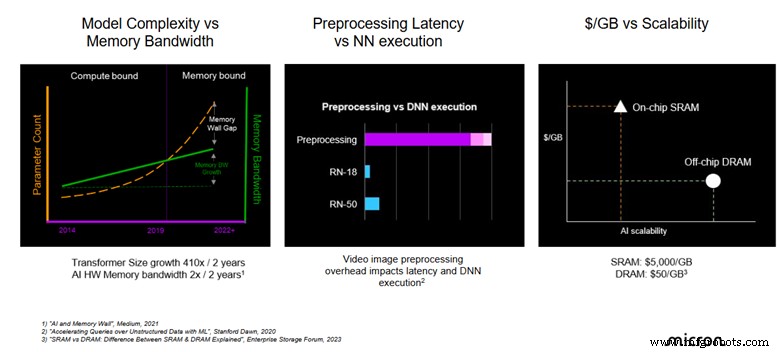
Memory bandwidth constraints have become the most significant performance limiter in embedded edge AI. Even as models grow more complex, a slow memory path can cripple real‑time inference.
Inference is a pipeline that starts with raw sensor data, passes through pre‑processing, feeds a quantised neural network, and ends with post‑processing that delivers actionable results. If any link in this chain is weak—whether it’s a low‑bandwidth memory bus or a sluggish pre‑processing routine—the entire system suffers.
Moreover, the addition of neural‑processing units (NPUs) or accelerator cores to system‑on‑chip (SoC) designs can raise the bill‑of‑materials and reduce flexibility. The solution lies in purpose‑built ASIC accelerators that marry high TOPS/W with compact, low‑power memory interfaces.
Dedicated ASICs deliver multiple benefits: they are optimised for the arithmetic patterns of neural networks, they can be tuned for a wide range of models, and they provide the best possible energy efficiency for edge deployments—whether that’s an autonomous farm machine, a surveillance camera, or a warehouse robot.
Synergy of Compute and Memory
Co‑processors that integrate seamlessly with edge platforms unlock real‑time deep‑learning inference while keeping power consumption and cost low. They support diverse workloads, from vision transformers to large language models.
A prime illustration of this synergy is the partnership between Hailo’s edge AI accelerator and Micron’s low‑power DDR (LPDDR) memory. Together, they provide the balanced compute‑memory mix needed to stay within tight energy and budget envelopes.
Micron’s LPDDR technology delivers high‑speed, high‑bandwidth data transfer without compromising power efficiency. Used in smartphones, laptops, automotive electronics, and industrial controls, LPDDR is ideally suited for AI workloads that demand fast I/O and low latency.
LPDDR4/4X supports up to 4.2 Gb/s per pin with bus widths up to x64. Micron’s LPDDR5/5X pushes that to 9.6 Gb/s per pin and offers 20 % better power efficiency than LPDDR4X, providing the bandwidth required for the most demanding edge AI models.
Hailo, a leader in AI silicon, leverages this memory partnership to deliver processors such as the Hailo‑10H, which achieves up to 40 TOPS. Its data‑flow architecture aligns with the statistical properties of neural networks, enabling edge devices to run complex models at full scale while keeping costs low.
Putting the Solution to Work

The Hailo‑15 VPU SoC is tailored for smart cameras and vision‑intensive applications. It couples Hailo’s inference engine with advanced computer‑vision pipelines, delivering premium image quality and sophisticated video analytics in a single, power‑efficient package.
Micron’s LPDDR4X, rigorously tested across automotive, industrial, and enterprise environments, pairs flawlessly with the Hailo‑15 VPU. The result is a solution that delivers high bandwidth, low latency, and uncompromised power efficiency, even in extreme temperature ranges.
Winning Combination
As the ecosystem evolves, developers must reimagine millions—even billions—of devices as fully autonomous edge AI platforms. Success hinges on processors built from the ground up to accelerate neural workloads and on low‑power, high‑performance memory that keeps data moving smoothly.
When processors and memory are optimised together, edge AI can scale to new applications, from autonomous farming equipment to real‑time video surveillance and robotics.
SPONSORED ARTICLE
Comment on this article via X: @IoTNow_ and visit our homepage IoT Now
Internet of Things Technology
- IoT-Driven Supply Chain Management: Real-Time Asset Tracking & Fleet Optimization
- How Health Insurers Can Embrace IoT in Three Strategic Steps
- Kaiserwetter’s Aristoteles IoT Platform Accelerates Global Green Energy Transition
- Artificial Intelligence in Retail: Proven Benefits, Not a Fad
- Smart Talk Episode 7: Navigating Cardinality, Control, and Costs in Observability
- Industrial IoT Connections Set to Surpass Consumer Devices by 2025, GSMA Forecasts
- The 3 Key Industries Thriving with Outdoor Asset Tracking
- Toyota Announces First North American EV Battery Plant in North Carolina
- 4 Reasons Manufacturing Will Thrive in the Digital Era
- Future-Proof Your IoT Strategy with SGP.32: An Essential Guide