



Private 5G Market Accelerates Past LTE, Projected to Exceed $5 B by 2028, According to SNS Telecom & IT
Private LTE has long been a niche segment of cellular infrastructure, but the adoption of 5G‑based Non‑Public Networks (NPNs) is rapidly redefining the market. 3GPP‑defined 5G specifications now enable private networks that deliver far superior throughput, latency, reliability and scalability—capabilities that private LTE simply cannot match.
In the past year, leading corporations have deployed production‑grade private 5G networks. Names such as Airbus, Aker BP, Boliden, Coal India Limited (CIL), Equinor, Etihad, Ford, Hutchison Ports, Hyundai, Jaguar Land Rover, John Deere, LG Electronics, Lufthansa, Newmont, POSCO, Tesla, Toyota and Walmart have all rolled out full‑scale private 5G infrastructures, signaling a clear shift toward Industry 4.0 and advanced automation scenarios.
Compared to LTE, private 5G delivers Ultra‑Reliable, Low‑Latency Communications (URLLC) and Massive Machine‑Type Communications (mMTC). These features, coupled with a future‑proof transition path to 6G, position 5G as a practical substitute for hard‑wired connections in machine‑to‑machine, robotic and control‑system environments. Its wider coverage per radio node, deterministic behavior, robust security, and seamless mobility make it an attractive alternative to interference‑prone unlicensed Wi‑Fi in Industrial IoT settings where sensor density is projected to explode.
Across the United States, Canada, Germany, the United Kingdom, France, China, Japan, South Korea, Taiwan, Australia and Brazil, organizations are realizing tangible gains—efficiency, cost savings and worker safety—once they migrate from Wi‑Fi to private 5G. For instance, Tesla, LG Electronics and Hyundai have eliminated connection‑related downtime at their U.S. and South Korean plants by replacing Wi‑Fi with private 5G for Automated Guided Vehicles (AGVs) and Autonomous Mobile Robots (AMRs). The French municipality of Istres cut the cost of a single surveillance camera from $34 000 to under $6 000 by switching from fiber to a private 5G link. China Huaneng Group now coordinates 100 unmanned electric mining trucks in Inner Mongolia’s Yimin open‑pit mine using a tri‑band 5G‑Advanced network (700 MHz, 2.6 GHz & 4.9 GHz).
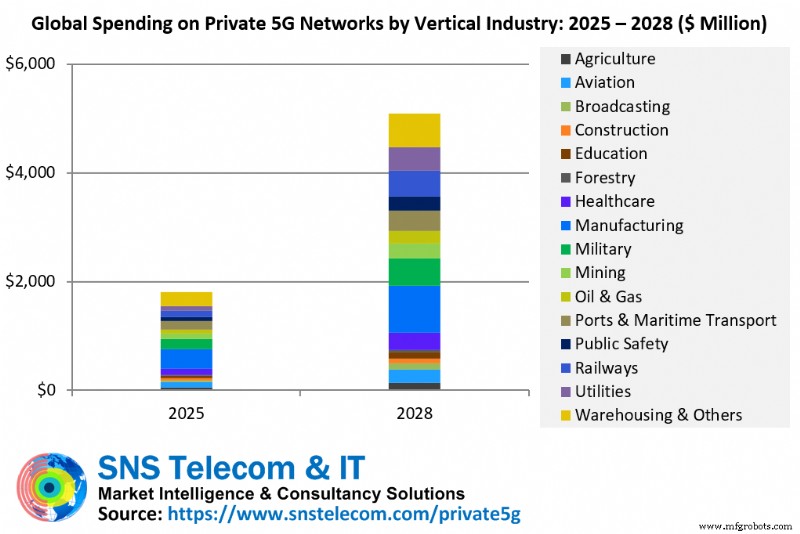
SNS Telecom & IT’s “Private 5G Market: 2025 – 2030” report projects that annual investments in private 5G for vertical industries will grow at a CAGR of roughly 41% between 2025 and 2028, pushing total spend beyond $5 billion by 2028. Early growth will stem from localized 5G deployments in manufacturing and process sectors, while critical‑communications networks for public safety, utilities and railways—currently relying on LTE, GSM‑R or other legacy narrowband systems—are expected to switch to 5G later in the forecast period. For deeper insights, visit https://www.snstelecom.com/private5g.
Comment on this article via X: @IoTNow and visit our homepage IoT Now
Internet of Things Technology
- Key Factors to Evaluate When Selecting a Fleet Management Service Provider
- How Quality of Service Enhances Reliability and Efficiency in LPWAN IoT Networks
- Choosing the Right Asset Location Technology for Your Business
- Northwestern University Accelerates Radiology Reporting with Inspur AI Servers
- How Connected Sensors and Smart Processors Power Industry 4.0
- Fontys & IXON Launch FLUFFY: A Robot‑Controlled Transfer System for Next‑Gen Manufacturing
- Biz4Intellia’s IoT Solutions: Automating Smart Greenhouses & Farms
- Predictive Analytics: Unlocking Value Beyond Maintenance
- Why Analog Measurements Drive Plant Performance
- How Equivalent Series Inductance (ESL) Impacts Capacitor Performance in High‑Speed Digital Circuits