



How Equivalent Series Inductance (ESL) Impacts Capacitor Performance in High‑Speed Digital Circuits
Capacitors are the backbone of modern electronic systems, enabling filtering, decoupling, energy storage, and tuning. In high‑speed digital designs, their non‑ideal characteristics—particularly Equivalent Series Resistance (ESR) and Equivalent Series Inductance (ESL)—can dictate circuit reliability and efficiency.
Practical Capacitor Non‑Idealities
While ideal capacitors store and release energy instantaneously, real devices exhibit parasitic elements arising from electrodes, leads, and dielectric material. These are captured by a simple equivalent circuit: a capacitor, ESR, ESL, and insulation resistance.
- ESR dissipates power as heat, limiting ripple current capability.
- ESL creates a magnetic field that alters current rise and fall times, becoming a dominant factor at high switching frequencies.
- Insulation resistance affects leakage and long‑term stability.
Why ESL Matters in Digital Circuits
In high‑speed logic, the loop current that connects a capacitor to the power and ground planes is the primary determinant of ESL. Larger current loops increase inductance, raising the resonant frequency and reducing the capacitor’s effectiveness in filtering high‑frequency noise. As device densities climb and clock speeds push beyond 10 GHz, the margin for high ESL shrinks dramatically.
Low‑ESL Solutions for Modern Applications
Manufacturers now employ advanced materials and architecture to reduce ESL without compromising capacitance or increasing cost:
- MLCCs (Multi‑Layer Ceramic Capacitors) – by minimizing pad spacing, using short vias, and implementing opposing current loops, MLCCs achieve the lowest inductances of any solid‑state capacitor.
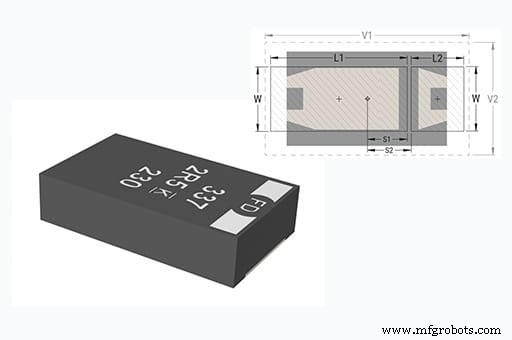
- Tantalum Polymer Capacitors – facedown terminations reduce loop area, delivering low ESL suitable for power distribution networks (PDNs).
- Aluminum Polymer Capacitors – replace wet electrolytics with conductive polymer electrolytes, yielding lower ESR and ESL for bulk decoupling.
Parasitic Inductance in MLCCs
MLCCs’ ESL scales with the size of the current loop. Key strategies to minimize it include:
- Shortening the distance between terminations.
- Optimizing pad layout and power‑plane spreading.
- Using surface‑mount packages with opposing current loops.
High‑capacitance MLCCs can still maintain low ESL when connected in parallel, offering excellent space‑efficiency for high‑speed designs.
Parasitic Inductance in Tantalum Capacitors
Tantalum’s finite conductor size introduces ESL that remains relatively constant across frequency. Facedown (undertab) designs mitigate this by shrinking the loop area. Low‑ESL tantalum polymer capacitors now excel in PDNs, outperforming traditional ceramic and aluminum electrolytics in high‑frequency decoupling.
Parasitic Inductance in Aluminum Electrolytic Capacitors
Wet aluminum electrolytics suffer from high ESL and ESR, limiting their response in bulk decoupling. Aluminum polymer capacitors, with conductive polymer electrolytes, deliver lower ESL and ESR, reduced footprint, and higher volumetric efficiency—though at a slightly higher cost.
Conclusion
In the era of ever‑faster digital circuits, selecting capacitors with minimized ESL is no longer optional—it’s essential. Manufacturers continue to innovate, offering low‑ESL ceramic, tantalum, and polymer capacitors that meet the stringent demands of modern processors and memory chips.
For detailed technical data on low‑ESL tantalum capacitors, see the reference technical paper by Kemet (T528).
© 2026 AVX Corporation – All rights reserved.
Internet of Things Technology
- Tantalum Capacitors: Key Characteristics & Applications
- Capacitor Types: Polarized, Non-Polarized, and Variable Explained
- Practical Considerations for Selecting and Using Capacitors
- Understanding Insertion Loss: Enhancing Filter Capacitor Performance
- Vishay Launches vPolyTan™ Polymer Tantalum Capacitors for Reliable High‑Temperature Performance
- Optimizing Polycrystalline Ga₂O₃ Photodetectors on Sapphire: Impact of Post-Annealing on Electrical Performance
- Electrolytic Capacitors Explained: Formation, Benefits, and Applications
- Tantalum Capacitor Marking: A Comprehensive Guide to Types and Identification
- Capacitor Leakage Testers: Understanding Their Purpose and Operation
- Optimizing Shearing Blade Quality: Enhancing Performance and Precision