



Battery‑Powered Stepper Motors for IoT: Reliable, Precise Actuation
Stepper motors deliver precise, low‑power actuation for IoT devices—from camera positioning to valve and window cover control.
Sensor‑enabled smart objects already serve as the IoT’s eyes and ears. For many years, however, practical, affordable “hands” that can move in response to data were scarce. That landscape is shifting thanks to inexpensive, IoT‑ready drivers that allow small battery packs to power stepper motors, solenoids, and other actuators, turning virtual commands into tangible actions.
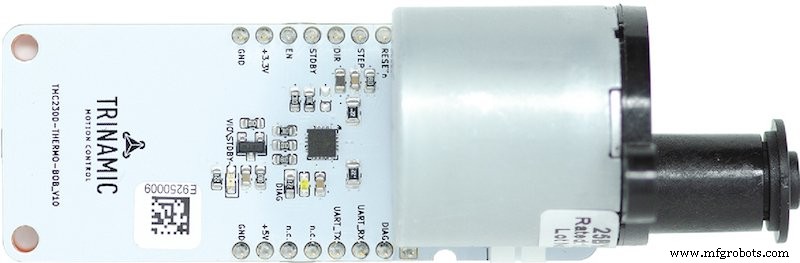
Figure 1a. Stepper motors are finding a growing number of IoT applications, such as this remotely activated radiator controller.
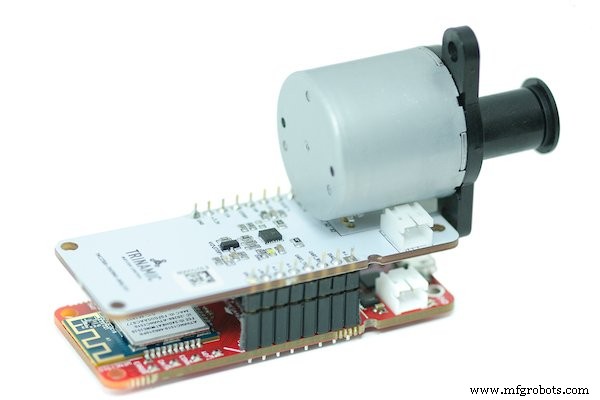
Figure 1b. Radiator controller shown with a Microchip AVR IoT development board.
Because stepper motors move in discrete, precise steps and hold position when unpowered, they excel in tasks like positioning security cameras, adjusting remote sensors, or actuating air vents, valves, and window covers.
Operating Within a Limited Power Envelope
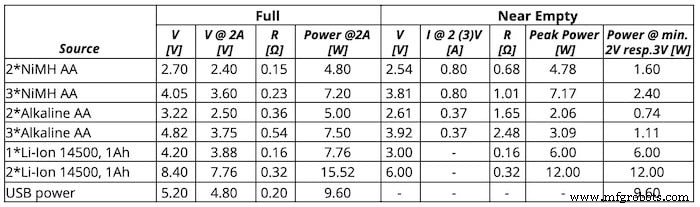
While line‑powered motorized IoT devices exist, many new applications demand operation in remote or aesthetically unobtrusive locations. These deployments rely on compact, low‑voltage sources such as a single Li‑ion cell or AA/AAA batteries. Battery power works when motors run infrequently, but the high voltage and current pulses required to energize stepper coils can exceed a small battery’s capability. Internal resistance rises with load, lowering the effective output voltage, as shown in Table 1.
Table 1. Small Battery Characteristics
Three proven strategies mitigate these constraints: supply buffering, step‑up converters, and custom‑wound steppers. Each offers a practical solution for battery‑powered IoT actuation.
Supply Buffering
Adding a supercapacitor to a battery circuit creates a “supply buffer” that can deliver brief, high‑current pulses. The required capacitance is calculated with:
C = dU × I ÷ t
where dU is the battery’s permissible voltage drop, I the supplemental current, and t the desired operating time. Supercapacitors typically max out at 2.7 V; higher voltages require series strings with balancing via a Zener diode or similar circuit.
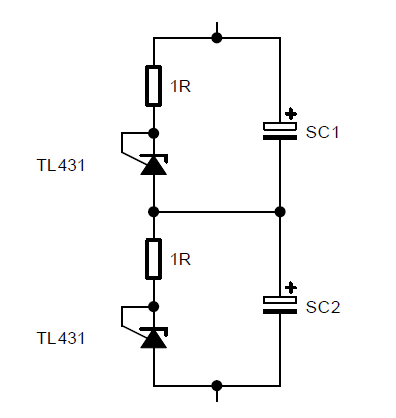
Figure 2. A supercapacitor balancing circuit with Zener over‑voltage protection (2.5 V).
Manufacturers such as Maxwell, Skeleton, and Vishay supply supercapacitors suitable for these applications.
Step‑Up Converters
Many motor drivers cannot run on the low voltages of small batteries, especially toward the end of the pack’s life. Low‑cost step‑up converters boost battery voltage by 3–4× while maintaining a stable supply. With efficiencies of 90–95 % under load, they can be paired with supercapacitors or used alone.
Leading IC vendors—Analog Devices, Maxim Integrated, and Texas Instruments—offer robust solutions. Maxim’s MAX8969 is a popular choice for battery‑powered stepper applications.
Custom‑Wound Steppers
Standard steppers are engineered for 5–12 V, yet many small batteries deliver only 1.5–5 V. Custom winding—fewer turns of thicker, lower‑resistance wire—reduces the required supply voltage. Manufacturers often accommodate custom orders at modest cost.
Specify the coil current (ICOIL) that yields the desired stand‑still torque. Use the motor’s original data to compute the necessary current, then determine the voltage requirement with:

For higher speeds, factor in the back‑EMF constant (CBEMF) with:

Lowering RCOIL allows operation at a reduced battery voltage. If your chosen stepper’s voltage demand exceeds the available supply, consult the manufacturer for a custom‑wound variant optimized for lower voltage, higher current operation.
Putting It All Together
For deeper insight, download Trinamic Application Note #57, “How to Make a Thermostat with the TMC2300,” which applies these concepts in a practical example. The theoretical underpinnings are further elaborated in the paper “Low‑Voltage Motor Control System Design for Mobile and Wireless IoT Devices,” presented at Embedded World 2020.
Additional Resources
- The Inventables Workshop: Stepper Motors Basics
- Choosing the Right Motor for Your Project – DC vs Stepper vs Servo Motors
- Driving a Stepper – Adafruit Industries
- TMC2300‑THERMO‑BOB evaluation kit (PDF)
- Datasheet: Trinamic TMC2300 low‑voltage stepper driver
Industry Articles are a form of content that allows industry partners to share useful news, messages, and technology with All About Circuits readers in a way editorial content is not well suited to. All Industry Articles are subject to strict editorial guidelines with the intention of offering readers useful news, technical expertise, or stories. The viewpoints and opinions expressed in Industry Articles are those of the partner and not necessarily those of All About Circuits or its writers.
Internet of Things Technology
- Overcoming the Three Key Challenges in IoT Solution Development
- IoT: The Real Golden Ticket for Business Growth—or Just a Goose with a Golden Egg?
- Leveraging IoT for Early Wildfire Detection and Prevention
- Connecting the Remote World: How Satellite IoT Expands Global Coverage
- Optimizing Motor Drivers for Battery‑Powered IoT Devices
- AIoT: Harnessing the Synergy of Artificial Intelligence and the Internet of Things
- IoT Revolutionizing Field Service: Predictive Maintenance & Higher ROI
- Why Battery Life Matters for Real‑World IoT Applications
- How IoT Transforms Transportation: Key Applications & Benefits
- 5 Transformative IoT Applications Revolutionizing Education