



Harnessing IIoT, Industry 4.0, and Fork Truck Free for Superior Plant Safety – Part 2
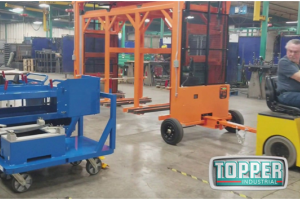
Driving Safety
Manufacturing plants built around Industry 4.0, IIoT, and Fork Truck Free principles can achieve dramatic safety gains—if the technology is applied thoughtfully.
Rapid re‑configuration of production lines—shifting tooling, moving equipment—creates fresh safety risks that require fresh assessments. Sensor‑enabled machinery can detect operator behavior that threatens safety.
Intelligent cameras are a common solution: they capture video, send it to a central hub, and flag abnormal actions such as unauthorized entry into restricted zones (Ed Brown & Ryan Brown, see part 1).
Many designers add safety‑sensing devices that instantly detect when a human has entered an unsafe zone or positioned too close to equipment. The default response is to shut the machine down or, for collaborative robots, to reduce speed to a safe level, giving staff time to clear the hazard. In automated carts, similar logic prevents runaway scenarios.
Fork trucks account for the majority of injuries on plant floors; eliminating or reducing their use is one of the most effective ways to improve safety metrics. Integrating human performance data—geo‑location, skill set—with IIoT analytics lets decision‑makers enforce optimal safety behaviors.
Modern IIoT dashboards overlay physiological and biomechanical data with work‑hour records, task logs, and welfare reports. Machine‑learning analytics then alert supervisors when workers approach physical or mental fatigue.
Automated Material Handling: The Best Fusion of Industry 4.0, IIoT and FTF
In a Fork Truck Free environment, automated material handling delivers a lean workflow that surpasses expectations while keeping costs low. Autonomous vehicles pull connected carts, increasing throughput by automating pick‑up, drop‑off, and transport for put‑away, cross‑docking, and replenishment.
These AGVs and carts are infrastructure‑free, adaptable, and scalable to seasonal or production shifts. Safety is preserved: the vehicles navigate safely around obstacles and alongside workers.
FTF shines as a total‑fulfillment solution, blending human and robotic strengths with real‑time IIoT intelligence. Automated pick‑up of totes, cases, and pallets is handled by industrial‑strength Topper carts that operate autonomously.
Fork Truck Free and IIoT Exceed Throughput Goals
Guided vehicles can be programmed by floor staff to perform tasks with repeatable precision, enabling a 24/7, three‑shift operation. Topper Industrial’s fleet of AGVs and follow‑on carts eliminates costly downtime and boosts throughput.
In the FTF framework, consistency of both AGVs and carts is essential to meet and surpass throughput targets. IIoT enables real‑time monitoring of material flow, while sensor‑rich machines provide predictive data that feeds into lean strategies.
IIoT, FTF and Material Flows
Custom or mass‑produced items demand more inventory and tighter material flows, driving logistical complexity. Nearly 50 % of production disruptions stem from material issues—wrong, defective, or missing parts.
State‑of‑the‑art factories are gearing up for this complexity, reflected in a boom in warehouse automation and WMS solutions. Traditional methods no longer fit; mother/daughter cart systems handle frequent, small deliveries more efficiently.
Precision in receiving—enabled by ASN messages—improves material flow from suppliers, ensuring production lines know exactly what arrives and in which shipping units.
High SKU counts make the classic “installer picks” approach impractical. The industry is moving toward 100 % picking: warehouse‑to‑manufacturing picking delivers speed, quality, and efficiency.
Forecasts predict a swift shift to the IIoT vision. About 25 % of manufacturers expect over 30 % cost savings.
Intralogistics 4.0 and Fork Truck Free: A Paradigm Shift Amid Workforce Shortages
Labor shortages accelerate the move to Intralogistics 4.0 and FTF. The U.S. Census Bureau projects that 60 million baby boomers will exit the workforce by 2025, while only 40 million new workers will enter, raising labor costs and skill gaps.
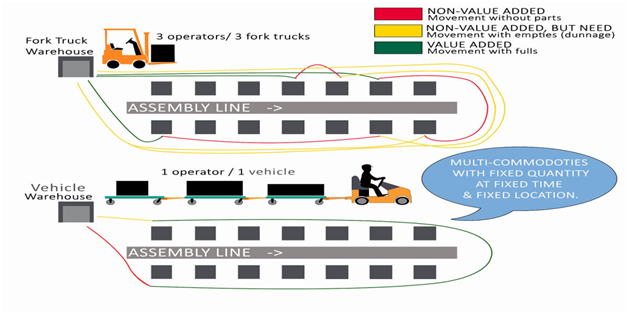
As labor becomes a larger slice of operating budgets, skill gaps in problem‑solving, situational response, and ethics widen. The logistics paradigm shift—integrating, managing, and optimizing material flow with information flow—offers a huge opportunity.
Smart networking, data logging, and adaptive system behaviors can unlock unprecedented efficiency, transparency, and productivity across fulfillment centers, distribution centers, and warehouses.
By 2025, the intralogistics industry must support a diverse set of order and distribution channels to meet demands for mass‑customized products and rapid deliveries. Data‑driven Industry 4.0, combined with FTF, will be pivotal.
The authors of this blog are Ed Brown and Ryan Brown.
Author Profiles
The engineering expertise behind moving from fork‑truck to Fork Truck Free lies in Topper Industrial founder Ed Brown and his son Ryan Brown, president of the Wisconsin‑based industrial cart company.
Ed Brown pioneered the North American Fork Truck Free movement. In 1994, he founded Topper Industrial, a leading manufacturer of material‑handling equipment in Sturtevant, Wisconsin.
Topper has consistently innovated to meet the evolving industrial environment, with numerous patents in ergonomics and safety—particularly in tow‑bar, coupling, cart handle, and tilt cart designs.
These patented products demonstrate the company’s commitment to safer, more efficient material handling.
Internet of Things Technology
- Industrial Internet of Things vs Industry 4.0: What You Need to Know
- Hyperconverged Secondary Storage: Driving Unified Data Management for Enterprise IoT
- How IIoT Drives MRO Excellence in Industry 4.0: Part 1
- Revolutionizing Manufacturing: Fork Truck Free, IIoT, and Industry 4.0 Integration
- Industry 4.0 to Transform Safety Sensors and Switches, Report Finds
- Enhancing Industrial Safety Through IoT and IIoT Integration
- Synergizing Industry 4.0 and IIoT: Driving Digital Transformation in Manufacturing & Beyond
- Revolutionizing Hydraulics: How Industry 4.0 Drives Smart Manufacturing
- Essential Pallet Truck Safety Practices for Warehouse Operations
- Industrial IoT (IIoT): Transforming Manufacturing & Why It Matters