



Revolutionizing Manufacturing: Fork Truck Free, IIoT, and Industry 4.0 Integration
Ed Brown and Ryan Brown
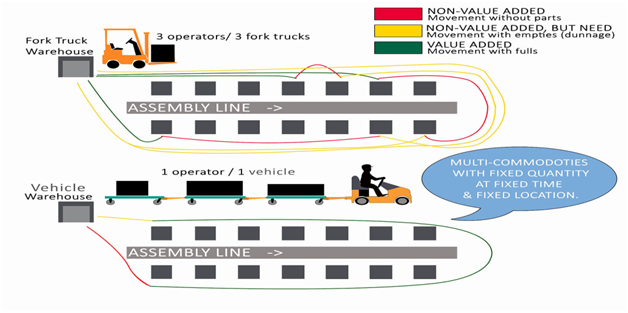
Fork Truck Free (FTF) may not be labeled on the graphic above, yet every element of the diagram embodies the FTF philosophy. Let’s dive deeper.
Integrated supply‑chain management powered by FTF initiatives is reshaping product design, production, and delivery. By eliminating repetitive fork‑truck runs, plants replace manual shuttles with a mother‑daughter cart system—a highly adaptable, cost‑saving solution.
Mother‑daughter carts consist of one large mother cart and one or more smaller daughter carts that nest inside its chassis. Once locked together, the pair moves as a single unit. Daughter carts can be static, rotating, or of other specialized types, allowing a single mother cart to serve multiple functions simultaneously.
With this system, manufacturers bring the right material to the line exactly when needed, boosting efficiency and cutting downtime.
Prescriptive analytics are integral to an FTF strategy. Predictive models drive optimal uptime and sustained performance, ensuring the material flow remains smooth and precise.
Real‑time visibility lets operators monitor cart movements and virtually eliminate fork‑truck usage. By delivering raw materials and finished goods to the manufacturing cell or shipping dock on demand, zero wait time becomes the norm—reducing downtime, enhancing labor productivity, and maximizing throughput.
FTF as an Extension of IIoT
Industrial Internet of Things (IIoT) blends engineering and IT, automating production sequencing. FTF initiatives embody this convergence, transforming linear supply chains into interconnected, open systems that unlock the full potential of digital networks.
While not a silver bullet, starting with FTF lays the groundwork for horizontal integration across operational systems, vertical integration across manufacturing layers, and end‑to‑end integration throughout the value chain.
By deploying IIoT and Industry 4.0 technologies, a single line can produce one product and up to 25 variants, achieving a 10% productivity lift and a 30% inventory reduction.
Beyond productivity gains, FTF initiatives deliver greater flexibility, higher quality, and faster time‑to‑market—key attributes for industry leaders.
Authors: Ed Brown and Ryan Brown
Author Profiles
Ed Brown, founder of Topper Industrial, is widely regarded as the pioneer of North American Fork Truck Free (FTF) solutions. Since launching Topper in 1994, he has driven innovation across material‑handling equipment, securing numerous patents focused on ergonomics, safety, and mechanical performance—including tow bars, coupling systems, cart handles, and tilt carts.
Ryan Brown, president of Topper Industrial, leads the Wisconsin‑based company’s continued FTF revolution, applying Ed’s legacy to modern manufacturing challenges.
Internet of Things Technology
- Industrial Internet of Things vs Industry 4.0: What You Need to Know
- Hyperconverged Secondary Storage: Driving Unified Data Management for Enterprise IoT
- How IIoT Drives MRO Excellence in Industry 4.0: Part 1
- Harnessing IIoT, Industry 4.0, and Fork Truck Free for Superior Plant Safety – Part 2
- Harnessing IoT Data for Manufacturing Excellence
- IIoT Trends & Challenges: Data Overload, Manufacturing Shifts, and the Skills Gap
- Machine Vision: Driving Industry 4.0 and the Industrial IoT
- Synergizing Industry 4.0 and IIoT: Driving Digital Transformation in Manufacturing & Beyond
- Revolutionizing Hydraulics: How Industry 4.0 Drives Smart Manufacturing
- Industrial IoT (IIoT): Transforming Manufacturing & Why It Matters