



Bosch Sensortec Introduces AI‑Enabled BME688: The Smallest Smart Air‑Quality Sensor
Bosch Sensortec has unveiled the BME688, a next‑generation gas sensor that integrates on‑sensor artificial intelligence and a dedicated gas‑scanning mode for volatile sulfur compounds (VSCs). This upgrade empowers users to train the sensor for bespoke applications such as detecting bad breath, monitoring food freshness, and more.
The BME688 is touted as the first MEMS air‑quality sensor to combine gas, humidity, temperature, and barometric pressure sensing with AI, effectively delivering the world’s smallest four‑in‑one solution.
Built on the same platform as its predecessor, the BME680, the new BME688 offers a higher gas‑resistance range through an application‑specific integrated circuit (ASIC). It also introduces a specialized VSC gas‑scanning mode and is paired with Bosch’s BME AI‑Studio software, which lets users import, label, and model data from their unique environments to create tailored algorithms.
Customers can categorize their own data within BME AI‑Studio, train the BME688 to recognize specific gas signatures—such as bacterial growth indicators in food—and then deploy the resulting lightweight AI code on the microcontroller that powers their final product. This approach keeps the AI workload modest and compatible with standard system controllers.
Potential use cases span a broad spectrum: from detecting oral malodour and diaper freshness to monitoring food spoilage in refrigerators and even early forest‑fire detection. The sensor’s ability to capture gas composition alongside temperature and humidity changes provides a holistic view of environmental conditions.
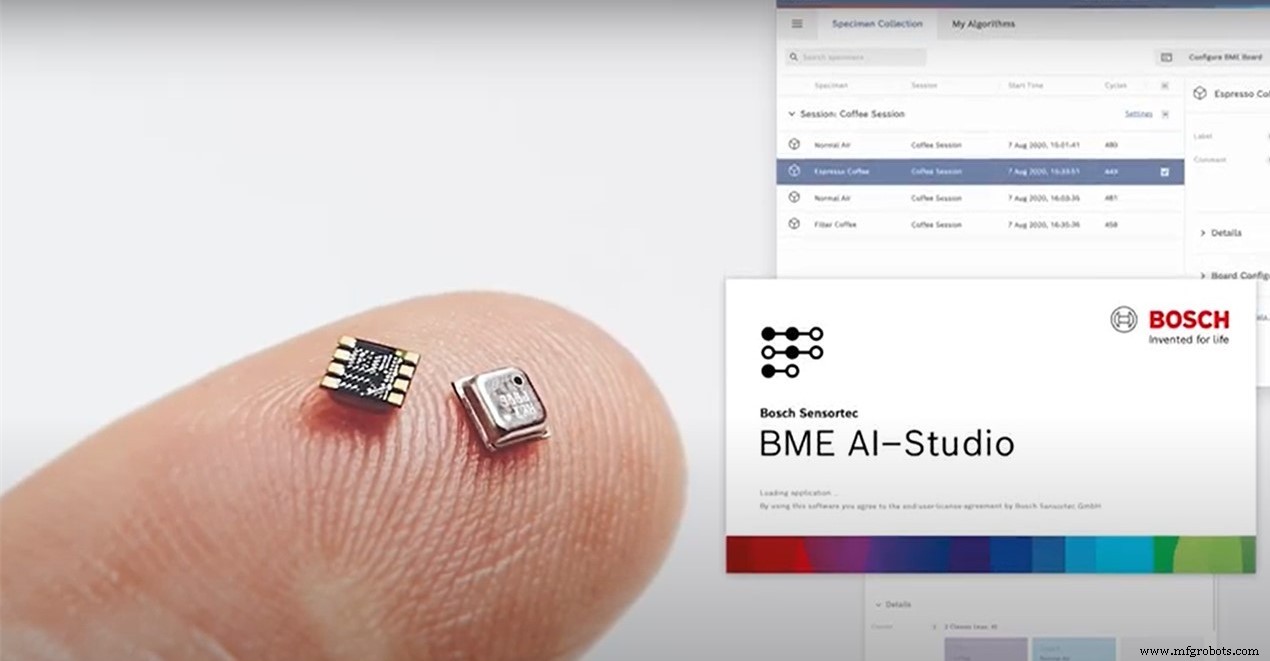
Coupled with BME AI‑Studio, developers can swiftly prototype custom solutions. Bosch Sensortec also offers an Adafruit‑compatible development kit to accelerate integration.
The sensor detects a wide array of gases—including VOCs, VSCs, carbon monoxide, and hydrogen—down to parts‑per‑billion (ppb) sensitivity.
VSCs as indicators of spoilage and breath quality
When targeting spoiled food detection, VSCs released by bacterial activity serve as clear markers. Similarly, body odor and bad breath can be identified through their distinct VSC profiles.
Field data collection is key: sampling gases near both fresh and decaying food enables the creation of accurate VSC models. The BME688’s default precision, combined with AI‑Studio’s optimization capabilities, ensures reliable performance across diverse gas mixtures.
Field‑based sampling, rather than laboratory testing, yields algorithms that better reflect real‑world conditions. The sensor’s simultaneous measurement of humidity, pressure, and temperature enriches AI models with essential contextual data.
Designed for mobile and connected scenarios, the BME688 packs into a 3.0 × 3.0 × 0.9 mm³ footprint. Current consumption ranges from 2.1 µA to 11 mA, adjustable based on data‑rate and feature requirements, and can be fine‑tuned via BME AI‑Studio.
Sensor
- MQ2 Gas Sensor: Functionality, Working Mechanism, and Practical Applications
- MQ135 Alcohol Sensor Circuit, Working Principle & Applications
- Analog vs Digital Sensors: Types, Applications, and Practical Examples
- Conrad Unveils Unified Digital Platform at Embedded World Nuremberg
- Mastering Digital Filtering on Embedded Microcontrollers: PowerQuad’s Dual Biquad IIR Engine in the LPC55S69
- Build an IR Sensor Project with Arduino UNO – Simple Guide
- New Wearable Hologram Sensor Provides Instant Gas Leak Alerts
- Revolutionary MEMS Multi‑Gas Sensor: Accurate Detection of 12 Combustible Gases
- Tiny Wearable Gas Sensor Alerts Users to Toxic Gases via Holographic Display
- Stretchable Wearable Gas Sensor for Ultra‑Sensitive NO₂ Detection