



Solid‑State LiDAR: A Reliable, Scalable Solution for Automotive Sensing
Leuven‑based XenomatiX delivers what it calls “true solid‑state LiDAR sensors,” combining a multi‑beam laser architecture with risk‑free, scalable semiconductor technology.
Advanced automotive applications such as ADAS and autonomous driving demand high‑performance range and object detection. LiDAR—also known as time‑of‑flight (ToF) or laser radar—fulfills this need by emitting precise optical pulses and measuring the returned signal. Key parameters include pulse power, round‑trip time, phase shift, and pulse width.
LiDAR systems fall into two main categories: mechanical and optical. Mechanical units use rotating heads to achieve wide fields of view (up to 360°) and excellent signal‑to‑noise ratios, but they are bulky and heavy. Solid‑state LiDARs eliminate moving parts, offering greater reliability and reduced size, though traditionally at the cost of a narrower field of view. XenomatiX overcomes this limitation with a multi‑beam strategy.
In this article we explore XenomatiX’s “true solid‑state” technology, suitable for ADAS, autonomous driving, and other road‑side applications. LiDAR’s versatility extends to 3‑D mapping, factory safety systems, smart ammunition, and gas analysis.
XenomatiX’s Approach
Most LiDAR solutions today are mechanical, relying on spinning heads that are heavy, costly, and prone to mechanical failure. While oscillating mirrors reduce size, they still involve moving components. XenomatiX’s philosophy is simple: in automotive sensing the only moving part should be the vehicle itself.
In an interview with EE Times Europe, CEO Filip Geuens explained, “Automotive demands cost, size, and reliability. Choosing LiDAR technology requires balancing these three factors. Temporary laser diodes and moving parts are not the future.”
Founded in 2013 and headquartered in Leuven, Belgium, XenomatiX coined the term “true” to differentiate solid‑state LiDAR systems that use semiconductor‑based laser sources and detectors without any scanning or moving parts. Unlike conventional optical LiDARs that sequentially emit a single beam, measure, then move to the next direction, XenomatiX’s system launches thousands of beams simultaneously.
“By eliminating the scanning mechanism and introducing a multi‑beam architecture, we achieve what we call true innovation,” said Geuens. “The entire scene is captured in one flash, enabling ranges beyond 200 m while consuming normal power.”
Because the system operates in a global shutter mode—capturing the whole scene in a single frame—it is immune to motion blur and does not require ultra‑fast laser drivers that emit nanosecond pulses.
Without the need for rapid scanning, XenomatiX’s LiDAR enjoys a longer processing window, allowing high‑resolution point clouds without time‑space correction or post‑processing, resulting in higher frame rates and improved accuracy.
The XenoLidar‑X (see Figure 1) is a stand‑alone, no‑moving‑part solution suitable for autonomous driving and industrial use. It delivers 15 000 laser beams projected simultaneously, achieving a resolution of 0.15° in both horizontal and vertical directions—meeting the most demanding market requirements.
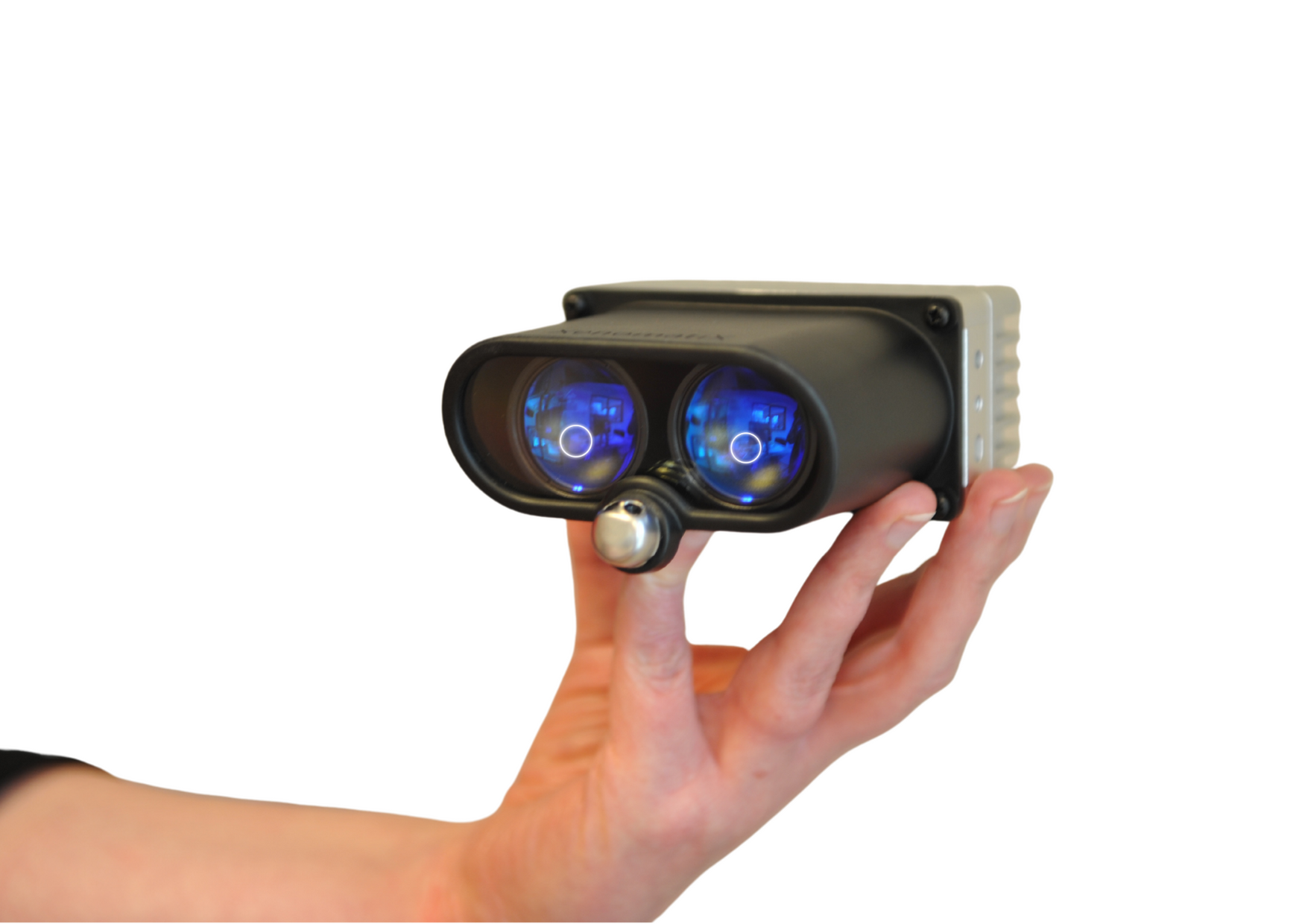
Figure 1: XenoLidar‑X (solid‑state)
XenomatiX’s solid‑state LiDARs use vertical‑cavity surface‑emitting lasers (VCSELs), which offer low power consumption and superior durability compared to traditional diode lasers.
“Because we can spend more time measuring, we can still allocate sufficient energy to achieve long‑range detection,” Geuens said.
The LiDARs are classified as 6D sensors, providing a perfectly overlapped point cloud and a 2‑D visual image. This inherent camera integration eliminates parallax errors and supplies complementary data for robust sensor fusion in safety applications. The sixth dimension is reflectivity, derived from the intensity of the returned laser signal.
Geuens highlighted the custom CMOS detector: “We designed a pixel that functions like a 3‑D camera, giving coordinates for every spot. It can also operate in 2‑D mode, delivering a visual image. The point cloud and image are sent to the vehicle’s ECU, where proprietary AI algorithms detect free space and objects.”
The system’s four‑dimensional AI processes patterns in 3‑D space combined with intensity, enabling powerful recognition capabilities. When the laser is off, the same pixels act as a conventional camera; when the laser is on, they capture 3‑D data.
Solid‑state LiDARs provide exceptional reliability—critical for automotive use. Mean Time Between Failure (MTBF) is high due to the absence of moving parts, the long‑lifetime VCSELs, and mature CMOS technology.
While spinning LiDARs naturally offer up to 360° coverage, XenomatiX LiDARs achieve wide fields of view by combining multiple modules. Placing units on vehicle corners eliminates blind spots.
With a flexible, modular design, XenomatiX offers a small, lightweight, future‑proof sensor that integrates easily into windshields, rear windows, grilles, headlights, taillights, and bumpers. The company collaborates with Tier I suppliers—AGC, Marelli, Kautex, and others—to develop customizable, modular solutions that can be seamlessly integrated into automotive architecture.
→ This article was originally published on our sister site, EE Times Europe.
Related Contents:
- Understanding wavelength choice in LiDAR systems
- ADAS experts ponder sensor integration in future vehicles
- What’s driving change in automotive electronics systems
- Time‑of‑flight technology promises enhanced accuracy
- Smart cities: the case for lidar in intelligent transport systems
For more Embedded, subscribe to Embedded’s weekly email newsletter.
Sensor
- Laser Diodes: The Backbone of Motion Sensing and LiDAR Technology
- Xilinx & Motovis Launch Integrated Forward‑Camera Solution for Automotive Perception
- Blaize & LeiShen Partner to Fuse Lidar and AI for Safer Autonomous Driving & Smart City Solutions
- MLX91377 Hall Sensor: High‑Linearity, Thermal‑Stable, ASIL‑Ready for Automotive Safety
- Sony Unveils First Single‑Chip SPAD Lidar Sensor for Automotive Applications
- SKF Launches Affordable TKSA 31 Laser Shaft Alignment Tool
- Enhanced Hydrogen Peroxide Detection via Surface-Modified Solid-State Nanopores
- Precision Liquid Level Detection with VL53L0X Laser ToF Sensor on Arduino
- Kodiak 3D LiDAR: Precision Spaceborne Ranging for High‑Orbit Missions
- 2020 Create the Future Design Contest Winner: Low‑Noise Laser for LiDAR in Automotive/Transportation