



Laser Diodes: The Backbone of Motion Sensing and LiDAR Technology
Laser diodes are revolutionizing motion sensing and LiDAR by offering unparalleled coherence, intensity, and directionality. In this article, we explain how these semiconductor devices drive modern sensing applications and why ROHM’s high‑power solutions are the industry’s best choice.
White light, comprising all visible wavelengths, is inherently diffuse and difficult to focus onto a single point. LEDs, commonly used for indicator lighting, emit light across a broad spectrum, making precise targeting challenging. Laser diodes (LDs), in contrast, emit a coherent, monochromatic beam that can be tightly focused, delivering high intensity over long distances.
Key Properties of Laser Light
- Coherence: All waves are in phase, enabling precise measurement.
- High Power & Intensity: Continuous, concentrated emission gives brighter illumination.
- Monochromaticity: Single‑wavelength output reduces dispersion and improves accuracy.
- Directionality: Minimal divergence allows the beam to travel farther without spreading.
LDs are fabricated by doping semiconductor layers (e.g., AlGaAs) to form a p‑n junction. When current flows, electrons and holes recombine, producing stimulated emission that amplifies light. This process is the foundation of Light Detection and Ranging (LiDAR) systems.
Time‑of‑Flight (ToF) Distance Measurement
The most common LiDAR method is ToF, where the device emits a laser pulse, waits for it to reflect from an object, and measures the return time. The distance is calculated by multiplying the travel time by the speed of light and halving the result.
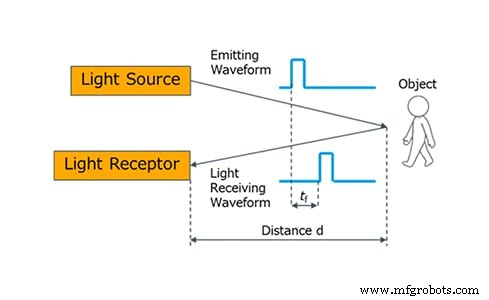
Figure 1. Conceptual diagram of the ToF method. Image from ROHM
Applications of High‑Power Laser Diodes
LDs’ linearity, pulse response, and monochromaticity make them ideal for a wide range of sensing tasks:
- Automated Control: Non‑contact motion sensing in HVAC and industrial equipment.
- Security & Surveillance: Detect intruders and capture imagery even in low light.
- Transportation: Train platform detection, driver‑assistance systems, and vehicle navigation.
- VR/AR & Gaming: Real‑time motion capture for immersive experiences.
- Robotic Vacuum Cleaners: Pre‑mapping rooms for optimal cleaning paths.
- 3D Scanners: Accurate coordinate data for manufacturing and retail.
- Ranging Machines: Precise distance measurement via phase‑shift or ToF.
- Drones & UAVs: Long‑range LiDAR for terrain mapping and autonomous landing.
- Automated Guided Vehicles: Reliable navigation in warehouses and factories.
- Supply Chain: Enhanced inventory accuracy through shape and condition detection.
- Autonomous Vehicles: 3D perception and obstacle detection; LDs up to 125W meet automotive power demands.
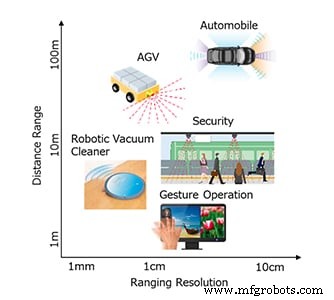
Figure 2. Applications of LiDAR technology using the TOF method. Image from ROHM
Limitations & Reliability
Typical semiconductor laser diodes last between 25,000 and 50,000 operating hours, with performance heavily influenced by temperature. High‑temperature environments can accelerate degradation, a critical factor for industrial and automotive use.
ROHM’s High‑Power LD Solutions
ROHM’s RLD series delivers robust performance across four sensing modalities—triangulation, ToF, Flash ToF, and structured light—supporting detection ranges from 3 m to 50 m and wavelengths of 630–640 nm or 800–950 nm. Key advantages include:
- High power efficiency and stability across a wide temperature band (–40 °C to +85 °C).
- Compact, lightweight packages ideal for space‑constrained applications.
- Wide availability through ROHM’s website and authorized distributors.
ROHM remains a trusted partner for motion sensing and ranging, combining advanced semiconductor technology with proven reliability.
Industry Articles are a form of content that allows industry partners to share useful news, messages, and technology with All About Circuits readers in a way editorial content is not well suited to. All Industry Articles are subject to strict editorial guidelines with the intention of offering readers useful news, technical expertise, or stories. The viewpoints and opinions expressed in Industry Articles are those of the partner and not necessarily those of All About Circuits or its writers.
Sensor
- Laser Pointer: Design, Manufacturing, and Safety Overview
- Semiconductor Lasers: Precision Light Generation for Modern Technology
- Color Sensors: How They Work & Key Applications
- BH1750 Ambient Light Sensor: Specs, Features, and Practical Applications
- Photoresistor (LDR): Function, Types, and Practical Applications
- Ambient Light Sensors: Functionality, Design, and Key Applications
- Laser Sensors Explained: Working Principles & Industrial Applications
- Sony Unveils First Single‑Chip SPAD Lidar Sensor for Automotive Applications
- Solid‑State LiDAR: A Reliable, Scalable Solution for Automotive Sensing
- Building an Arduino LIDAR System with VL6180X and Servo Motor