



Solar Orbiter Launches to Unlock the Sun's Secrets
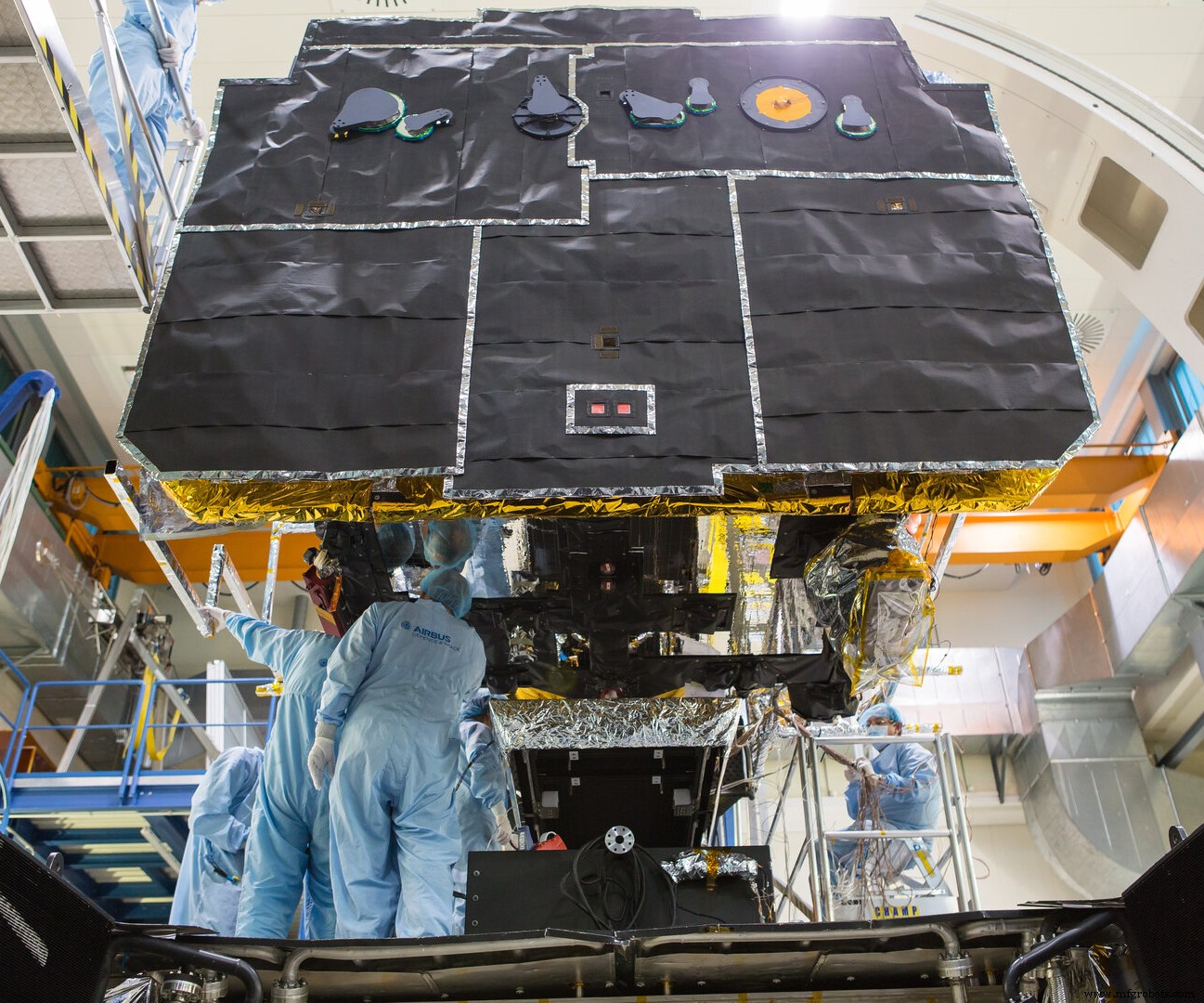
Solar Orbiter, a collaborative mission between European Space Agency (ESA, Paris, France) and NASA (Washington, D.C., U.S.) to study the Sun, launched at 11:03 p.m. EST February 9 on a United Launch Alliance (ULA, Centennial, Colo., U.S.) Atlas V rocket from Launch Complex 41 at Cape Canaveral Air Force Station in Florida.
Solar Orbiter is on a unique trajectory that will allow its comprehensive set of instruments to provide humanity with the first-ever images of the Sun's poles. This trajectory includes 22 close approaches to the Sun, bringing the spacecraft within the orbit of Mercury to study the Sun and its influence on space.
Solar Orbiter comprises a 2.5 x 3.0 x 2.5-meter box-shaped bus with two solar panel wings spanning 18 meters. A 4.4-meter instrument boom and three 6.5-meter antennas protrude from the spacecraft body.
A carbon fiber composite, titanium layered solar shield covers one side of the spacecraft. The shield has apertures for various instruments. The 324-pound heat shield reflects and guides heat away from the spacecraft and can withstand up to 970º F (521º C). The heat shield measures 3.1 meters by 2.4 meters. The front layer — a 0.05 millimeter thick layer of titanium foil — reflects heat. At the base of the heat shield is a 2.94-meter by 2.56-meter support panel that is about 5 centimeters thick. It is made of lightweight aluminium honeycomb with two high thermal conductivity carbon fiber skins and insulated by multi-layer insulation layers capable of withstanding 572º F (300 °C). Solar Orbiter’s heat shield is coated with a thin, black layer of calcium phosphate, a charcoal-like powder much like pigments used in ancient cave paintings.
It will take Solar Orbiter about two years to reach its primary science orbit where it will combine two main modes of study. In-situ instruments will measure the environment around the spacecraft, detecting such things as electric and magnetic fields and passing particles and waves. The remote-sensing instruments will image the Sun from afar, along with its atmosphere and its outflow of material, collecting data that will help scientists understand the Sun's inner workings.
Throughout its mission, Solar Orbiter will use successive Venus gravity assists to draw its orbit closer to the Sun and lift it out of the ecliptic plane, allowing for unprecedented views of the Sun's north and south poles.
fiber
- 12 Companies Revolutionizing 3D Printing
- Case Study: Honda Lincoln Plant – Engineering Excellence & Reliability
- DIY Sun‑Tracking Solar Power System with Arduino UNO
- Ahlstrom-Munksjö Completes Sale of Glass Fiber Reinforcement Unit to Vitrulan Group
- The Future of Contactless Delivery: A New Standard for the Post-Pandemic World
- Turning Tough Challenges into Collaborative Wins: Gentz Industries’ Proven Approach
- Precision Foundations: Metalex Manufacturing's 30‑Foot Concrete Masterpiece
- How Digital Platforms Drive Efficiency in Modern Manufacturing
- Key Industrial Applications of Alloy A286: High Strength & Corrosion Resistance
- Why Isotropy Matters in 3D Printing: Enhancing Consistency and Performance