



Revolutionizing Hydrogen Storage: Composite Pressurized Tanks Integrated into Vehicle Structures
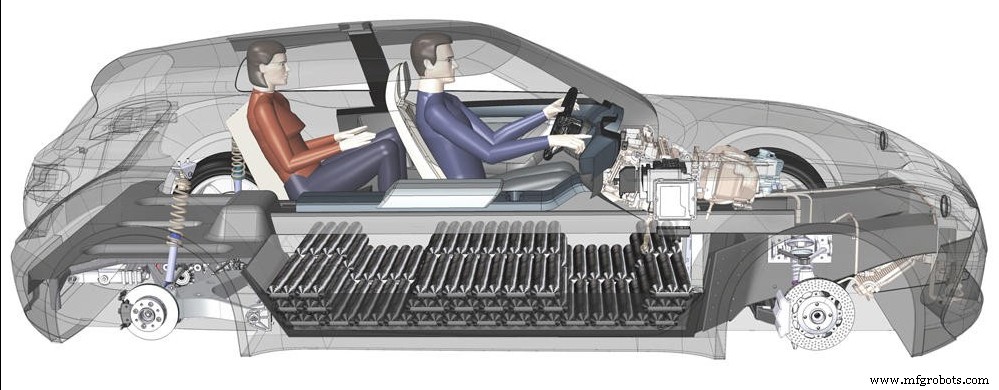
ILK is developing chained tubular storage tanks in close cooperation with LZS and herone GmbH (Dresden). (See “Injection-forming for high-performance, unitized thermoplastic structures”.) These tanks are manufactured from semi-finished thermoplastic fiber-reinforced composites based on braided reinforcements. Due to the high productivity of braiding and thermoplastics, this technology is intended to reduce the production costs of hydrogen tanks for fuel cell vehicles and enable easier recycling of the tank structures. This supports both improved competitiveness compared to battery electric vehicles and increased sustainability for the BRYSON approach. For more information, contact maik.gude@tu-dresden.de
Thermoplastic composites and integration as solutions
“The aim of the BRYSON program is to develop modular storage systems that can be adapted to any geometric design of the given vehicle design space,” says Alexander Rohkamm, co-founder of herone GmbH and the company’s project leader for Bryson. “The material processing properties of thermoplastic composites enable more integrated part designs as well as more cost- and energy-efficient manufacturing. This improves the ratio between performance and cost compared to conventional metal and thermoset composite solutions.”
“Alternative transportation concepts also need a rethinking in every step of the development and manufacturing chain,” notes Rohkamm. “In today's combustion engine vehicle architectures, gasoline and diesel drives share the same installation space, using the same architectures to achieve significant cost savings. Similarly, to achieve the greatest possible flexibility and economy in future electric vehicle architectures, hydrogen can be stored in the same installation spaces where high-voltage batteries would otherwise be located. Integrating both types of energy supply (hydrogen and battery) in the same installation space could enable scaling effects, reduced cost and more flexible production that can compensate for fluctuations in demand for either system.”
BMW’s commitment to hydrogen
According to Arian Dorofte’s March 30, 2020 article “BMW Group reaffirms commitment to hydrogen fuel cell technology,” BMW and fellow Hydrogen Council founding member Toyota Motor Corporation (Toyota, Japan), will continue their cooperation started in 2013 and aimed at industrialization of hydrogen fuel cell technology and production of scalable parts and modular components for hydrogen fuel cell vehicles. These components and the resulting powertrain will be deployed in the BMW i Hydrogen NEXT vehicle, schedule for 2022. BMW’s involvement in the BRYSON research project supports its aim to develop a safe and space-optimizing hydrogen storage system for fuel cell vehicles.
fiber
- How Aerospace Companies Are Leveraging Advanced Composites for the Future
- STELIA Aerospace Composites Innovates Hydrogen Storage
- Advanced Composite Isogrid Structures Created with Cutting‑Edge Deposition Technology
- Faurecia Secures Major Hydrogen Storage Deal for 1,600 Hyundai Heavy‑Duty Trucks
- DOE Grants $139M to 55 Projects Accelerating Advanced Vehicle Composite Technologies
- LMS Designs Advanced Composite Fuel Gauge for Stratolaunch’s Hypersonic Talon‑A Vehicle
- GKN Aerospace Unveils Fully Integrated Composite Structures for Eviation’s All‑Electric Alice Aircraft
- Hyzon Motors Introduces Lightweight, Cost‑Effective Hydrogen Storage System for Commercial Vehicles
- FACC Secures ArianeGroup Contract to Produce Composite Structures for Ariane 6 Launch Vehicle
- Empa Accelerates Hydrogen Fuel Cell Vehicle Innovation