



NASA Confirms Successful Extension of James Webb Telescope's Deployable Tower Assembly
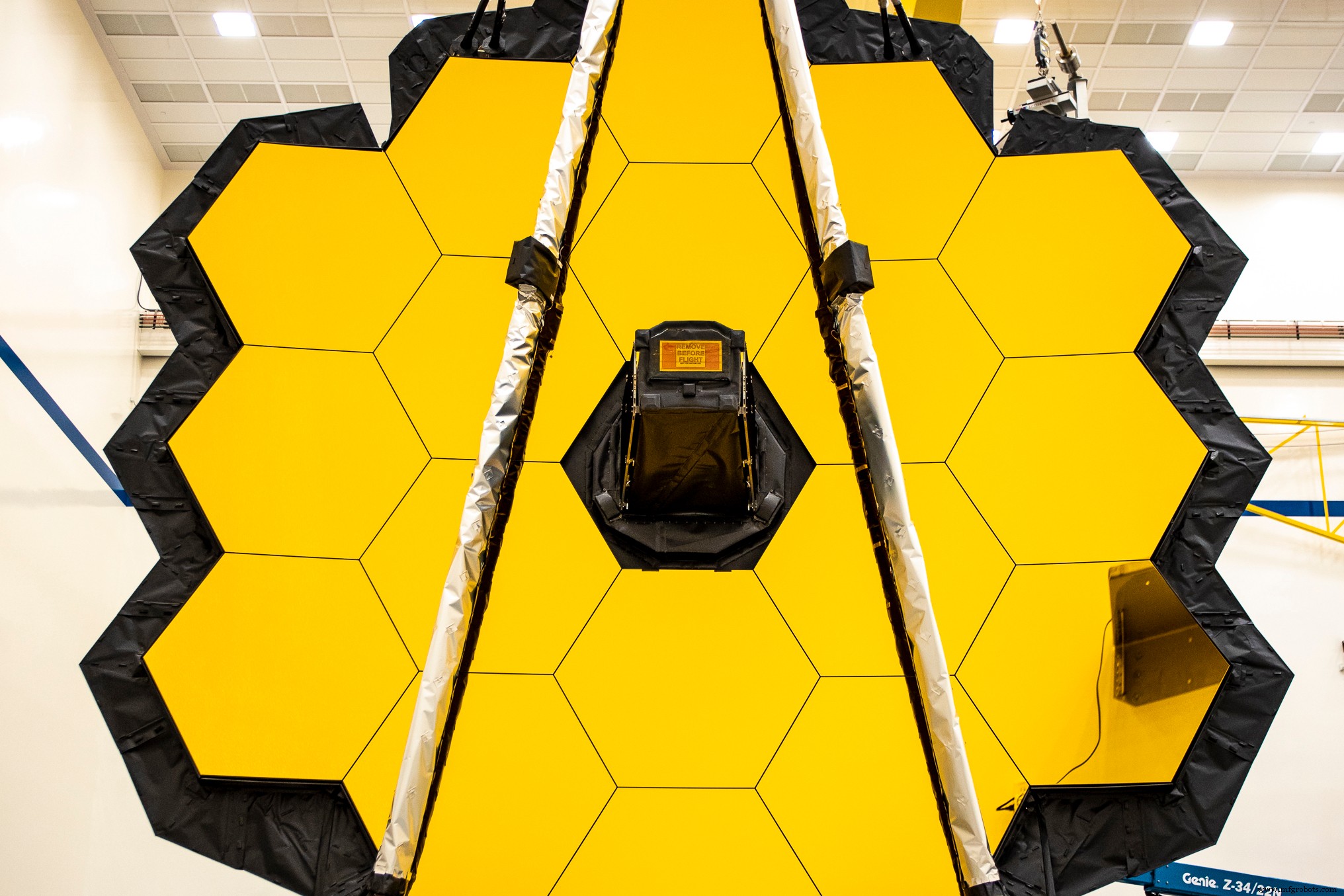
NASA (Washington, D.C., U.S.) announced on June 9 that it has successfully deployed and extended the Deployable Tower Assembly as part of the testing regime of the James Webb Space Telescope (JWST). NASA’s most complex, composites-intensive space telescope, JWST is designed to look for faint traces of infrared light coming from astronomical objects.
NASA says the Deployable Tower Assembly’s primary purpose is to create a large gap between the upper part of the observatory that houses its gold mirrors and scientific instruments, and the lower section known as the spacecraft bus, which holds its comparatively warm electronics and propulsion systems. By creating a space between the two, it allows for Webb’s active and passive cooling systems to bring its mirrors and sensors down to the cold temperatures required to perform properly.
During the test, the tower was slowly extended 48 inches (1.2 meters) upward over the course of several hours. Simulating the zero-gravity environment in which Webb will operate, engineers employed a series of pulleys, counterbalances and a gravity-negation system that offloaded the effects of Earth’s gravity on the structure.
“It performed as predicted, and from our expectations from previous tests before the full observatory was assembled,” says Alphonso Stewart the Webb deployment systems lead for NASA’s Goddard Space Flight Center in Greenbelt, Md., U.S. “This was the first time this part of Webb was tested in its flight-like configuration to the highest level of fidelity we possibly could. This test provides the opportunity to assess all interfaces and interactions between the instrument and bus sections of the observatory."
As the largest space science observatory built, NASA says engineers had to design JWST to fold into a much smaller configuration to fit inside an Ariane 5 rocket for launch. The Deployable Tower Assembly — in addition to helping the observatory cool down — allows Webb to just barely fit inside a 17.8-foot (5.4-meter) payload fairing. Once in space, the tower will extend to give the rest of Webb’s deployable parts, such as the sunshield and mirrors, the amount of room needed to unpack and unfold into a fully functional infrared space observatory.
“We need to know that Webb will work the way we expect it to before we send it to space,” notes Stewart. “This is why we test, and when we do, we test as flight-like as possible. The way we send the commands to the spacecraft, the sequence, the individual sitting at the console, the communication that we use. We replicate all of these things to see if we are missing something, to see if there is something that needs to be changed, and to make sure that all of our planning to date has been correct.”
Following augmented personal safety procedures due to COVID-19, JWST’s team in California continued integration and testing work with significantly reduced on-site personnel and shifts. The NASA/Northrop Grumman team recently resumed near-full operations. NASA is evaluating potential impacts on the March 2021 launch date and will assess the schedule and adjust decisions as the situation unfolds.
fiber
- Revolutionizing Space Travel with Next‑Generation 3D‑Printed Materials
- 12 Proven Practices for a Successful CMMS Implementation
- Irkut’s MS-21 Secures Third Flight Test Milestone Toward EASA Certification
- MS-21 Achieves Fourth Flight Test Milestone Toward EASA Certification
- Benedict’s Reagent Test: Quick Detection of Monosaccharides
- James Webb Space Telescope Launches Successfully, Opening New Frontiers
- James Webb Space Telescope: Unveiling the Universe's Origins
- Lightweight Flexible Holographic Lens Paves Way for Next-Gen Space Telescopes
- Advanced Optical Receivers for Space Communications
- The Critical Role of PCB Design in Successful In‑Circuit Testing