



Olli 2.0: Local Motors’ Autonomous Electric Shuttle Enhanced with CRP Technology Windform Composites

Ground mobility company Local Motors’ (Phoenix, Ariz., U.S.) autonomous electric vehicle (EV), Olli 2.0, possesses 3D-printed parts manufactured by CRP Technology (Modena, Italy) using its Windform composite materials. As additions to the original Olli 2.0 model developed by the engineering team in Chandler, the parts also support Local Motors’ ability to obtain individual approval in Europe.
“Olli is operating in campuses, stadiums, industrial districts and local communities around the world. To approve deployments in Europe, it needed some additional components not required in U.S. market,” notes Carlo Iacovini, general manager EMEA, Local Motors. This was particularly true due to Olli 2.0’s unique design, which is characterized by a tall rectangular pod with wide-set headlights and expansive windows nestled between a frame (see image above).
Among these additional components were the windshield wipers. “To add the wipers we opted for the retrofit technique, or re-adaptation process, through an integration on the 2.0 model,” Iacovini says. “We started from the original project, and we adapted it to our needs. These phases [retrofit and integration] were carried out in Italy, based on the original design produced by the Chandler engineering team.”
However, because of the shuttle’s shape, “the wipers arm could not be positioned from above, but from the below side of the front window. Thus, Local Motors’ engineering department designed a new front bumper with brackets for fixing both the wipers starter motor and the front wiper washer reservoir.”
During the wipers assembly phase, the Local Motors engineering team noticed that the motor protruded from the modified front bumper: “To avoid the issue we then thought to add two coordinated covers, with the purpose of concealing the protruding part [the first cover] and protecting the pressure system of the washer reservoir from external agents [the second cover],” explains Iacovini.
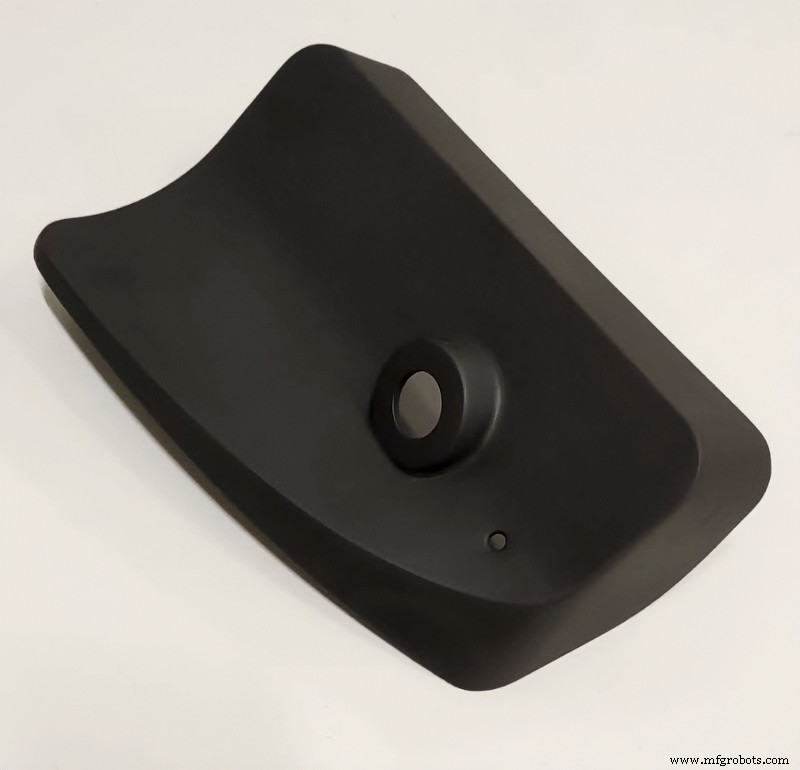
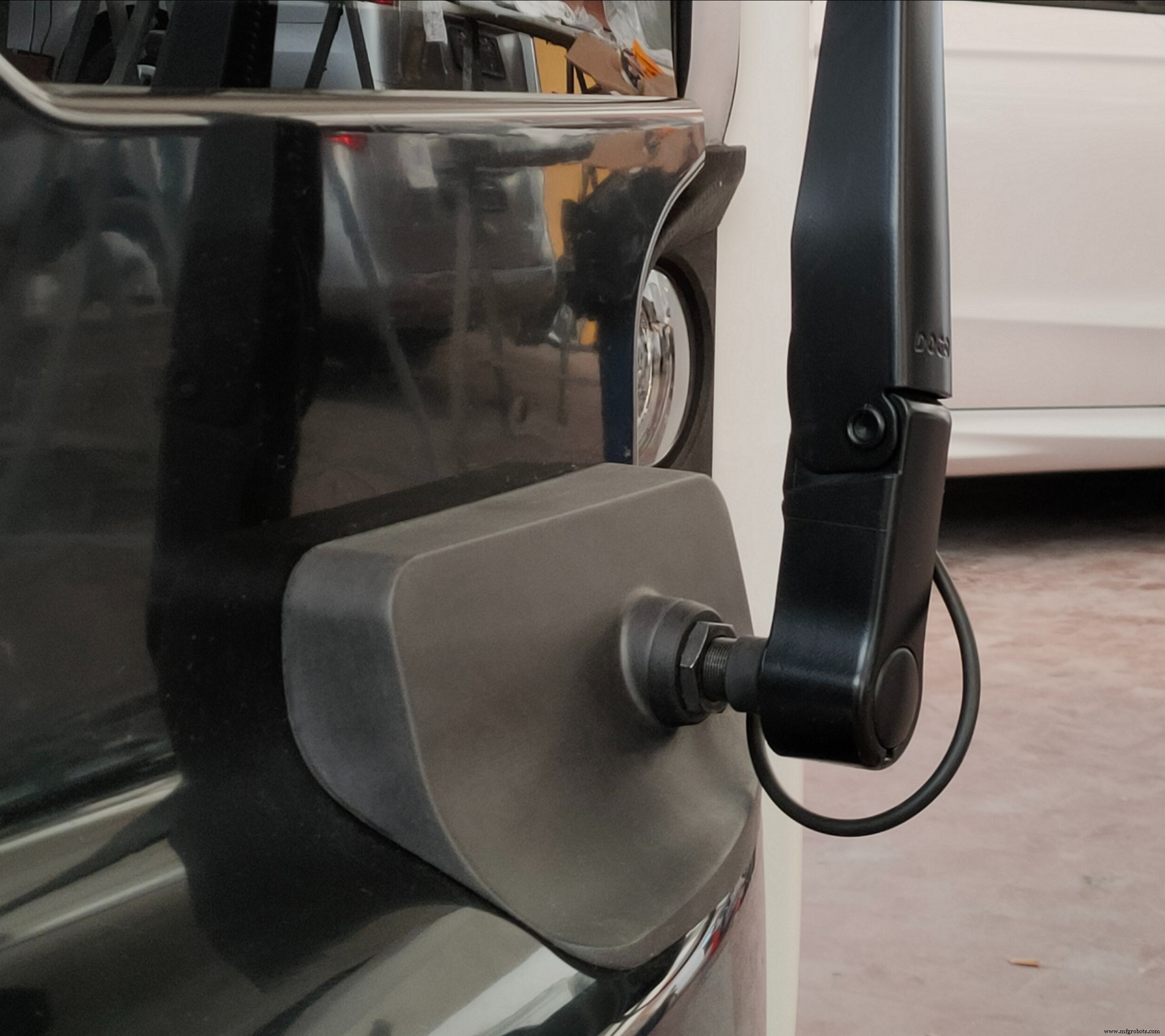
To achieve this, Local Motors designed the motor cover from scratch. “For the wipers’ washer reservoir flap valve we modified and adapted the design of the flap valve of the charging socket on Olli 2.0’s rear bumper,” says Iacovini. “In this way we maintained homogeneity from the design point of view, and we positioned the water flap valve symmetrically to the charging one.”
Once the parts to manufacture were identified — the motor cover and the washer reservoir flap valve of the wipers system — Local Motors turned to CRP Technology. “We wanted to collaborate with a European firm,” Iacovini pointed out. “Therefore we contacted CRP Technology, a company I have known for a long time and with which I have collaborated on relevant projects. Relying on CRP was the winning choice: The uniqueness of Windform materials in terms of quality and strength allow achieving optimal results in a short time [possible].”
After a careful study of the projects, CRP Technology experts opted to create the parts using 3D printing/powder bed fusion (PBF) process with fiber-reinforced composites. Specifically, the company went with its Windform Top-Line range: the polyamide-based carbon fiber Windform XT 2.0 material and Windform LX 3.0, a polyamide-based glass fiber. CRP says Windform XT 2.0 was used for the motor cover primarily for aesthetic purposes but also for functionality (i.e., able to contain/support the oscillatory movement of the wiper arm and blade, guarantee electromagnetic compatibility, resist the oscillating movement of the wiper arm and blade, withstand continuous stress and vibrations caused by traffic circulation on roads and preserve the electrical unit from external agents). Alternately Windform LX 3.0 was applied to the washer reservoir flap valve, as it is mainly retains a functional purpose (to ensure quick access to the wipers washer reservoir positioned behind, protect it from external agents and resist continuous stress and vibrations caused by the traffic circulation on roads) and only partly aesthetics.
The resulting starter motor cover for the wipers is a lightweight rectangular part — more specifically a protruding oblique parallelepiped with a puncture for the placement of the wipers arm and a smaller one for the water hose. It features high stiffness, strength and is highly durable. The resulting washer reservoir flap valve component consists of a rectangular structure frame and the flap valve equipped with magnets to access the wipers washer reservoir.
After manufacturing the parts, CRP Technology carried out the final tests and delivery. A Local Motors’ supplier installed them on Olli without encountering any mounting and fixing issues. Additional electromagnetism tests performed showed no critical issues.
fiber
- High‑Performance 3D‑Printed Fixtures: Solving Skilled Labor Shortages and Boosting Quality
- Revolutionizing Sand Casting with Stratasys FDM Technology
- How IoT Is Transforming Consumer Business and Manufacturing
- Electric‑Field‑Induced Alignment of Nanocarbon Fillers in Epoxy Composites: Impact on Electrical Conductivity
- Swancor Secures Global Wind Blade Material Supply Deal with MHI Vestas in Taiwan
- Mastering Composite Materials: Efficient Production Strategies for Aerospace OEMs
- CRP Technology Unveils Windform RS: High-Performance Polyamide Composite for Powder Bed Fusion 3D Printing
- Realtime Robotics Deepens Collaboration with Mitsubishi Electric to Deliver Advanced Motion Planning Solutions
- Manufacturing with Recycled Materials: Building a Sustainable Future
- The Future of Autonomous Vehicles: Technology, Challenges, and Innovations