



Converting ASTM Steel Grades: A Practical Guide for Designers
Specifying steel for overseas manufacture
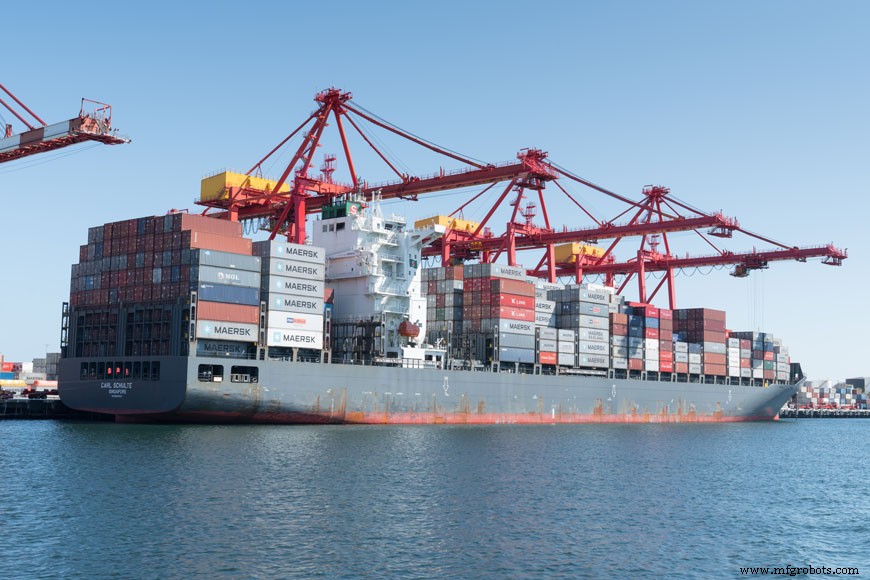
When manufacturing overseas, North American designers might need to navigate differences in spoken language. Engineering specification is also a language, and standard specifications for material and processes are defined differently in each country in the world. To a new designer, steel grades might seem easy, where 316 stainless steel is one material and cast iron another, but there are variations in each of these categories of metal. Rumors abound about people receiving poor quality steels from other jurisdictions. It leaves some designers wondering if there is something intrinsic in the official standards in other countries that can lead to these complaints.
International standards do not translate, metal-for-metal, the way words might translate. When converting from one standard to another, it’s almost impossible to find identical compositions for a given type of metal. The question becomes: can you find an equivalent? This can be confusing, as each named metal grade has its own chemistry and production guidelines.
For people without a materials background, these differences can make the purchase of foreign-made metal seem iffy, like ordering an inferior knockoff. However, the quality of the grades of steel are as good, country to country. Understanding what makes a steel standard or specification can help a North American business navigate overseas production.
Steel grades explained
Metal alloys are a mixture of different proportions of elements. A standard includes the chemistry, or “recipe” for the alloy, documenting what different elements should be melted into it. Specific instructions may also be given on melting temperature, cooling, and treatment.
Published standards also record the mechanical properties of a specified metal. If it has been made correctly, a metal should not only have the correct chemical analysis, but also perform within the correct range in mechanical tests.
Steels contain iron and carbon. Standards for each grade of steel specify the proportions by weight of each of these elements, as well as any additional elements alloyed with them. These additions may create different characteristics: for example, chromium is present in stainless steel to help prevent rusting.
In most consumer metal standards, the proportions of each element are given an acceptable range, rather than a precise number. For example, the ASTM 1050 grade steel is so named because it is approximately .50% carbon by weight. However, the tolerance for carbon percentage in the ASTM 1050 standard is .48-.55%. A similar Japanese specification sets carbon between .47-.53%, and allows for silicon and other trace elements, whereas the ASTM standard does not.
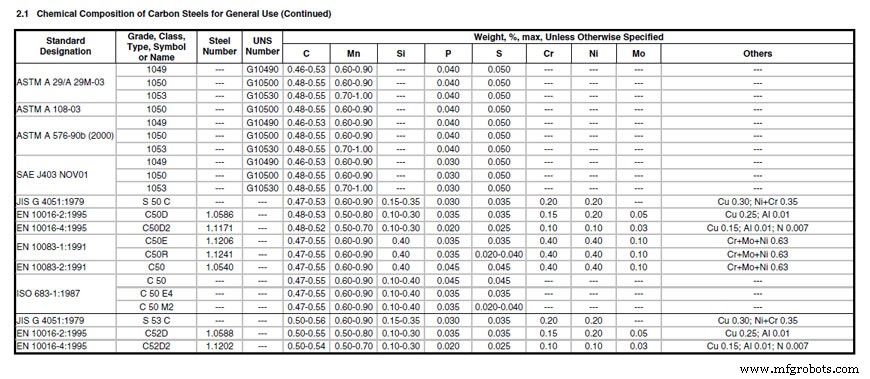
Steel specifications often provide ranges for carbon, manganese, silicon, phosphorus, sulfur, chromium, nickel, and molybdenum, and none set identical ranges for each element. It is for this reason that steel standards from different organizations are not precise matches: the tolerances merely overlap. If one steel specifies less than .007% sulfur content, and another allows up to .040%, are they different steels? Small changes do not matter in many situations but may be relevant depending on the metal’s intended use.
It is not just chemistry, but also processing, that changes the behavior of a metal. Metal is crystalline and forms grain microstructures as it cools. Chemistry, melting, cooling, and heat treatment all can change the grain of the metal. This directly influences tensile strength, hardness, and brittleness. Therefore, steel specification may also include the production steps needed to create particular microstructures, including martensite, austenite, or ferrite grains.
When making a substitution between one standard and another, a skilled metallurgist or engineer will evaluate comparable grades based on mechanical properties. The engineer considers what the final product needs to do, and in what conditions. Using their understanding of chemistry, the expected working load, and knowledge of the conditions the product will work in, they can find a steel for the product’s requirements in any standard. All recognized steel standards generally have equivalent rigor, making this translation possible.
It is not a difference in published standards that are the source of poor-quality foreign metals.
A guide to standards organizations
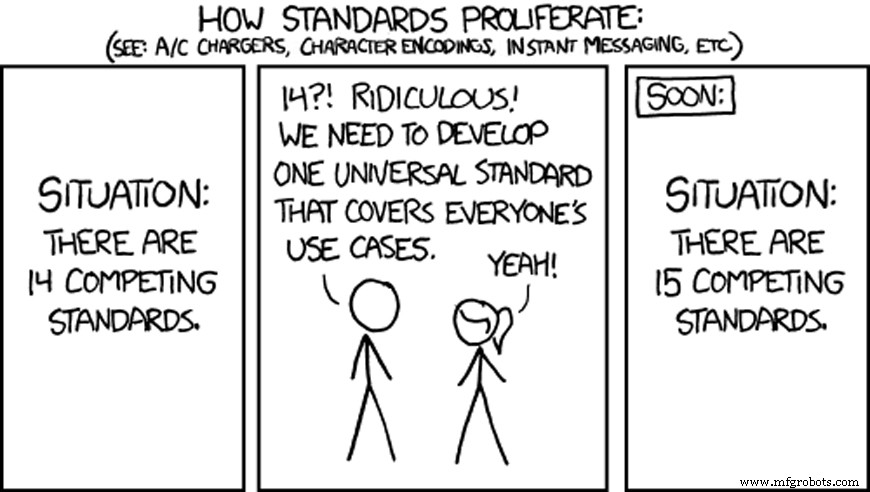
There are many standards organizations that lay out specifications for manufacturing.
In most countries, metal standards were started when metal manufacturing organizations got together to create and distribute a “recipe book” for members of their industry.
As the Industrial Revolution progressed, this standardization seemed such a benefit to industry that umbrella standards organizations, who tied different related organizations together, began to spring up.
For example, the American Iron and Steel Institute (AISI) specifies many steel grades; they are the original manufacturing organization to standardize steel in the United States. Their expertise, along with other bodies interested in the production and use of steel, was used to create the American Standard for Testing and Materials (ASTM), a more general standards organization that creates documents for production and testing across many related manufacturing fields. ASTM does not just specify steel, but also other materials (metals, plastics, paint) as well as diverse testing procedures—from measuring the weight of coatings to testing how well bollards protect against vehicle attack.
There are also top-level organizations that do not make their own standards, but rather organize other bodies, and accredit those that are publishing complete and rigorous standards documents. ANSI, or the American National Standards, accredits 41 specialized organizations similar to ASTM. These include a range from textile colorists to the tree care industry.
ISO, the International Organization for Standardization, is an international standardization body that draws on member bodies, one from each country, for expertise. ANSI is the American member body for ISO.
Navigating this hierarchy of standards can seem impossible, but because so many have done it before, comparable metals are known for most regularly used alloys.

A sample of standards organizations specifying steel
This list of standards organizations is not complete, but instead has been chosen to reflect the complexity and variation of standardization throughout the world and demonstrate the standards that a metal engineer may run into while specifying a product.
International
- ISO: International Organization for Standardization
- It might look like “ISO” is a mistaken acronym—shouldn’t it be “IOS”? No; ISO is not meant to be an acronym. The prefix “iso” is from Greek, meaning “equal.” ISO is a global network of the top standards organizations in each country. ISO offers standards for metals separate from but informed by global member organizations.
- ASTM International: American Standard for Testing and Materials
- ASTM was originally an American standards organization but now has 12,000 standards in 140 participating countries. ASTM integrates the standards of smaller industry-led standards organizations (see AISI and ASME below.)
Americas
- AISI: The American Iron and Steel Institute
- Started in 1855 as the American Iron Association to “take proper measures for advancing the interests of the trade in all its branches,” AISI was one of the first to provide North American standards for various steel product lines.
- ASME: The American Society of Mechanical Engineers
- Mechanical engineers founded this organization in 1880. In 1905, a boiler explosion caused ASME to start looking towards creating standards to safeguard and prevent similar tragedies from unfolding again. Steel standards are important for ASME since material properties determine safe working loads.
- ANSI: American National Standards Institute
- ANSI is the top-level umbrella organization providing oversight in the US, and is the American member body to ISO. Formed in 1918, it manages the voluntary consensus standards for products, services, processes, systems, and personnel in the US.
- CSA Group: Canadian Standards Association
- The Canadian Standards Association specifies steel in Canada. It formed in 1919 when industry found that the inability to communicate easily made it difficult for Canadian companies to respond quickly enough to the war effort. Standardizing industrial processes made it possible for industry to merge production in a way that had never been tried. CSA works on an industrial level, but there is a higher body, the SCC or Standards Council of Canada, which is the ANSI equivalent. In Canada, it is a public corporation, not a private one.
- DGN: Dirección General de Normas
- This standards organization is the Mexican member body of the ISO. It’s a governmental agency rather than a voluntary one, creating standards and exercising the powers and regulations of several governmental departments.
Europe
Europe has three umbrella bodies: CEN, CENELEC, and ETSI. In steel specification, it is more common to run into the following:
- DIN: Deutsches Institut für Normung
- First founded as an industry standards organization in 1917, DIN was recast as major standards organization in the 1920s. This is Germany’s member body of ISO.
- BSI Group: British Standards Institution
- BSI was the world’s first National Standards body, formed in 1901. One of its very first specifications was for the steel to be used in tramways, to ensure safety and durability. It is one of the founders of the ISO, and the British member body to that organization.
Asia
- JISC: Japanese Industrial Standards Committee
- The JISC is the Japanese member body of the ISO and maintains the JIS, or Japanese Industrial Standards, which were established during WWII to simplify material output. In 1949 laws were enacted to create the legal foundation of the JIS.
- GB: Guobiao
- The Standardization Administration of China (SAC) is the member body to the ISO. The standards it issues are known as the GB or Guobiao standards. These are the basis for product testing and certification in China.

Specifying in practice
Across all these specifications, there are often clear substitutions for commonly-used alloys. The previously mentioned ASTM 1050 steel might be substituted for GB#50 or JIS S 50 C. For each specification, there are small variations in chemistry. An engineer with knowledge of the application can advise whether these differences will be a problem to the final product.
In most cases, what really changes is not the metal, but the paperwork. Even if the standards are slightly different, the material that comes out at the end will be almost the same. In this, specifying metal is a bit like mixing paint colors, in which measured additions of pigment are added to a base paint. Two almost identical colors will be called different names by different manufacturers and will have varying pigment allowances. Further, each mixed batch of paint may be minutely different from the last. Still, experts know what substitutions can be made between manufacturers, and a neon green will never be mistaken for a ruby red.
Similarly, a metallurgist will know what “close enough” means. When designing a product, engineers will include a safety factor. This means that they overdesign the product, so that the material can withstand greater forces than those for which they are rated (a typical safety factor when human life is at stake is a factor of five). This safety factor is generally at least an order of magnitude larger than the slight variations in mechanical properties that exist between standards, so the variations do not become design concerns.
Exceptions to this are in military and aerospace applications, where the tolerance for variance is much, much smaller. Even a slight shift in mechanical properties can spell disaster. For these cases, the same standard must always be rigorously applied.
Buyer beware—in any jurisdiction
Paperwork is easy enough to do. Standards are not so different, and not so sloppy, as to be the reasons for the rumors about foreign steel.
What matters most is the quality control within the factory. Good steel should be free of inclusions, consistent throughout, and have very minor and mostly surface defects. In casting, there are many places where a well-specified steel grade could be made badly: input stock, age and upkeep of the furnaces, the time at heat, de-slagging, the craft of the pattern, and care taken during pour all contribute to the success of the product made.
Bad steel can be produced on any specification, if it’s not being made carefully.
Getting the paperwork done is not nearly as important as making sure a manufacturer is producing quality with due care and attention. This is one of the reasons steel from other jurisdictions can get a bad name. When ordering from far away, not visiting the factory may mean missing those clues that suggest a manufacturer is sloppy in their work. If the manufacturer is across the world rather than down the block, this is harder to assess.
However, business travel makes the world much smaller than it once was. Relationships and oversight along the supply chain are as important in a global economy as in a local one. Meeting people and learning who they are, examining what they value in their business, makes all the difference when sourcing the right vendor. Quality assurance at both ends is important, to monitor the variances that might happen over the course of a production run.
As with so much in business, the problem is human. Standards and automation are important, but they do not substitute for good judgement and commitment to excellence. In the end the quality of steel is a product of the care and attention in manufacturing, whatever jurisdiction it’s manufactured in.
For more information on steel, or to request a quote for a custom project, please contact us.
Metal
- How Stainless Steel Is Made: From Raw Materials to Finished Products
- How Tantalum Is Mined: Process, Sources, and Uses
- Hot Rolled Steel Grades & Applications – A Comprehensive Guide
- Create a Weathered Look: A Safe Guide to Rusting Metal
- Defeating Rust: 5 Proven Strategies to Preserve Your Metal Assets
- The Steel-Making Process Explained: From Iron Ore to Alloy
- Preventing Metal Corrosion: Proven Strategies for Long-Lasting Durability
- ASTM A537 Class 2 Steel: High-Performance Pressure Vessel Plates
- ASTM A537 Class 3 Steel – Optimal Low-Carbon Alloy for Pressure Vessels
- Understanding Steel Fabrication: Processes, Materials, and Applications