



Carbon Nanotubes Deliver Record Flexibility and Speed in Electronics
For the last few decades, the relentless scaling of transistors on rigid silicon wafers has driven unprecedented gains in performance for personal gadgets and high‑end computing. Yet emerging fields such as real‑time edge analytics and the Internet of Things demand high‑performance logic and sensors that can conform to curved surfaces, roll‑to‑roll manufacturing, and low‑power operation. Flexible nanomaterials—particularly carbon nanotubes (CNTs)—offer a compelling combination of high carrier mobility, low cost, and scalability that could surpass conventional silicon in these areas. However, until recently, CNT thin‑film transistors (TFTs) on flexible substrates have lagged behind their rigid counterparts, with logic gate delays exceeding 1 µs. This gap is narrowing thanks to breakthroughs from IBM Research.
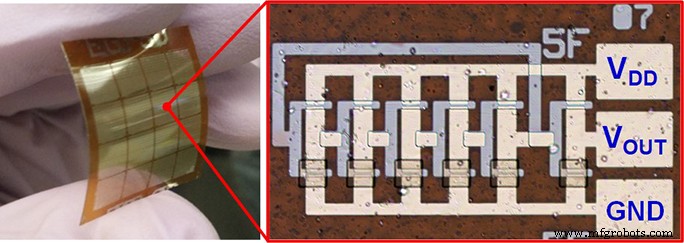
Flexible CNT CMOS integrated circuits with sub‑10 ns stage delays. Pictured: A flexible 5‑stage CMOS ring oscillator made on a polyimide substrate. (Figures 1b and 4a in “Flexible CMOS integrated circuits based on carbon nanotubes with sub‑10 ns stage delays”, published in Nature Electronics)
In our recent publication, Flexible CMOS integrated circuits based on carbon nanotubes with sub‑10 ns stage delays (Nature Electronics), we show that high‑performance CNT TFTs and complementary logic can be realized on flexible platforms. Building on IBM’s decades‑long research in carbon electronics, we tackled the core challenges that have limited flexible CNT devices: achieving a pure, densely packed semiconducting CNT network; developing a robust n‑type doping method for complementary circuits; and ensuring high process yield and uniformity on bendable substrates. The resulting flexible CNT TFTs deliver industry‑leading figures of merit—current densities exceeding 17 mA/mm, ON/OFF ratios above 10⁶, sub‑threshold slopes under 200 mV/dec, mobilities near 50 cm²/Vs—and maintain performance even when wrapped around a finger.
Leveraging these advances, we constructed a benchmark 5‑stage CMOS ring oscillator that operates at a stage delay of just 5.7 ns—nearly a thousandfold improvement over earlier CNT work and the fastest flexible ring oscillator reported to date across all nanomaterial platforms, including organics, oxides, and nanocrystals. This milestone demonstrates that CNTs can underpin high‑speed logic on bendable substrates, opening doors to IoT edge computing, flexible displays, and sensor networks that combine low cost with unmatched performance.
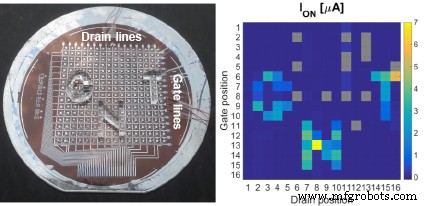
Integrated flexible pressure sensor with an active matrix of CNT TFTs. Pictured: Current mapping of a flexible CNT pressure sensor resembles the shape of “CNT” word stamps. (Figure 4b in “Large‑area high‑performance flexible pressure sensor with carbon nanotube active matrix for electronic skin”, published in Nano Letters)
In a complementary study, Large‑area high‑performance flexible pressure sensor with carbon nanotube active matrix for electronic skin (Nano Letters), we fabricated a 16×16 CNT TFT array that mimics human skin’s tactile sensing. The fully integrated sensor operates at only 3 V, achieves a spatial resolution of 4 mm, responds in less than 30 ms—faster than biological skin—and accurately detects complex shapes on both flat and curved surfaces. These results illustrate the practicality of CNT‑based electronic skin for smart robotics, prosthetics, and next‑generation human‑machine interfaces.
About the author
Dr. Jianshi Tang earned his PhD in Electrical Engineering from the University of California, Los Angeles, where he investigated the physics of low‑dimensional nanomaterials such as semiconductor nanowires, topological insulators, and magnetic nanostructures. In 2015 he joined the IBM Thomas J. Watson Research Center as a postdoctoral researcher and was later promoted to Research Staff Member. Dr. Tang’s current focus is on high‑performance CNT electronics and energy‑efficient neuromorphic computing, with the aim of translating nanomaterial breakthroughs into industrially viable technologies.
Nanomaterials
- Visualizing Oceanic Dissolved Carbon at the Atomic Scale
- Carbon Fiber Prosthetics: How High‑Performance Materials Transform Limb Replacement
- Printing the Future: Flexible Electronics Powering the Internet of Things
- Synergistic Electrical Enhancement in Epoxy Composites with Carbon Nanotubes and Graphite Nanoplatelets
- Regulating Carbon Nanotube Slide‑Roll Motion Through Hydroxyl Functionalization
- Pulmonary Exposure to Multi‑Walled Carbon Nanotubes Elevates Blood Pressure and Impairs Cardiac Function in Rats
- Carbon Nanotubes in Water Purification: Assessing Safety, Risks, and Sustainability
- Recycled Carbon Fiber: Current Landscape & Future Outlook
- Holiday Gift Ideas: The Best Carbon Fiber Gadgets
- Carbon Fiber: The Ultimate Strength‑to‑Weight Advantage