



Atomic‑Resolution Imaging of Molecular Charge States
Energy conversion and transport in biological systems hinge on the precise charging and discharging of molecules. Porphyrins—such as chlorophyll and hemoglobin—are central to these processes, and their charge‑induced structural changes also drive the performance of organic electronic and photovoltaic devices.
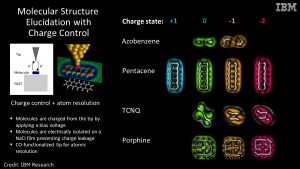
When a molecule gains or loses an electron, its geometry and electronic structure shift. By resolving these subtle changes at the atomic level, we gain unprecedented insight into the link between charge state and function.
My colleagues at IBM Research, together with partners from CiQUS, the Universidad de Santiago de Compostela, and ExxonMobil, recently reported in Science that we have achieved atomic‑resolution imaging of the structural evolution of individual molecules upon charging. The study focused on porphine, the parent scaffold of all porphyrins, and revealed how its conjugation pathway adapts with each added or removed electron.
A Decade of Methodological Innovation
Ten years ago we pioneered a technique that captures the structure of molecules with atomic precision (Science 325, 1110, 2009). We later extended this method to probe bond strengths directly (Science 337, 1326, 2012). The key to these advances was functionalizing the tip of a low‑temperature atomic force microscope (AFM) with a single CO molecule, which sharpens imaging contrast and stability.
Building on that foundation, we refined the technique to control the charge state of adsorbed molecules on insulating substrates, preventing charge leakage (Nature Comm. 6, 8353, 2015). By applying a bias between the AFM tip and the sample, we can add or remove electrons at will.
Last year, Shadi Fatayer and I envisioned merging these capabilities—ultrahigh‑resolution CO‑tip imaging with dynamic charge control. Our latest publication demonstrates this integration and explores the structural ramifications for several biologically and technologically relevant molecules.
Key Findings
We first examined azobenzene, a classic molecular switch. While neutral, its two phenyl rings lie flat and parallel. Upon accepting an electron, the rings tilt relative to each other, a clear signature of charge‑induced geometry change.
Next, we probed pentacene, a benchmark organic semiconductor. By manipulating its charge from +1 to –2, we observed bond‑by‑bond variations: certain C–C bonds stiffen while others soften, illustrating how electronic redistribution governs mechanical response.
We then investigated TCNQ, a common charge acceptor. In its neutral state it stands upright on the surface, but becomes planar once charged negatively. The increased aromaticity of the central ring in the doubly negative state is directly visualized.
Finally, we turned to porphine. For the first time, we captured its conjugation pathway and aromatic character across three distinct charge states. These observations clarify long‑standing debates about porphyrin chemistry and provide a framework for predicting functional behavior in both biology and materials science.
Our work demonstrates that precise control and imaging of molecular charge states unlocks a deeper understanding of how charge modulates structure and function—knowledge that is vital for advancing bioenergetics, organic electronics, and photovoltaic technologies.
Molecular structure elucidation with charge‑state control, Science, Shadi Fatayer, Florian Albrecht, Yunlong Zhang, Darius Urbonas, Diego Peña, Nikolaj Moll, Leo Gross, DOI: 10.1126/science.aax5895
The project was supported by the European Research Council Consolidator grant ‘AMSEL’ (Contract No. 682144), Agencia Estatal de Investigación (MAT2016-78293-C6-3-R), Xunta de Galicia (Centro singular de investigación de Galicia, accreditation 2016–2019, ED431G/09), and the European Regional Development Fund.
Nanomaterials
- Inside Vayyar’s 4D Imaging Radar SoC: Design, Applications, and Market Impact
- IBM Breaks New Ground: First Liquid‑Phase Atomic Imaging of 2D Materials at Room Temperature
- Scientists Successfully Synthesize and Visualize Cyclo[18]Carbon
- Atomic‑Resolution Imaging of Molecular Charge States
- Revolutionary Ghost Imaging Enhances Precision of Atmospheric Gas Measurements
- Explore 15 Essential Milling Machine Types for Precision Metalwork
- 10 Essential Casting Pattern Types for Optimal Metal Production
- Explore 7 Powerful Applications of Graphite
- Key Sheet Metal Operations in Modern Manufacturing
- The Production Process of Nylon: From Polymers to Durable Fibers