



Clean Sky 2 Publishes 30 New Project Findings Advancing Sustainable Aviation
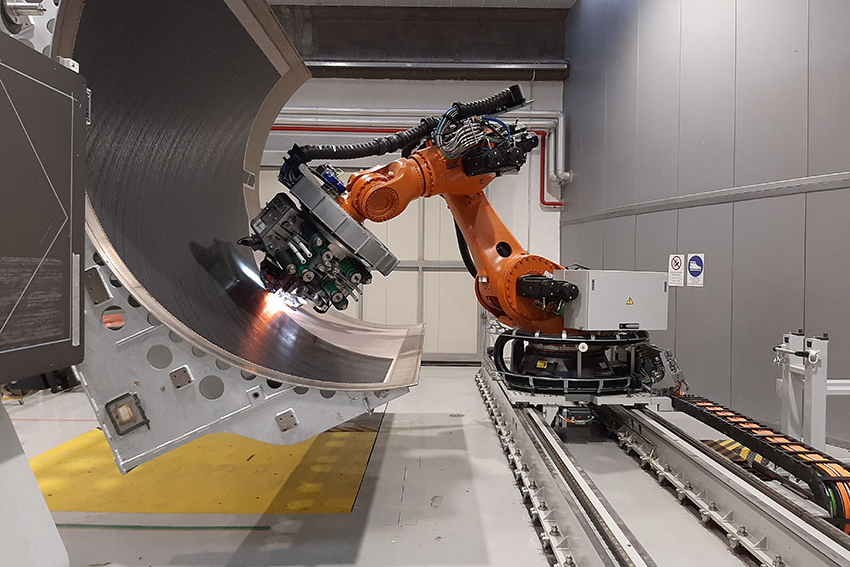
On June 21, Clean Sky 2 published 30 new articles that cover the results of several projects Clean Sky is investigating to date, a majority of which touch on the organization’s vision to push aeronautical science beyond the limits of imagination via new technologies that significantly reduce aviation’s impact on the planet. From engines and systems, to large passenger aircraft, fast rotorcraft and more, many of these projects also aim to apply composite materials and processes. A short summary of each project and a link to the full articles are covered below.
Born again: Obsolete composites find a second life with RESET
As airliners increasingly use composite materials, finding a solution to recycle aircraft thermoplastics is essential. In particular, Clean Sky’s RESET project focused on carbon fiber reinforced with a PEEK (Polyether ether ketone) or PPS (Polyphenylene sulphide) matrix, and worked to developed a recycling process to be applied to thermoplastics.
Circular economy: Composite fuselage for regional aircraft takes shape
Clean Sky’s Composite Fuselage project, part of the Regional Aircraft Innovative Aircraft Demonstrator Platform (IADP), aims to develop technologies that are suitable for an advanced regional aircraft fuselage and to integrate and validate them up to full-scale demonstrator level. The project focuses around innovative low-cost and low-weight composites, advanced manufacturing and assembling processes and structural monitoring.
Bigger engines, bigger challenges. Clean Sky’s ASPIRE resolves them
Kicked off at the beginning of 2016 and concluded Sept. 2020, the ASPIRE project served to study the aerodynamics and acoustics efficiency of new propulsion systems, such as Ultra High Bypass Ratio (UHBR) engines which Clean Sky 2 says will be the prevailing power paradigm from around 2025 onwards for medium- and large-scale airliners. New carbon fiber composite fan blades and reduction gearbox technologies are said to be key enablers to achieve improved aerodynamic and aeroacoustic interaction.
Cool customer: HEFESTO keeps the heat at bay
Clean Sky's HEFESTO (Helicopter Engine Deck – Multifunctional layered insulation for carbon fiber-reinforced plastic (CFRP) fire and thermal protection) project, funded by the European Commission’s Horizon 2020 program and completed in June 2020, focused on the design of a helicopter engine deck/firewall using composite materials that aims to cut weight by 10% and improve fatigue resistance compared to metal structures, while assuring required thermal isolation and fireproof capabilities.
Lighten up: Innovative tooling enables RACER’s fuselage to shed weight
The RACER (Rapid And Cost-Efficient Rotorcraft) consists of two parts. The AFPMet project (which concluded in 2020) was devoted to the innovative design, development, manufacture and delivery of specialized tooling to perform automated fiber placement (AFP) for the lamination and curing of the RACER side-shells. The RoRCraft project (a core partner project) was in charge of the design and manufacture of the front and central fuselage section for the RACER demonstrator. The ultimate goal is to achieve a Technology Readiness Level 6 (TRL 6) target, slated for early 2022 via RACER’s flight test program.
SORCERER: Clean Sky wizardry for multifunctional aircraft composites
Clean Sky’s SORCERER (Structural pOweR CompositEs foR futurE civil aiRcraft) project aims to develop composite materials that can store and deliver additional electrical energy for electrically powered aircraft, as well as address the challenge of lightweighting. The project, which started in 2017 and ran until July 2020, also contributed to Clean Sky’s Multifunctional Fuselage Demonstrator program (see “Moving forward on the Multifunctional Fuselage Demonstrator (MFFD)”).
It’s about time: Human/robot collab zips up production rates
To enable European aeronautics to maintain a competitive advantage, Clean Sky 2 worked to optimize lightweight composite technologies and systems via automated and human/robot collaborative systems. This was coordinated by Leonardo Aircraft Division, and supported by three complementary projects: SMART LAY-UP for semi-automated manufacturing; ACCURATe for non-destructive inspection (NDI); and LABOR for fast assembly.
UltraFan progressing at full throttle
The UltraFan turbofan engine demonstrator, a collaboration between Clean Sky and Rolls-Royce (London., U.K.) targets fuel-efficient and more environmentally-friendly engine performance and achieves this by incorporating a raft of technologies and innovative high-temperature materials, as well as new geared architecture. Key technologies include 140-inch-diameter carbon fiber blades encased in a composite fan case. Carbon fiber prepreg was also recently adopted for the engine nacelle.
Clean Sky’s Advanced Rear End Demo shapes up
Clean Sky's Advanced Rear End project, which is ongoing until 2023, brings together an extensive combination of interrelated aircraft rear end and empennage elements, leveraging innovative materials and novel manufacturing techniques to save weight and boost production rates for future-generation, medium-sized passenger aircraft. The project focuses on the development of composite structures — the frames, stringers and skin.
A picture of health: Clean Sky’s SHERLOC leaves no clue unturned
Clean Sky’s SHERLOC (Structural Health Monitoring, Manufacturing and Repair Technologies for Life Management Of Composite Fuselage) project is said to present the most comprehensive assessment of existing structural health monitoring (SHM) technologies and methodologies to date for a composite airframe in the operational and environmental conditions of a regional fleet.
OPTICOMS brings automated composites manufacture to the SAT category
Beginning July. 2016, the six-year OPTICOMS (Optimized Composite Structures for Small Aircraft) project aims to bring innovative approaches in automated composite aircraft structure R&D to the Small Air Transport (SAT) category of aviation, enabling smaller airframe companies to justify building up automation infrastructure and realize a return on investment on low-volume production. Project targets include include reducing composite design and certification costs by 30%; cutting composite production costs by 40%; lowering structural weight by 20% (relative to use of metals); and trimming lifecycle costs by 20%.
Resin
- J.D. Power Unveils 2010 U.S. Vehicle Dependability Study Results
- Clean Sky 2 FUSINBUL Advances Carbon Fiber Pressure Bulkheads for Regional Aircraft
- Clean Sky 2 FRAMES Project Enhances Thermoplastic Composite Heating Simulations for Automated Fiber Placement with Xenon Flashlamp
- Hexcel Announces Q4 2020 Financial Results: $296M Net Sales
- IMCOLOR: Pioneering Integrated Manufacturing for Lightweight, Eco‑Friendly Aerospace Components
- Clean Sky 2 Releases 2019 Report Showcasing Milestone Achievements in Greener Aviation
- Driving Thermoplastic Composite Innovation with RTM for Clean Sky 2 in Spain
- Introducing Toray's First LM-PAEK Laminate for Clean Sky MECATESTERS Initiative
- PASSARO: Pioneering One‑Shot, Out‑of‑Autoclave Composite Cockpits for Clean Sky 2
- Clean Sky Project Completes Advanced Carbon‑Fiber Canopy for Airbus RACER Demonstrator