



Virtual Inventories & 3D Printing: Securing the Future of Distributed Manufacturing

Additive manufacturing (AM) is reshaping production by enabling parts to be created from digital files, unlocking agile, on‑demand manufacturing and virtual inventories.
Traditional supply chains often carry costly, bulky physical inventories of spare parts—especially problematic for automotive fleets that may need thousands of unique components. By keeping only digital design files, companies can generate components locally whenever and wherever they are needed, dramatically reducing storage costs and inventory risk.
While virtual inventories promise efficiency, they also introduce new cybersecurity challenges. A 2023 survey by the Engineering Equipment Federation (EEF) found that 91% of manufacturers are investing in digital tools, yet 35% cite security concerns as a barrier to full adoption.
Why Security Matters in AM
Digital design files contain proprietary specifications; if accessed by unauthorized parties, they can be duplicated, tampered with, or used to produce counterfeit parts that undermine brand integrity and customer safety. Unlike conventional manufacturing, a single compromised file can lead to unlimited unauthorized production.
Beyond files, 3D printers connected to networks are vulnerable to remote hacking. An attacker could alter firmware, disrupt production, or even cause physical damage to the machine.
Emerging Security Solutions
File Encryption
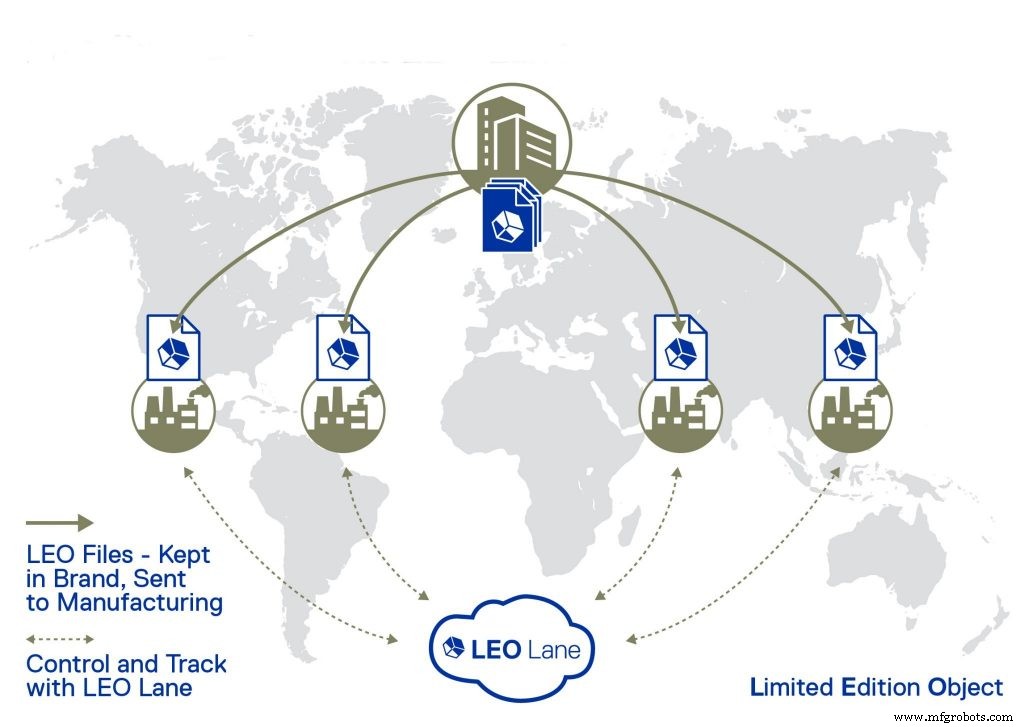
At the design stage, encrypting files ensures only authorized users can decrypt and print them. LEO Lane offers a cloud‑based solution that replaces standard STL files with a custom LSTL format. The LSTL embeds print restrictions—machine type, material, and print count—directly into the file, preventing unauthorized mass production.
Authenticity Verification
US firm InfraTrac uses light‑based anti‑counterfeiting tags that integrate chemical markers into polymer layers. The marker is invisible yet detectable with a handheld spectrometer, confirming a part’s legitimacy. New York University researchers added a 3D QR‑cloud embedded in printed parts, verifiable via micro‑CT scanning—tested across thermoplastics, photopolymers, and metal alloys without compromising structural integrity.
Blockchain for IP Protection
Blockchain’s immutable ledger can enforce licensing agreements in AM. A smart contract authorizes a contractor to print a defined number of parts on specified equipment; the printer verifies the license before decrypting the file. Every step—license check, decryption, print initiation—is recorded, ensuring traceability and tamper‑resistance. Initiatives led by the National Center for Manufacturing Sciences, Moog Inc., and Siemens are already integrating blockchain into government supply chains, while GE patented a ledger‑based traceability system for its 3D‑printed components.
Proactive Security Is Essential
To harness AM’s full potential, manufacturers must secure the entire digital thread—from design to final product—across all stakeholders. End‑to‑end security platforms can protect data, enforce IP rights, and provide transparency without disrupting existing workflows.
For a deeper dive into secure distributed manufacturing, download our free guide and lay the foundation for a resilient, smart production ecosystem.
3D printing
- 3D Printing Revolutionizes Clear Aligners in Digital Dentistry
- How 3D Printing Is Transforming Manufacturing, Healthcare, Aerospace, and Education
- Top Metal 3D Printing Materials: Unlocking Additive Manufacturing’s Potential
- Unlocking Innovation: The Key Advantages of 3D Printing in Modern Manufacturing
- Why 3D Printing Is Revolutionizing Modern Manufacturing
- Top 10 Cybersecurity Firms Protecting the Manufacturing Industry
- Choosing the Right 3D Printing Software: A Comprehensive Guide
- Additive Manufacturing & 3D Printing Explained: Key Insights & Applications
- How 3D Printing Will Transform Manufacturing in the Next Decade
- How 3D Printing is Revolutionizing Modern Manufacturing