



Industry Adoption of 3D Printing: A Maturity Landscape
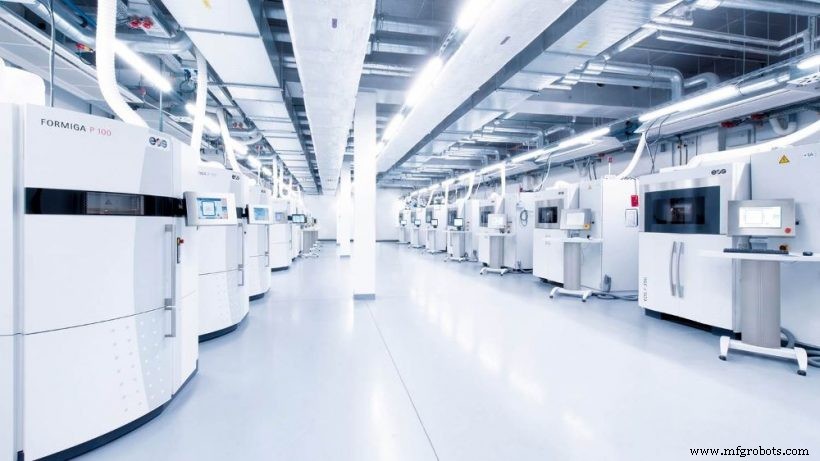
Image credit: EOS
3D printing now powers prototyping, product development, and production across sectors—from aerospace to construction—driving digital transformation with faster lead times, design freedom, and on‑demand manufacturing.
Adoption Across Industries
Our Maturity Chart maps eight key industries onto four adoption stages: Early, Adolescent, Early Mainstream, and Mature. View the infographic.
Stages defined:
- Early – Exploratory pilots, limited real‑world cases.
- Adolescent – Growing prototyping use, emerging case studies.
- Early Mainstream – Tooling, functional prototypes, some end‑use parts; best practices emerging.
- Mature – Proven, standardized, scalable manufacturing across sectors.
Aerospace
Stage: Early Mainstream
In 2020, aerospace held 16.8% of the $10.4 bn additive manufacturing market, contributing to rapid standards development. Key players—GE, Airbus, Boeing, Safran, GKN—deploy metal 3D printing for tooling and end‑use parts. Boeing’s 777X incorporated six 3D‑printed GE9X engine components, including fuel nozzles and heat exchangers. Standardization led by Boeing/Oerlikon (titanium) and SAE International (four 2020 standards). CAGR projected 17.5–20.2% over five years.
Medical
Stage: Early Mainstream
Market size $1.25 bn in 2022, projected $6.08 bn by 2027 (SmarTech). Orthopedics, personalized surgery, and medical devices dominate. By 2021, >1 bn metal implants are expected. Dental applications—clear aligners—are expanding, with Invisalign and SmileDirectClub leveraging SLA and HP Jet Fusion 4210 for mass production. Regulatory alignment remains a critical enabler.
Automotive
Stage: Early Mainstream
3D printing has moved from prototyping to series and custom parts, especially in motorsports and luxury vehicles. Ford collaborates with Carbon for end‑use spare parts; BMW printed its 1 millionth component (window guide rail) via HP Multi‑Jet Fusion. Metal binder jetting (HP Metal Jet) targets mass production of structural parts within 2–3 years.
Electronics
Stage: Adolescent
Rapid prototyping of circuit boards and antennas is common; high‑volume production remains distant. Leading firms—Optomec, Nano Dimension—develop functional electronic components. Scalability, material libraries, and design tools are the next hurdles to mainstream adoption.
Construction
Stage: Early Concrete extrusion, mold printing, large‑scale metal structures, and architectural models are emerging applications. Global concrete 3D‑printing market projected $57.89 m by 2024. Dubai aims 25% 3D‑printed projects in six years. Current use centers on moulds and façade components, with projects like a 42‑story NYC building demonstrating rapid mold production via BAAM.
Oil & Gas
Stage: Early BP cites 3D printing as a top six technology for the sector, offering cost, lead‑time, and supply‑chain flexibility. Adoption lags due to reliance on proven suppliers, but GE and Siemens Oil & Gas already print turbomachinery parts. Metal processes (SLM, EBM, DED) are most relevant; DED also enables repair. The World Economic Forum estimates $30 bn value from early adoption. Industry‑wide standards and QA are under development through collaborations such as NTU–DNL GL.
Industrial Goods
Stage: Early Mainstream Manufacturers like CNH Industrial use 3D printing for spare parts and tooling, shifting from plastic to metal. Companies such as Caterpillar and Siemens Mobility also adopt 3D‑printed components. Sand 3D printers create molds for heavy equipment, reducing lead times and errors.
Consumer Goods
Stage: Adolescent Rapid prototyping dominates, yet end‑use production shows promise in footwear, eyewear, jewellery, and bikes. Brands (adidas, Nike, Mykita) use SLS, SLA, and DLS for custom products. Production volumes still low; scalability will dictate future adoption.
Strategic Takeaway
High‑value, low‑volume sectors (aerospace, medical) lead adoption, while mass‑production industries face cost and standardization barriers. To succeed, companies must align with emerging standards, invest in scalable hardware, and integrate digital workflows beyond prototyping.
Industry Resources
For deeper insights, refer to the full infographic and supporting case studies linked throughout the article.
3D printing
- Revolutionizing Healthcare: How 3D Printing Transforms Medicine
- 3D Printing: A Cornerstone of Industry 4.0
- How 3D Printing Is Revolutionizing Defence – Benefits, Challenges, and Future Applications
- How 3D Printing is Revolutionizing Automotive Production – 2021 Insights
- Assessing the Maturity of Metal 3D Printing Technologies
- AM Around the World: Asia‑Pacific 3D Printing Maturity and Rapid Growth
- Revolutionizing Food & Beverage: How 3D Printing Drives Innovation and Efficiency
- Mastering 3‑D Print Orientation: Tips for Surface Finish, Strength, and Support Efficiency
- How 3D Printing is Driving Innovation in the Automotive Industry
- Unlock Efficiency: A Practical Guide to Adopting Industry 4.0 in Your Manufacturing Business