



3D Printing Rockets: How Additive Manufacturing is Revolutionizing Spacecraft Production

3D printing is rapidly becoming the go‑to technology for spacecraft manufacturing, especially for rockets. Start‑ups and established aerospace giants alike are leveraging additive manufacturing to produce rocket components that deliver superior performance, lower costs, and faster time‑to‑market.
In this edition of our Application Spotlight series, we examine the tangible benefits of 3D printing for both individual rocket parts and entire launch vehicles.
Other applications featured in this series:
- 3D Printing for Heat Exchangers
- 3D Printing for Bearings
- 3D Printing for Bike Manufacturing
- 3D Printing for Digital Dentistry & Clear Aligners
- 3D Printing for Medical Implants
- 3D Printing for Footwear Manufacturing
- 3D Printing for Electronic Components
- 3D Printing in the Rail Industry
- 3D‑Printed Eyewear
- 3D Printing for End‑Part Production
- 3D Printing for Brackets
- 3D Printing for Turbine Parts
- How 3D Printing Enables Better‑Performing Hydraulic Components
- How 3D Printing Supports Innovation in the Nuclear Power Industry
Why 3D Printing Is Transforming Rocket Component Manufacturing
The global race to launch satellites more efficiently has forced spacecraft manufacturers to accelerate development cycles, cut costs, and boost efficiency. Conventional manufacturing of key engine parts—such as combustion chambers—often spans 10 to 14 months and involves multiple casting, forging, and machining steps. These processes are labor‑intensive, expensive, and limit design complexity.
By contrast, 3D printing can produce a full combustion chamber in just a few weeks, dramatically slashing lead times and cost. The precision and versatility of additive manufacturing also enable engineers to design complex geometries that are impossible with traditional tooling, such as intricate internal cooling channels that keep combustion temperatures below 100 °F (38 °C).
The Additive Technologies Driving Rocket Manufacturing
Most aerospace companies now rely on laser‑based metal 3D printing, primarily Selective Laser Melting (SLM). SLM fuses layers of metal powder with a finely tuned laser, achieving a layer thickness as thin as 20 µm and accommodating high‑performance alloys from titanium to nickel. This technique is ideal for small, intricate parts like injectors, nozzles, pumps, and valves.
For larger components, Direct Energy Deposition (DED) is favored. DED printers melt metal material—either powder or wire—directly as it is deposited, creating dense, near‑net‑shape parts that can reach 2.7 m in diameter and 4.5 m in height.
Key Benefits of 3D Printing for Rockets
Rapid Iteration
One of additive manufacturing’s biggest advantages is the speed of design iteration. “With additive, you can iterate five times before a single traditional build and still save costs,” says Scott Killian, Aerospace Business Development Manager at EOS North America. By eliminating tooling, engineers can tweak CAD files and generate new parts within hours instead of weeks.
Design Flexibility
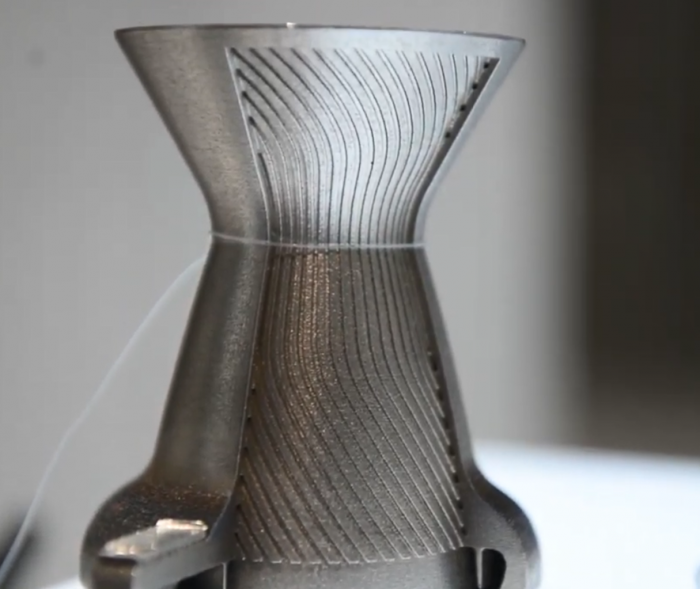
Traditional machining can’t accommodate the complex, lattice‑like cooling channels that modern combustion chambers require. 3D printing can weave these channels into the chamber’s interior in a single print, reducing assembly steps and improving thermal performance.
Lower Production Costs
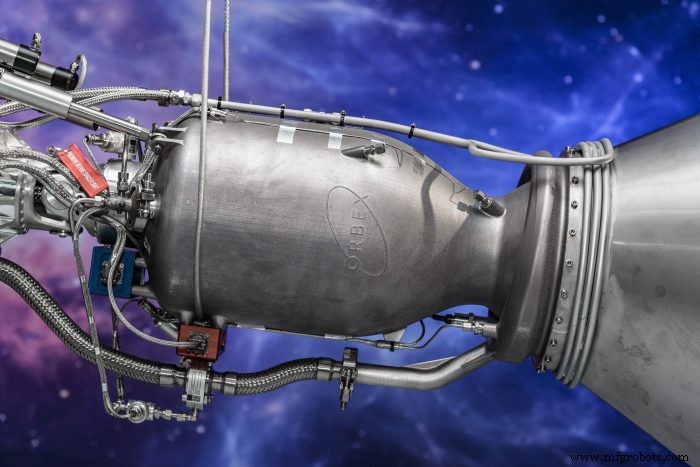
Engines can account for up to 40 % of a launch vehicle’s cost. Additive manufacturing cuts the number of production steps, removes expensive tooling, and reduces labor. For example, Orbex used SLM to 3D‑print an engine for its Prime launcher, cutting turnaround time by 90 % and costs by 50 % versus CNC machining.
SpaceX has embraced SLM for its Draco and Super‑Draco thrusters, producing Inconel combustion chambers that are lighter, stronger, and cheaper to manufacture. Musk notes that 3D printing enables “robust and high‑performing engine parts at a fraction of the cost and time of traditional methods.”
Simplified Assembly
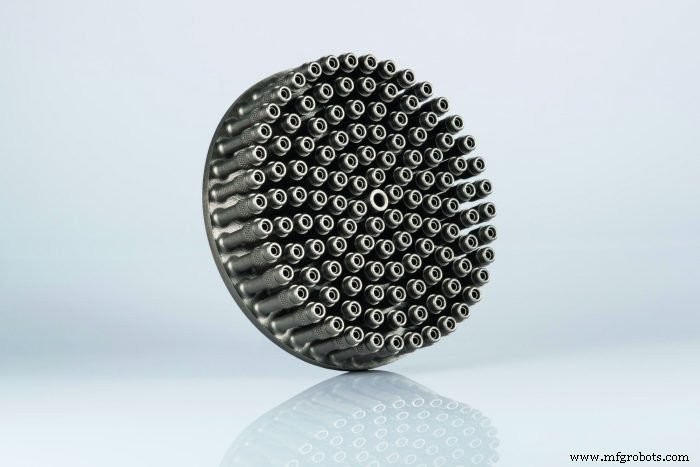
Complex parts that once required dozens of machining and welding steps can now be printed as monolithic components. The German Aerospace Center (DLR) printed a 10 % lighter injector head with a single print, eliminating 30 fastener points and reducing failure risk. EOS re‑engineered an Ariane 6 injector head from 248 parts to one, halving cost and cutting lead times to a third.
Case Studies
Rocket Lab’s 3D‑Printed Rutherford Engine
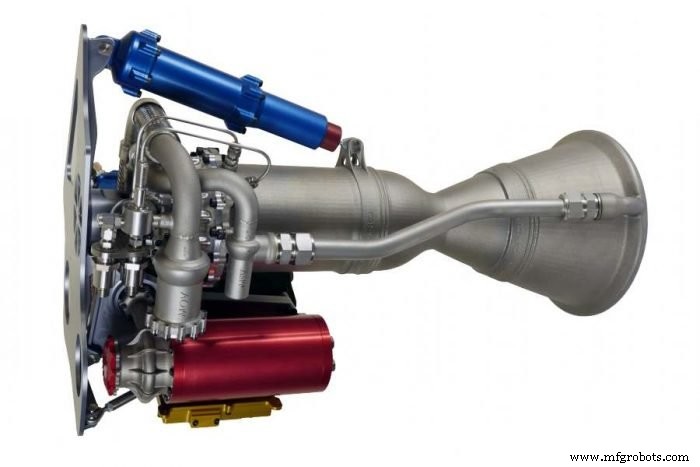
Rocket Lab’s Electron launch vehicle relies on nine Rutherford liquid‑propellant engines, all fabricated with Electron Beam Melting (EBM). Since 2013, the company has printed every major engine component—combustion chambers, injectors, pumps, and valves—resulting in a 100‑unit milestone of 3D‑printed engines and a proven track record of launching four satellites to orbit.
3D Printing Entire Rockets: Relativity Space
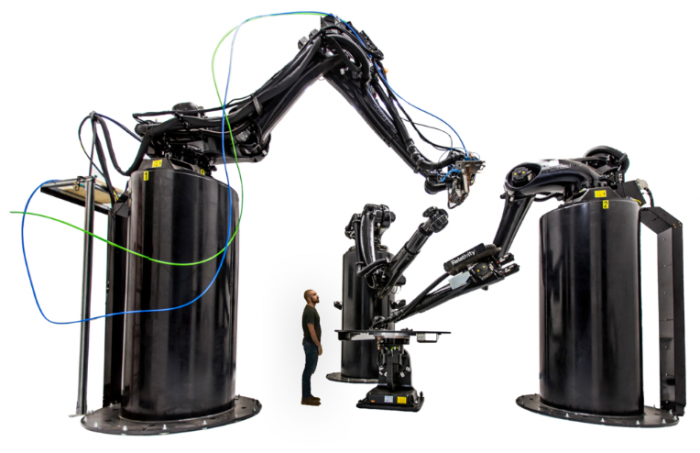
Relativity Space is pushing the envelope with its Terran rocket, which will feature 95 % 3D‑printed parts. Their proprietary Stargate printer—one of the world’s largest DED machines—can print components up to 2.7 m in diameter and 4.5 m tall, covering all major fuel tanks and large structural elements.
By printing virtually the entire rocket, Relativity expects to reduce mass, cut launch costs, and increase payload capacity. The company also plans to shorten the build cycle from raw material to flight‑ready vehicle to under two months, thanks to the rapid design‑to‑print workflow.
The Future of Additive Manufacturing in Aerospace
3D printing has reshaped how rocket engines are conceived, built, and iterated. While the technology is already proving cost‑effective for engine parts, its potential for fully 3D‑printed launch vehicles remains largely untapped. As tooling requirements shrink and material science advances, additive manufacturing will likely become the cornerstone of next‑generation spacecraft, enabling faster innovation and more efficient access to space.
Stay tuned for our next article, where we explore the impact of 3D printing on the footwear industry.
3D printing
- Generative Design & 3D Printing: Building Tomorrow’s Manufacturing
- Application Spotlight: 3D Printing Transforms Bike Manufacturing
- 3D Printing Revolutionizes the Rail Industry: Case Studies & Benefits
- 3D‑Printed Eyewear: From Prototyping to Customization—Industry Trends & Case Studies
- 3D‑Printed Brackets: Optimizing Strength, Weight, and Production Efficiency
- How 3D Printing Is Transforming Manufacturing, Healthcare, Aerospace, and Education
- How Automation is Shaping the Future of Digital Manufacturing
- How 3D Printing Will Transform Manufacturing in the Next Decade
- How 3D Printing is Revolutionizing Modern Manufacturing
- 4D Printing: Revolutionizing Additive Manufacturing for Adaptive Solutions