



Five Transformative 3D Printing Business Models and Their Real‑World Impact

3D printing is more than a manufacturing tool—it reshapes how companies deliver value, streamline operations, and boost profitability.
This article examines five powerful 3D‑printing‑enabled business models, detailing their benefits and real‑world examples.
1. On‑Demand Manufacturing
Balancing supply and demand remains a perennial challenge. Traditional approaches rely on forecasting and inventory, often leading to excess stock or shortages. On‑demand manufacturing flips this paradigm: parts are produced only after a customer confirms a purchase, eliminating the need for large inventories.
3D printing is the enabler—no tooling is required, and small batches can be produced in hours or days rather than weeks. This speed is crucial for industries where downtime costs are high.
Spotlight: Spare Parts
Imagine a customer ordering a replacement part via a manufacturer’s website. Within hours, a nearby 3D‑printing bureau prints the part and ships it directly—or the customer prints it on their own machine, saving on shipping and tariffs.
Fast, on‑demand spare parts increase machine uptime and reduce production disruptions. A practical demonstration involved a Boeing 777‑300 carrying a broken cabin bumper. While the plane was airborne, maintenance in Auckland ordered a replacement from a digital catalogue. A local printer in Los Angeles produced the part in 30 minutes, allowing the aircraft to complete three more flights before returning to Auckland. The traditional lead time of 44 days would have cost approximately $30,000 in lost revenue.
Not all parts benefit equally from on‑demand printing. Research indicates that a hybrid strategy—combining inventory for rarely used parts with on‑demand printing for others—yields an average cost saving of 5% versus full inventory, with potential savings up to 40% in some cases.
2. Manufacturing as a Service (MaaS)
MaaS connects customers with a network of manufacturing facilities, routing orders based on capacity, materials, and location. 3D printing is a core component, enabling rapid, data‑driven production of small batches and one‑offs.
Examples of MaaS Companies Using 3D Printing
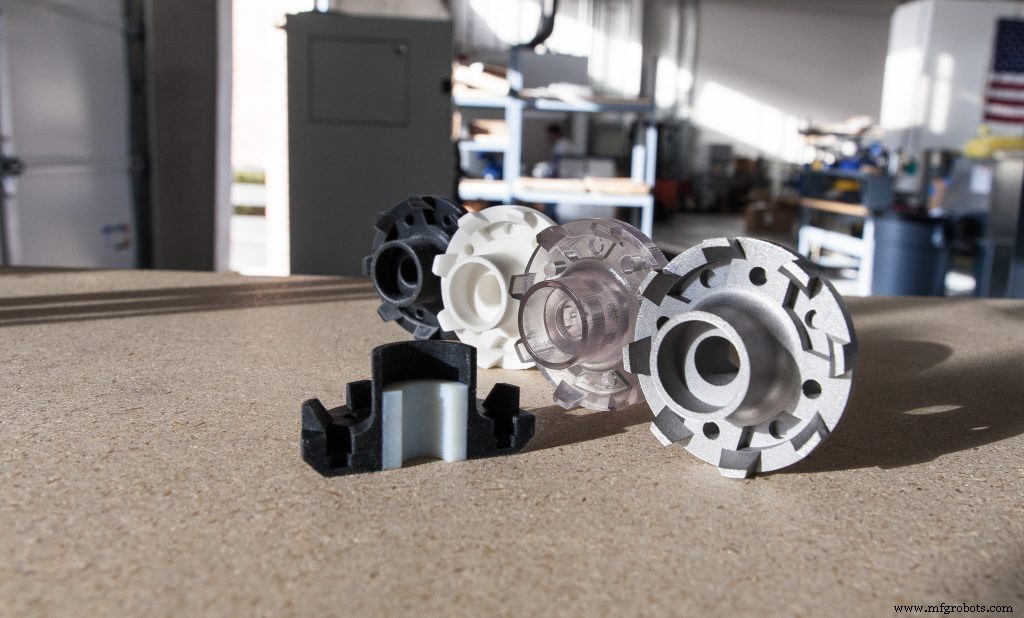
Xometry, a leading U.S. MaaS provider, leverages a partner network of small and medium manufacturers. 3D printing accounts for 15–20% of its end‑use, low‑volume production orders. Techniplas Prime, a U.S. automotive service provider, operates a similar platform and has produced over 40 million parts since 2018.
3. Supply Chain Consolidation
Volatility in global supply chains drives companies to simplify procurement. 3D printing can replace multiple discrete parts with a single, complex component—known as part consolidation—reducing the number of suppliers and the risk of disruption.
How Jabil and GE Use 3D Printing to Consolidate Their Supply Chains
Jabil redesigned a cooling system fan from 73 parts to one additively manufactured unit, streamlining production and supply reliability. GE’s Catalyst Advanced Turboprop engine dropped from 855 parts to just 12 through 3D printing, cutting the supplier count from 10–15 to a single source.
4. Mass Customisation
Consumers now expect products tailored to their preferences. 3D printing turns one‑off, personalised items into a scalable business model without costly tooling.
Creating Personalised Goods with 3D Printing
American Pearl’s “Jewelry Replicator” lets customers upload designs, which are printed in wax, poured with metal, and finished by expert jewelers—delivery in 3–4 days versus competitors’ weeks.
Footwear brand Wiivv uses 3D‑printed insoles mapped from over 200 foot points, while Gillette’s Razor Maker, developed with Formlabs, offers customers custom handle designs that ship within weeks.
5. Direct‑to‑Consumer (D2C) Business Model
D2C brands bypass middlemen, delivering products directly to buyers. 3D printing reduces lead times and tooling costs, enabling rapid product launches.
Gantri’s platform allows designers to prototype and ship 3D‑printed lighting and decor items in about 3 weeks, cutting a typical 18‑month development cycle. In dentistry, SmileDirectClub and Candid produce clear aligners at scale, offering a cost‑effective alternative to Invisalign.
3D Printing Powers New Business Models
By enabling on‑demand production, co‑creation with customers, supply‑chain consolidation, and mass customisation, 3D printing is reshaping operations across industries. Companies that adopt these models will become more agile, responsive, and profitable in the years ahead.
3D printing
- Designing Object Models for 3D Printing: CAD, Scanning, and Photogrammetry Explained
- Topology Optimisation + 3D Printing: Revolutionizing Design and Production
- Assessing the Sustainability of Industrial 3D Printing
- Unlock New Revenue Streams with IXON Cloud: 5 Proven IoT Business Models
- Integrating 3D Printing at Scale: Caterpillar’s Roadmap to Additive Manufacturing Success
- How Quickly Can a 3D Printer Produce Parts? Understanding Print Speed Factors
- A Step-by-Step Guide to Launching Your 3D Printing Project
- Are 3D Printing Pens Safe? A Comprehensive Safety Guide
- Beginner's Guide to 3D Printing: Start with Confidence
- Create a 3D Printing Profile: A Step-by-Step Guide to FDM Success