



Topology Optimisation + 3D Printing: Revolutionizing Design and Production
Additive manufacturing (AM) unlocks unprecedented design and production capabilities for functional parts. To harness this full potential, advanced design tools—particularly topology optimisation—are essential.
Topology optimisation enables the creation of stronger, lighter components. This article examines how combining topology optimisation with 3D printing empowers engineers to rethink design and manufacturing.
What is topology optimisation?
Topology optimisation is a generative design method that uses advanced mathematical algorithms to refine an object's geometry for optimal performance.
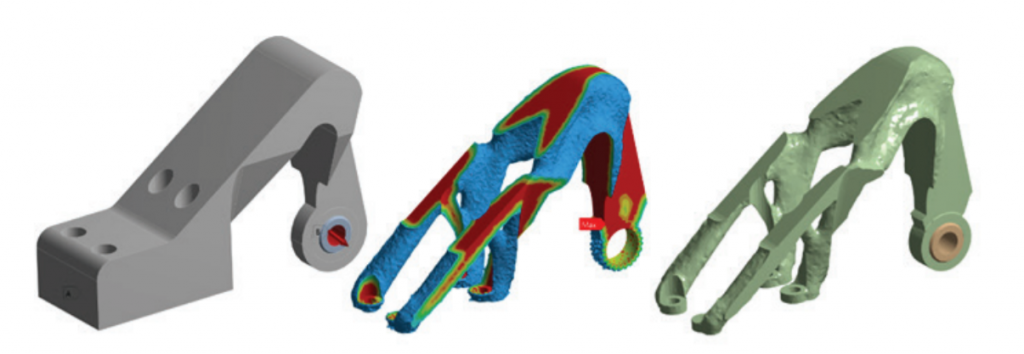
The optimisation process begins by defining the design space—the maximum volume a part may occupy. The software then evaluates the geometry against load, deformation, stiffness, and boundary conditions, pinpointing material that can be removed without compromising functionality or performance. This yields the most efficient structure for the part.
The benefits of topology optimisation
Accelerated design cycles
Topology optimisation software automates iterative design, rapidly converging on an optimised geometry. By embedding performance criteria from the outset, engineers produce innovative solutions faster, shortening the overall design cycle.
Weight reduction and strength enhancement
Removing or redistributing material based on defined parameters allows for lightweight yet resilient structures. Industries such as aerospace and motorsports benefit from significant fuel savings and performance gains. Lower material usage also drives down manufacturing costs.
Combining topology optimisation and 3D printing
Traditional manufacturing methods struggle to realise the complex geometries produced by topology optimisation, often rendering them infeasible or prohibitively expensive. 3D printing—whether selective laser melting, electron beam melting, or binder jetting—produces intricate shapes at scale, making it the ideal partner for optimised designs.
Topology optimisation in practice
Aerospace
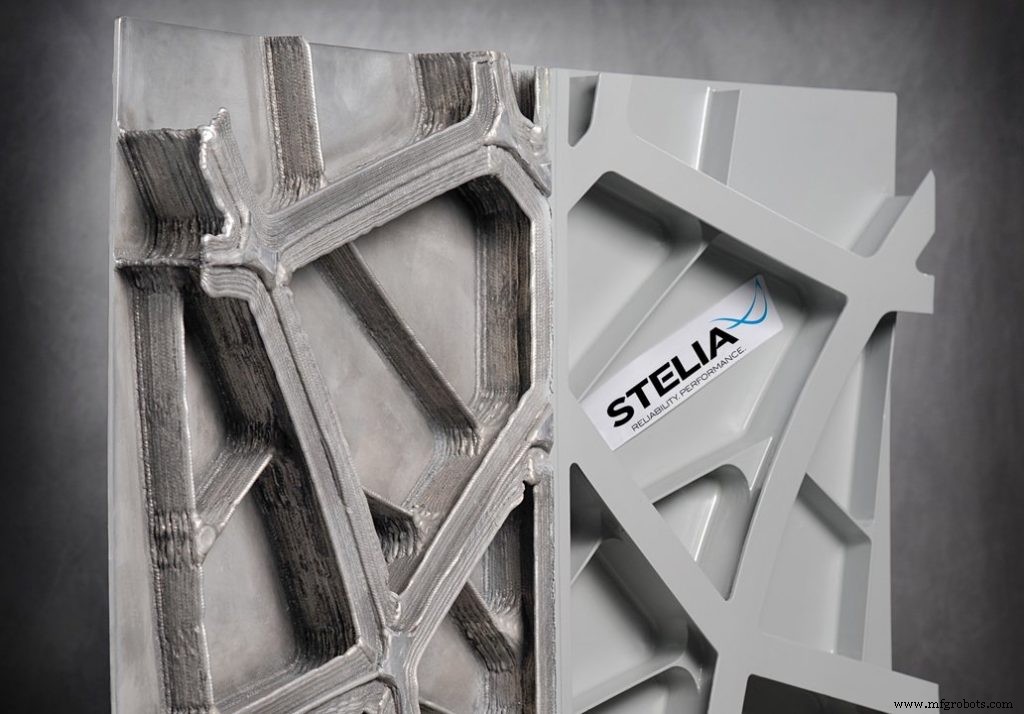
Aerospace leaders are early adopters of topology optimisation, leveraging lighter parts, reduced support structures, and preserved strength to cut launch costs. STELIA Aerospace, for instance, used the technique to design fuselage panels that are both stronger and more stable while generating less material waste.
Medical
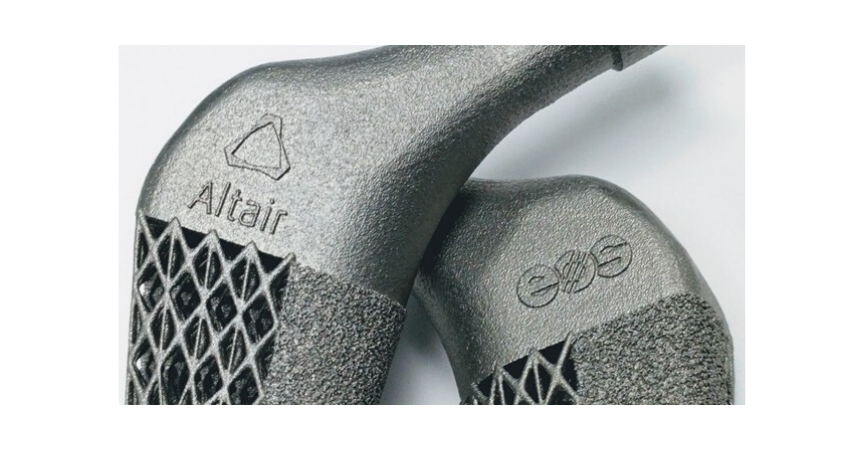
In medical implants, topology optimisation can tailor stiffness and density to match patient bone properties. Altair combined its optimisation engine with 3D printing to produce a hip stem that distributes stress more efficiently and incorporates lattice structures, achieving an endurance limit of ~10 million cycles—enough to sustain long-distance jogging twice.
Automotive
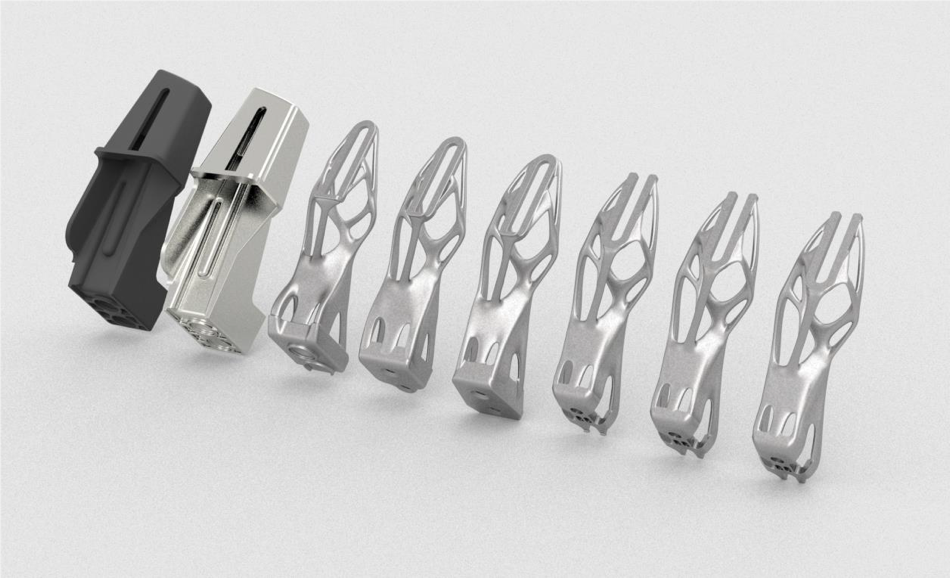
BMW’s 2018 i8 Roadster featured a 3D‑printed metal roof bracket created through topology optimisation. By feeding weight, size, and load parameters into the software, engineers produced a design that was 10× stiffer and 44 % lighter than conventional counterparts—an achievement only possible with selective laser melting.
Topology optimisation software for 3D printing
Altair Inspire
Altair Inspire offers a comprehensive suite of optimisation objectives—stress, displacement, acceleration, gravity, temperature—and respects AM constraints such as overhang limits, enabling truly manufacturable designs.
Ansys Mechanical
Ansys Mechanical integrates topology optimisation with multiphysics simulation, allowing simultaneous consideration of static loads, modal frequencies, and minimum material thickness, all while providing quick validation tools.
ParaMatters CogniCAD
CogniCAD delivers an automated workflow powered by in‑house topology optimisation, high‑resolution finite element analysis, and computational geometry, with a full range of loading conditions and design constraints tailored for additive manufacturing.
nTopology nTop Platform
nTopology’s nTop Platform applies multiple load cases and optimises for stress, displacement, and stiffness. It then converts optimisation results into editable geometry automatically, saving engineers time on manual reconstruction.
Topology optimisation: a new design paradigm
Advancements from both established vendors and innovative startups have propelled topology optimisation into mainstream use across aerospace, automotive, medical, and beyond. The resulting design freedom, faster cycles, and superior part performance signal a clear shift toward more sustainable, high‑performance manufacturing. As the technology matures, new applications and capabilities will continue to emerge, reshaping the future of design.
3D printing
- Generative Design & 3D Printing: Building Tomorrow’s Manufacturing
- AMendate’s CEO Thomas Reiher on Revolutionizing 3D Printing with Automated Topology Optimization
- Five Transformative 3D Printing Business Models and Their Real‑World Impact
- Revolutionizing Food & Beverage: How 3D Printing Drives Innovation and Efficiency
- Virtual Reality Revolutionizes Design: From Immersive Modeling to Rapid 3D Printing
- 3D Printing: Transforming Everyday Life Through Rapid Design, Production, and Repair
- Designing Parabolic, Hyperbolic & Elliptical Reflectors for 3D Printing: A CAD Guide
- Unlocking the Future: Challenges and Opportunities in 3D Printing & Additive Manufacturing
- Top 3D Printing & Design Online Courses: Free & Paid Options
- Mastering 3D Printer Flow: Definition, Significance, and Calibration Tips