Industrial manufacturing
Industrial Internet of Things | Industrial materials | Equipment Maintenance and Repair | Industrial programming |
home  MfgRobots >> Industrial manufacturing >  >> Manufacturing Technology >> 3D printing

2021 3D Printing Industry Statistics: 40+ Insights on Growth, Adoption, and Market Dynamics

A snapshot of 40+ 3D printing statistics that illustrate the current market dynamics and future trajectory.

3D printing is no longer a niche prototyping tool; it is reshaping manufacturing workflows worldwide. To keep pace, stakeholders must stay informed with up‑to‑date data. The following statistics highlight recent growth, sectoral adoption, and evolving applications.

Current State of the Industry

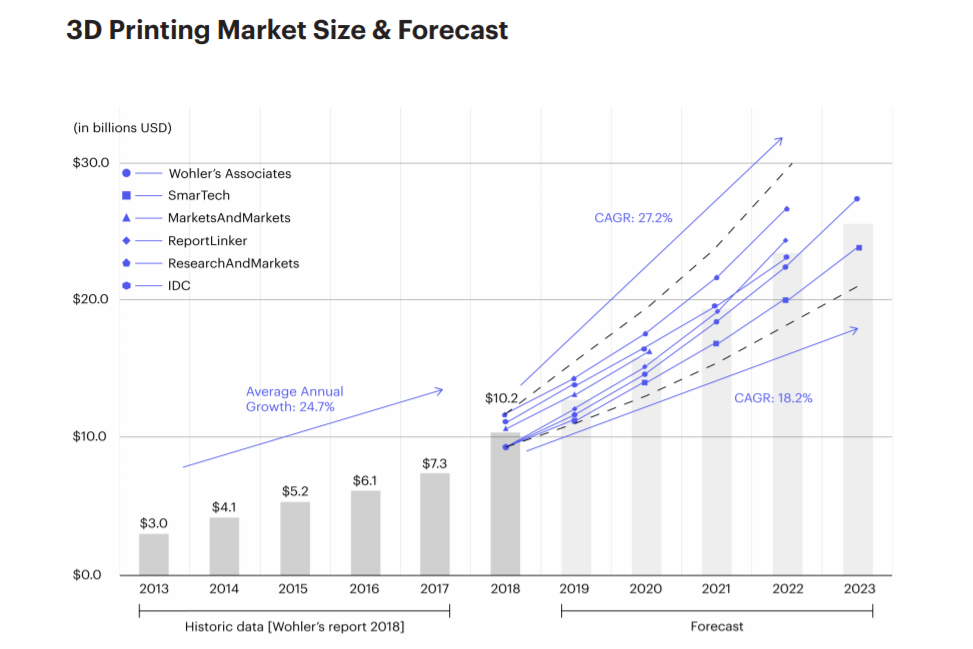
The additive manufacturing market has moved from a fringe technology to a core part of the manufacturing ecosystem. In 2019, global revenue surpassed $10.4 billion, crossing the double‑digit billion threshold for the first time in almost four decades (SmarTech Analysis, 2020 Additive Manufacturing Market Outlook). VC investment in 3D‑printing start‑ups exceeded $300 million in 2018, with a clear focus on industrial solutions (Hubs, 2019 Trends Report). Analysts now project the market to double in size every three years, with growth rates between 18.2 % and 27.2 % annually (Hubs, 2019 Trends Report). Yet, 71 % of companies cite knowledge gaps as the biggest barrier to adoption, and 29 % lack confidence in reliability (Jabil, 2019 Stakeholder Survey). System manufacturers dominate the player landscape at 38 %, while service providers are rising fast at 34 % (EY, 2019 Global Report).

2021 3D Printing Industry Statistics: 40+ Insights on Growth, Adoption, and Market Dynamics

Adoption

Different sectors and regions are embracing 3D printing at varying paces. Aerospace, medical, automotive, and industrial goods lead in maturity, while North America and Europe currently dominate, though Asia is rapidly closing the gap.

  • Footwear 3D‑printing revenue comprised only 0.3 % of the global footwear market in 2019 (SmarTech Analysis).
  • The orthopaedics 3D‑printing market grew to $691 million in 2018 and is projected to reach $3.7 billion by 2027 (SmarTech Analysis).
  • Medical 3D‑printing—including materials, services, software, and hardware—is now worth $1.25 billion (SmarTech Analysis).
  • 3D‑printed dentistry revenue is expected to hit $3.7 billion in 2021 and dominate dental restoration production by 2027 (SmarTech Analysis).
  • The USA, UK, Germany, France, and China top the list for adoption and investment (Ultimaker, 3D Printing Sentiment Index).
  • Germany generated €1 billion in AM‑related revenues in 2019 (Ultimaker).
  • The U.S. leads with 422,000 3D printers worldwide (Ultimaker).
  • Companies with in‑house AM systems grew from 9 % in 2016 to 40 % in 2019 (EY, 2019 Global Report).
  • Over 70 % of enterprises identified new applications for 3D printing in 2019, and 60 % used CAD, simulation, and reverse engineering internally (Sculpteo, 2019 Report).

Applications

While prototyping remains dominant, full‑scale production is gaining traction. The following data underscore this shift.

  • Proof‑of‑concept and prototyping were the leading 3D‑printing applications in 2019 (Sculpteo, 2019 Report).
  • Manufacturers using 3D printing for production parts doubled from 21 % in 2018 to 40 % in 2019 (Essentium, 2019 Survey).
  • 79 % of surveyed companies anticipate their use of 3D printing for production parts to at least double in the next 3‑5 years (Jabil, 2019 Survey).
  • In aerospace and defence, prototyping (72 %), repair (44 %), R&D (43 %), and production parts (39 %) are the most common uses (Jabil, 2019 OEM Survey).

Hardware

The hardware segment is evolving rapidly, with metal and polymer systems leading in adoption and performance.

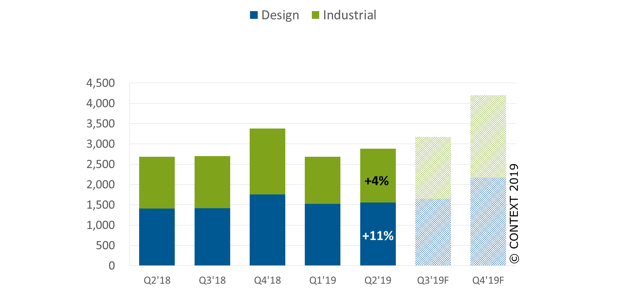
  • Metal 3D printer shipments are projected to grow at over 49 % year‑on‑year (CONTEXT).
  • The metal AM hardware segment is expected to generate nearly $4 billion by 2024 (AMPOWER, 2019 Report).
  • German suppliers supply 62 % of all installed PBF metal AM systems worldwide (AMPOWER).
  • Material costs account for 20‑40 % of part costs in PBF processes, 70‑80 % in powder‑based DED, and up to 80 % in wire‑arc deposition (AMPOWER).
  • The global metal AM market was valued at €1.51 billion in 2018, with a 25 % CAGR (AMPOWER).
  • PBF accounts for 80 % of all metal AM system installations globally.
  • Sales of compact industrial metal printers are expected to exceed $1 billion by 2027.
  • Polymer AM systems are used by 72 % of companies, compared to 49 % for metal systems (EY, 2019 Global Report).
  • HP’s Multi‑Jet Fusion has produced over 10 million parts in 2018 (HP, 2018 Report).
2021 3D Printing Industry Statistics: 40+ Insights on Growth, Adoption, and Market Dynamics

Materials

Materials development is a key driver of market expansion, with prices gradually falling while performance rises.

  • The AM materials market was valued at $1.5 billion in 2019 (SmarTech Analysis).
  • 99 % of manufacturing executives believe an open ecosystem is essential for scaling 3D printing (Ultimaker).
  • Plastics remain the most used material at 82 %, followed by carbon fibre (24 %) and composites (20 %) (Ultimaker).
  • The polymer AM segment grew to an estimated $5.5 billion in 2018 (SmarTech Analysis).
  • Polymer PBF material sales exceeded $400 million in 2018 (Wohlers Report 2019).
  • The ceramic materials market is projected to rise from $20 million in 2020 to over $450 million by 2029 (SmarTech Analysis).
  • 94 % of companies report that designers choose traditional manufacturing due to a lack of additive materials (Jabil, 2019 Survey).

Software

Although smaller than hardware and materials, software is critical for design, simulation, and workflow optimization.

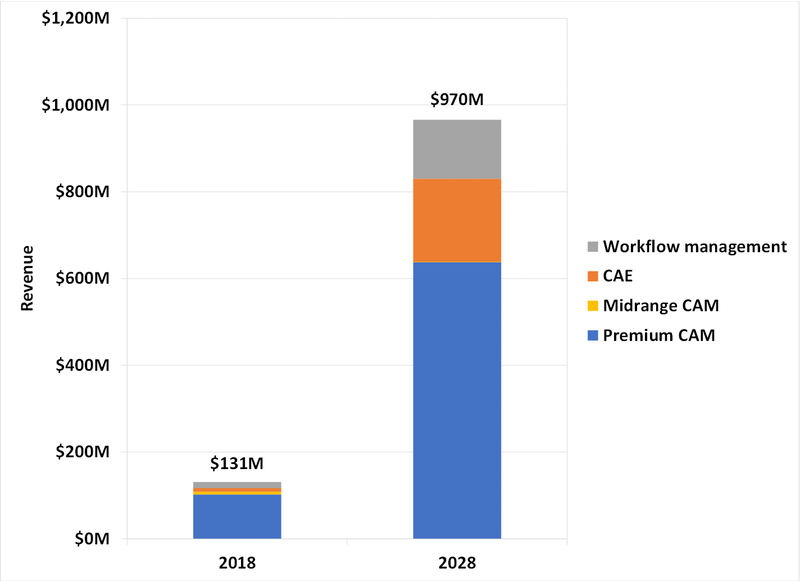
The software segment was modest in 2018 but is poised to reach a $1 billion opportunity over the next decade.

2021 3D Printing Industry Statistics: 40+ Insights on Growth, Adoption, and Market Dynamics

Post‑Processing

Post‑processing can add 17 % to 100 % to production time, underscoring the need for automation.

  • 66 % of companies face multiple post‑printing challenges (PostProcess Technologies, 2019 Survey).
  • Length of time to finish parts is the key challenge for 75 % of respondents; 51 % cite consistency issues (PostProcess Technologies, 2019 Survey).

Service Bureaus

Service providers play a crucial role, especially for SMEs and those lacking in‑house expertise.

  • SMEs account for more than 75 % of customers using online 3D printing services (Hubs, 2019 Trends Report).
  • Consumer goods is the most served industry (77 %), followed by automotive (75 %) and industrial goods (73 %) (AMFG, 2019 Report).
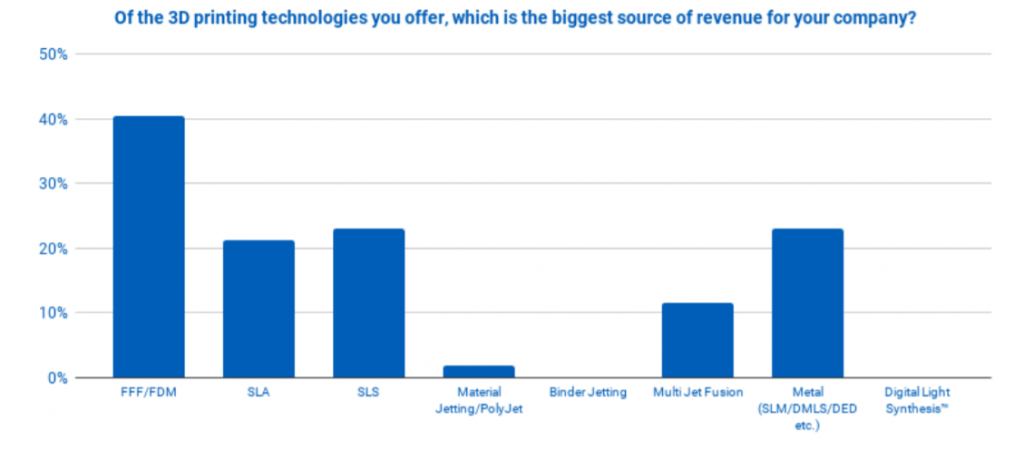
  • FFF/FDM, SLA, and SLS are the most common technologies offered by service providers (AMFG, 2019 Report).
  • 37 % of providers produce 1,001–10,000 parts annually; 25 % produce 10,001–50,000 parts (AMFG, 2019 Report).
  • Use of service providers has tripled from 8 % in 2016 to 26 % in 2019 (EY, 2019 Global Report).
  • 81 % of companies cite reluctance to invest in their own systems as a primary reason for partnering with service providers; 48 % cite unfamiliarity with AM processes, and 38 % uncertainty around AM design (EY, 2019 Global Report).
2021 3D Printing Industry Statistics: 40+ Insights on Growth, Adoption, and Market Dynamics

Looking Ahead

The 3D printing industry continues to mature, driven by technology breakthroughs, material innovation, and expanding market reach. Overcoming knowledge gaps, ensuring reliability, and making the technology accessible to SMEs will accelerate adoption. With industry stakeholders investing heavily and capabilities improving, the impact on manufacturing over the next decade promises to be transformative.

2021 3D Printing Industry Statistics: 40+ Insights on Growth, Adoption, and Market Dynamics

3D printing

  1. 6 Essential Insights About 3D Printing You Probably Haven’t Heard
  2. Polylactic Acid (PLA) 3D Printing: A Comprehensive Guide for Professionals
  3. Why ABS is the Premier Thermoplastic for 3D Printing: Benefits, Limitations & Expert Tips
  4. Nylon 3D Printing: Expert Guide to Materials, Tech, and Applications
  5. Master Polymer 3D Printing: Latest Technologies, Innovations & Applications in 2021
  6. Mastering Post‑Processing in Industrial 3D Printing: Emerging Trends and Solutions
  7. Revolutionizing Rail Operations: Key Equipment Innovations You Need to Know
  8. Simplify Custom Car Parts with 3D Printing: Your Comprehensive Guide
  9. Is 3D Printing Safe? Expert Guide to Avoiding Toxic Emissions
  10. CNC Machining in Energy Production: 3 Key Insights for Industry Professionals