



Additive Manufacturing: How 3D Printing Cuts Production Costs & Boosts Efficiency
Over the last five years, 3D printing has evolved dramatically. Today, printers are widely available, cost‑effective, and business teams are increasingly fluent in the technology. It has earned its place as a bona fide manufacturing discipline and continues to make headlines.
The first 3D‑printed house went on sale this year, and beyond a myriad of consumer goods, 3D‑printed items are now integral to sectors ranging from renewable energy to healthcare. While the excitement often centers on end‑part applications, the true value often lies right on your production floor—optimizing tools and processes to cut costs.
Think small, save big
Additive manufacturing shines in complex end‑part production, yet the most immediate gains frequently come from refining existing manufacturing steps. A well‑designed 3D‑printed component can unlock cost savings and efficiency without needing to redesign the entire product.
For teams entrenched in intricate traditional production lines, this offers a surprising yet welcome relief. Lines often feature tens of thousands of grippers, brackets, and other components—each a potential candidate for additive optimization. AM does not aim to replace conventional manufacturing but to enhance it, reducing costs on injection‑molding, assembly, and bottling operations while delivering additional benefits.
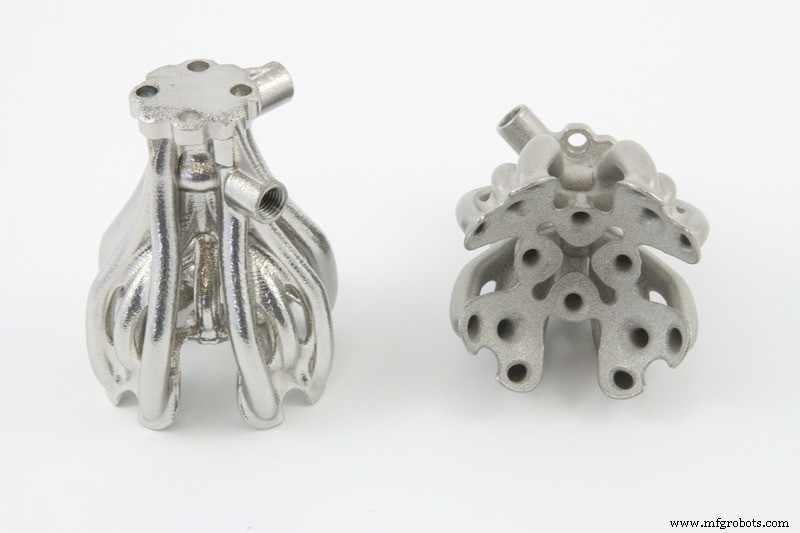
Small changes to your production, like this redesigned suction gripper, can create significant positive impacts.
Costs halved for humble jig at Volvo (plus added benefits)
Take Volvo Car Gent, for instance. Half of Volvo’s annual car output is produced here, with roughly 57 vehicles leaving the line each hour. Speed is critical, but precision is equally essential, especially when three distinct ranges—and multiple models within each—share the same line.
Each car requires unique branding—logo, model number, and other markings—applied swiftly and without damaging paint. Historically, this was achieved with a variety of cumbersome gluing jigs: heavy, delicate, and expensive. Moreover, a new jig could take six weeks to arrive if one broke.
Such production‑line tools are prime candidates for additive solutions. The key is that the jig need not be fully 3D‑printed; a hybrid approach often delivers the best cost performance.
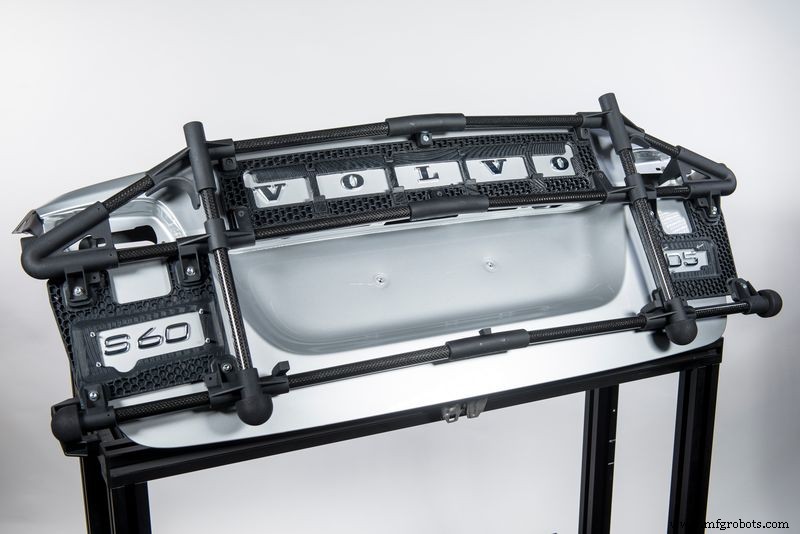
This jig has 3D‑printed components and costs 48% less than the traditional jig.
Materialise’s team re‑examined the jig and discovered it could be built from a mix of off‑the‑shelf and 3D‑printed parts. They began with standard carbon tubing for the frame—light, durable, and readily available—then added 3D‑printed connection points, pads, and buffers. Each element was fabricated from the most suitable material, resulting in a jig that was 48% cheaper overall.
But cost savings come in many guises
While the hybrid jig improved Volvo’s speed and accuracy, the benefits extended beyond the initial cost reduction. The new jig was almost two‑thirds lighter, enhancing operator safety and reducing the likelihood of mistakes. Shorter lead times lowered downtime risk and diminished the need to hold spare jigs on site. Thus, a cheaper tool delivered savings across quality, safety, and supply‑chain dimensions.
More long‑term benefits
Volvo’s jig demonstrates a direct cost improvement, but additive manufacturing can also yield lasting value. In 2017, Signify (then Philips Lighting) approached Materialise to explore whether 3D printing could reduce failure rates of components on their assembly line. The collaboration produced a re‑engineered lamp‑holder bracket and suction gripper that operated continuously for four years without a single break, saving about €89,000 annually.
This example illustrates how the true cost driver is not the part’s price but the maintenance it eliminates. Over four years, Signify saved over €250,000, all from a pair of small, palm‑sized components.
Cutting costs through innovation
Pushing the boundaries of 3D printing for end products is essential, yet the most immediate opportunities often lie in enhancing existing production lines worldwide. These lines are brimming with humble parts that can be re‑engineered today to lower cost and footprint.
Volvo Car Gent’s experience shows that even a single component—such as a lighter, cheaper jig—can transform the entire production mindset, driving savings and fostering a culture of continuous improvement from the inside out.
3D printing
- How 3D Printing Drives Innovation, Efficiency, and Customization in the Automotive Industry
- Scaling Serial Additive Manufacturing: How Additive MES Drives Efficiency and Growth
- Cutting 3D Printing Material Costs: Unlocking ROI and Sustainability
- Scaling Additive Manufacturing: How MES Software Drives Production Growth
- Overcoming the Top 10 Additive Manufacturing Challenges for Production in 2020 – Expert Insights
- Manufacturers' Guide to Cutting Production Waste: Proven Strategies & Tools
- Additive Manufacturing Explained: From Design to Finished Part
- Cutting Automotive Production Costs: Proven Strategies for OEMs & Tier Suppliers
- Unlock Production Value with OEE: Boost Efficiency & Continuous Improvement
- How Additive Manufacturing Is Revolutionizing Industrial Production