



How to Get Started with 3D Printing for Maximum Business Impact
While 3D printing resources are plentiful, newcomers often feel overwhelmed by the sheer range of possibilities. By learning from seasoned experts, you can cut through the noise and unlock the technology’s most powerful advantages for your business.
Below is a concise roadmap to help you begin your 3D printing journey, highlighting the core benefits that have already reshaped industry leaders.
Freedom of Design
3D printing removes the constraints of traditional manufacturing, allowing you to design parts solely around performance. This freedom leads to lighter, stronger components and often consolidated assemblies.
For example, Philips collaborated with Materialise to rethink a lamp‑holder bracket and a suction gripper. By consolidating four separate parts into a single, lightweight design, they now save approximately €89,000 annually. The redesign was driven by a co‑creation process that focused on functional requirements rather than manufacturability limits.
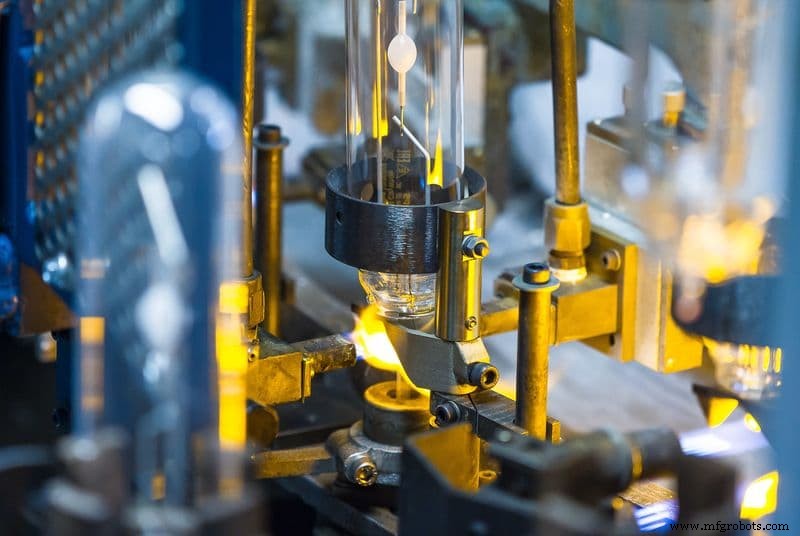
Philips is saving €89,000 a year after re‑engineering parts with Materialise, prioritizing function over traditional manufacturing constraints.
Shorter Supply Chains
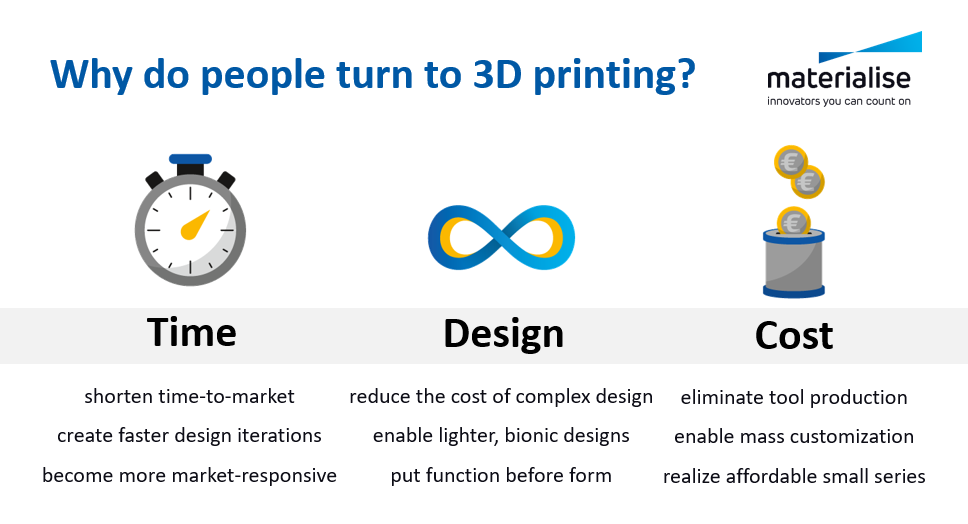
Eliminating tooling costs means fewer steps between concept and finished product. Shorter supply chains reduce inventory, enable digital warehousing, and cut transportation expenses.
Volvo Car Gent, which produces half of Volvo’s vehicles, partnered with Materialise to create a gluing jig that weighs 64% less, is delivered in just two weeks, and costs nearly half the price of the original jig.
Fast Time‑to‑Market
On‑demand manufacturing accelerates product launches and eliminates unsustainable inventory. The result is a more agile, cost‑effective production cycle.
Koiwai, a Japanese metal part producer, transitioned from wooden molds to 3D‑printed sand molds. With Materialise’s expertise, they cut casting lead time from ten days to just one—a 90% reduction.
Revolutionary Innovation
Digital warehouses empower companies to explore industry‑disruptive concepts. HOYA leveraged 3D printing to offer bespoke eyewear, scanning each customer’s face to create perfectly fitted glasses—no excess inventory, no costly tooling.
“AM allows us to react better to changing market needs.”
- Félix España, Global New Media Manager, HOYA Vision Care
It’s Not All or Nothing
Integrating 3D printing doesn’t require a wholesale shift. Many firms embed additive manufacturing at multiple stages—from prototypes to production tools—while retaining traditional processes where they still excel.
Vivien Cheng, Head of Product Development at Samsonite Europe, explains: "Today, we use 3D printing for visual prototypes, proofs of concept, functional prototypes, and production line tools. Even with high weekly volumes, we partner with Materialise for cost efficiency, flexibility, and access to cutting‑edge technology."
“3D printing helps us get the right design on the market fast—while meeting the high standards our customers expect.”
- Vivien Cheng, Head of Product Development, Samsonite Europe
In a rapidly evolving market, 3D printing can unlock hidden value across your value chain. A technology‑neutral partner like Materialise can help you decide which stages to adopt, whether to set up in‑house or outsource, and how to align design and production for maximum ROI.
Ready to explore the possibilities? Download our whitepaper for an in‑depth look at 3D printing’s role in Industry 4.0 and how it can solve your toughest challenges, or contact us directly to discuss a custom solution.
3D printing
- Getting Started with Python: Install, Run, and Write Your First Program
- Launching Your Manufacturing Business into E‑Commerce: A Practical Guide
- Master International Shipping: A Practical Guide for Retailers & Manufacturers
- Begin Your Industry 4.0 Journey: A Practical Guide
- Master Edge AI Inferencing: A Practical Guide to Actionable Insights
- Optimize 3D-Printed Parts with Generative Design: A Practical Guide
- Beginner’s Guide to Yaskawa Motoman Robot Programming: Boost Speed & Accuracy
- Beginner’s Guide: Setting Up RoboDK on Raspberry Pi
- Beginner's Guide to 3D Printing: Start with Confidence
- Achieving High-Quality All-Metal Parts with 3D FDM Printing