



Yuniku: The First Vision‑Centric 3D‑Printed Eyewear That Transforms Sight and Style
Choosing glasses is more than a fashion decision; the shape, size and positioning of your frames directly influence how your lenses work. With Yuniku, a partnership of HOYA Vision Care, Materialise and Hoet Design Studio, we’ve engineered the world’s first vision‑centric 3D‑printed eyewear that places your visual performance first while still delivering style and comfort.
We achieved this by fusing HOYA’s expertise in precision lens design, Hoet’s flair for contemporary frame aesthetics, and Materialise’s mastery of 3D‑printing software, scanning and engineering. Yuniku lets you select the style you love, the lens you need, and the exact fit that optimises vision, appearance and comfort. The result is a collaborative tool that transforms the way you and your optician create a pair of glasses that look great and perform brilliantly.
Vision‑centric eyewear starts with pinpointing the optimal lens position for your eyes. The frame is then engineered around that position to preserve precision. Felix España, Global New Media Manager, Vision Care, HOYA
Vision‑Centric Eyewear: How Yuniku Works
The Yuniku journey begins like any visit to an optician: you browse a curated collection and choose the frame that speaks to you. From there, you enter a new era of bespoke eyewear that marries cutting‑edge technology with unparalleled comfort.
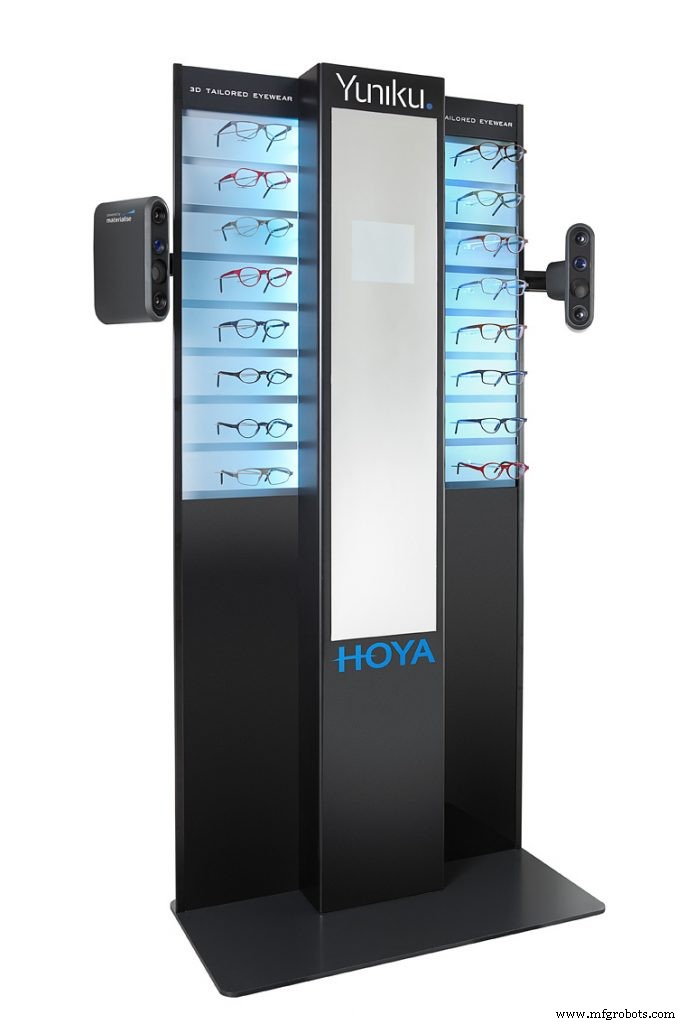
Your experience is launched by the Yuniku scanning station—powered by Materialise—that captures your unique facial geometry and visual requirements to build the perfect pair of glasses.
What appears as a simple display case is, in reality, the gateway to clearer, more comfortable vision. Once you step into the station, you’ll follow these four stages:
1. A high‑resolution scan records the contours of your nose, ears and other facial features that influence frame fit and comfort.
2. You complete a short questionnaire about your visual habits—work, home, sports, driving—so the system tailors the lens prescription and placement to your lifestyle.
3. HOYA’s advanced software calculates the precise lens location for optimal vision, then passes this data to Materialise, which customises the frame geometry to match your face.
4. With your optician, you tweak the frame’s shape, color and style—transforming “I’d love these glasses, but could they be a touch smaller and in green?” into a perfect pair—while the integrated software safeguards both visual precision and fit.
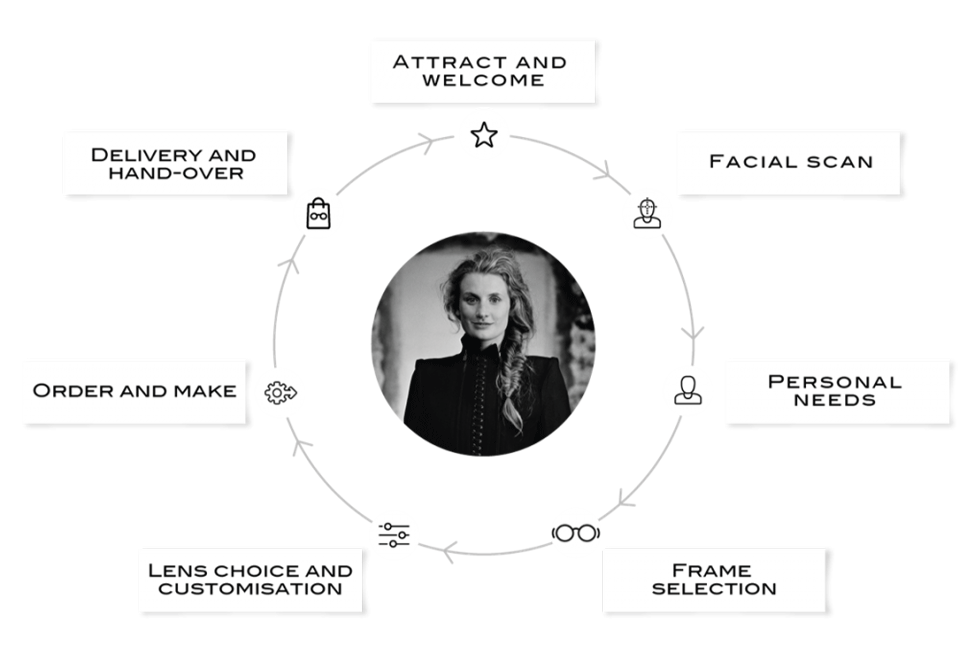
The customer's journey to personalized vision care
Yuniku is not confined to a single brand. As an open platform, it can be deployed in any optical store, enabling a growing roster of designers—beginning with the esteemed Hoet Design Studio—to bring their frames into the vision‑centric workflow. For Bieke Hoet, it is a chance to translate high‑performance luxury eyewear into everyday clinical practice.
As an eyewear designer, I’ve long seen the transformative power of 3D printing. Yuniku amplifies that potential, allowing us to share it globally.
Bieke Hoet, Hoet Design Studio
Now for the Technical Details
After the digital design is finalized, Materialise’s software suite prepares the file for production—repairing, orienting and slicing for 3D printing. The frames are then produced using laser sintering, a technique certified for eyewear. Post‑production, the Materialise Luxura finishing process transforms the prints into consumer‑grade frames. Finally, at HOYA, lenses are fitted, quality‑checked and mounted precisely, delivering a pair that blends aesthetic appeal with peak visual performance.
“By partnering with HOYA, we’ve built one of the most sophisticated digital supply chains, enabling eye‑care professionals to deliver unmatched service quality,” says Alireza Parandian, Materialise’s Wearable Projects Lead. “We’ve also redefined eyewear manufacturing—creating a single product that unites lens and frame to revolutionise visual comfort.” “With Yuniku, we’re shaping the future of eyewear,” adds Felix España. “It’s truly unique.”
3D printing
- How 5G Will Transform Industrial IoT: Unlocking Faster, Safer, and Smarter Factories
- 5 Cutting‑Edge Additive‑Manufacturing Innovations to Watch at formnext 2021
- Transforming Maintenance Culture: Strategies for Reliability & Accountability
- Step‑by‑Step Guide to Replacing Nozzle Tips on Your Stratasys 3D Printer
- Integrating 3D Printing at Scale: Caterpillar’s Roadmap to Additive Manufacturing Success
- How 3D Printing is Driving Innovation in the Automotive Industry
- Future-Proofing Manufacturers: Strategies for Navigating Global Supply Chain Shifts
- Mastering Lean Six Sigma: A Step‑by‑Step Guide to Implementation
- Turn Failed 3D Prints into Resources: 4 Simple Recycling Methods
- Step-by-Step Guide: Setting Up OpenMediaVault on Your Raspberry Pi NAS