



3D Hubs’ Agata Lovrecich on Scaling Online Manufacturing: Insights into MaaS and 3D Printing Innovation
Digital manufacturing and cloud‑based software have given rise to a new Manufacturing as a Service (MaaS) business model.
Companies offering MaaS provide customers with instant, AI‑powered quotes and rapid turnaround on prototypes and production parts.

Agata Lovrecich, Product Marketing Manager at 3D Hubs
3D Hubs began as a community marketplace where 3D printer owners could sell their services. Today the company has pivoted to serve the industrial manufacturing sector, building a global network of vetted partners.
What is 3D Hubs?
3D Hubs is an online manufacturing platform that empowers engineers to bring ideas to life faster. By automating supplier search, quoting, and order placement, the platform frees engineers to focus on design and testing.
Engineers can upload a CAD file and receive an instant price calculated by our proprietary machine‑learning algorithm. Orders can be placed immediately and delivered within days, depending on technology and material.
Why is the MaaS model beneficial?
Access to manufacturing capacity has historically been a barrier for small firms. MaaS lowers that barrier, giving companies—especially SMEs—instant access to both local and global capacity without the overhead of owning equipment.
Why did 3D Hubs shift to the B2B space?
In 2013 we connected hobbyists with 3D printers. Early adopters were engineers who needed fast prototypes across multiple technologies. To better serve this market, we added CNC machining and injection moulding, transforming from a peer‑to‑peer marketplace to a managed platform that guarantees quality and consistency across our network.
What drives 3D Hubs’ success?
Our growth stems from a skilled team, a timely pivot to the engineering sector, and early investment in robust online infrastructure that scales with demand.
How does 3D Hubs stand out?
We combine a vast network of manufacturing partners with competitive pricing, instant capacity matching, and automation that streamlines the entire order cycle. Exceptional customer support rounds out the experience.
Demand mix: 3D printing vs. traditional methods?
CNC machining currently leads demand, but 3D printing is growing steadily. Many customers already have in‑house printers and only outsource when capacity is exceeded. CNC, in contrast, requires a machine that most offices lack.
Examples of 3D printing beyond prototypes
1️⃣ Design flexibility – A VR headset company used 3D printing to iterate enclosure designs after launch, something impossible with injection moulding. 2️⃣ Complex assemblies – Optisys re‑engineered a 100‑part antenna into a single printed component, cutting nine months of production time, 75 % of startup costs, and 25 % of production costs. 3️⃣ Rapid production – SureFire Electronics saved seven weeks by switching from injection moulding to 3D printing while maintaining material performance.
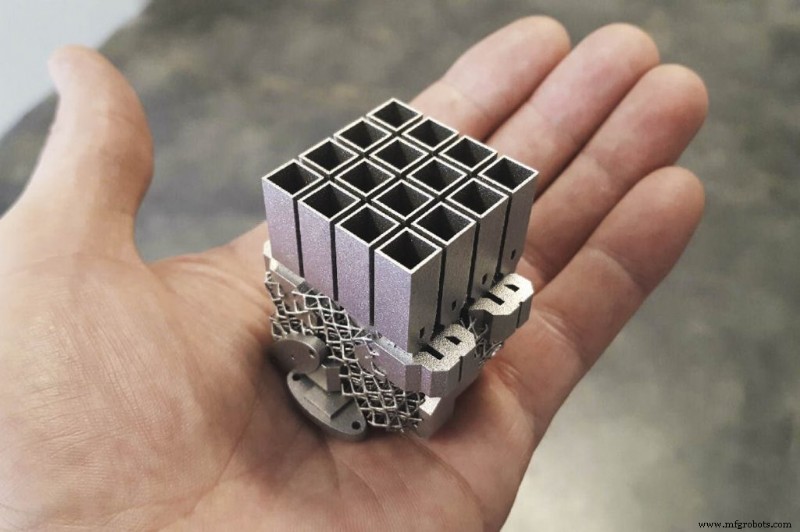
A metal antenna printed via 3D Hubs’ network – Image credit: Optisys
Common misconceptions about 3D printing
• Accuracy – Industrial 3D printers now achieve tolerances close to CNC. • Material properties – New engineering materials often match or surpass traditional alloys. • Replacement vs. complement – 3D printing augments rather than replaces CNC or injection moulding, enabling lean manufacturing across a wider scope.
When to choose 3D printing vs. CNC or injection moulding?
Ask yourself: 1️⃣ Do you need the part urgently? 2️⃣ Are you limited by your current production method? 3️⃣ Do you require post‑production design flexibility? If any answer is “yes,” 3D printing is likely the best choice. Otherwise, CNC or injection moulding may be more appropriate.
Future of 3D printing
Quality will continue to close the gap with conventional methods. As the industry becomes more educated, adoption will accelerate, unlocking new applications and efficiencies.
What’s next for 3D Hubs?
We will deepen our 3D printing capabilities, expand into industrial‑grade technologies, and broaden our material portfolio to better serve engineering‑focused customers.
3D printing
- Choosing Between Nylon and PETG Filaments for 3D Printing: Pros, Cons, and Best Applications
- Dunlop Systems Accelerates Tooling Production with 3D Printing – Insights from Mark Statham
- Imperial College Unveils Desktop Metal Printer Blending Electroplating and Additive Manufacturing
- Gantry Systems in 3D Printing: Benefits, Drawbacks, and Key Considerations
- 3D Printing Revolutionizes Clear Aligners in Digital Dentistry
- Formlabs Tough Challenge Results: Winners, Runners‑Up, and Record‑Breaking Resins
- PLA vs. ABS in 3D Printing: Key Differences and When to Use Each
- Markforged 3D Printing: The Secret Weapon Behind BattleBots Team Valkyrie
- SLA vs. FDM: Comprehensive Comparison & Key Benefits
- How Quickly Can a 3D Printer Produce Parts? Understanding Print Speed Factors