



Digital Integrated Circuits: Foundations and Best Practices
Digital circuits operate on binary levels—either a strict zero or a full‑scale voltage—unlike analog circuits that allow continuous signal variation between supply limits. These discrete signals enable reliable logical operations and computation in modern electronics.
At the heart of every digital system are integrated circuits (ICs), compact networks of transistors, resistors, and capacitors fabricated on a single semiconductor wafer. ICs bring a plethora of pre‑engineered functions to designers at a fraction of the cost and with higher reliability than discrete component assemblies.
Choosing the Right Technology: CMOS vs TTL
CMOS technology dominates today’s digital designs because it supports a wide range of supply voltages while consuming very little power. It also tolerates a broader voltage margin than earlier CMOS families, reducing the risk of damage from occasional voltage spikes.
TTL devices, on the other hand, require a tightly regulated 5 V supply and are sensitive to any deviation from this level. Whenever a TTL chip is used, its power specifications must be clearly marked and strictly adhered to.
Protecting Your Chips: ESD and Handling
Although modern CMOS ICs are more resilient to electrostatic discharge (ESD) than older variants, they remain vulnerable to high‑voltage spikes that can breach MOSFET insulation. Proper handling involves storing ICs in anti‑static foam, using a grounding wrist strap, or frequently touching a grounded object to dissipate charge.
Power Distribution on a Breadboard
Digital circuits often need multiple control signals—such as reset, enable, and disable—as well as dedicated VDD (or VCC) and ground pins. A breadboard with continuous power rails along its length simplifies the connection of these pins, allowing any section of the board to be powered with a single jumper wire.
Most commercial breadboards include these rails, though some models omit them. While not strictly mandatory, rail‑enabled boards significantly reduce wiring complexity for digital projects.
Below is an example of a typical power rail setup on a breadboard:
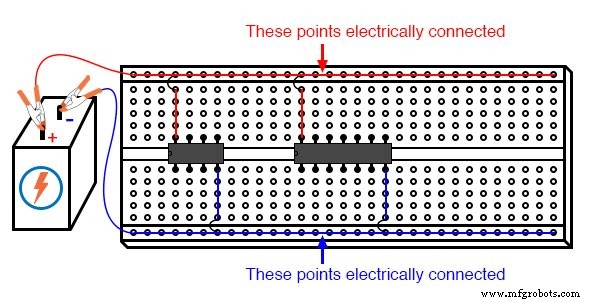
With the power rails in place, connecting VDD and ground to the appropriate IC pins becomes straightforward, enabling you to focus on logic design rather than routing.
Industrial Technology
- Foundations of DC Circuits: Understanding Direct Current and Core Electrical Concepts
- Understanding AC Circuits: A Beginner's Guide
- Discrete Semiconductor Circuits: Foundations and Practical Applications
- Foundations of Analog Integrated Circuits: Concepts, Components, and Practical Applications
- Integrated Circuits: Fundamentals of Digital Logic Gates
- Digital‑Analog Conversion: Fundamentals, ADCs, and DACs
- Rectifier Circuits: From Half‑Wave to Polyphase Full‑Wave Designs
- Power Supply Circuits: Types, Design Principles, and Performance
- Understanding Power in Electric Circuits: Measurement & Significance
- Digital Integrated Circuits: Types & Applications