



DeMorgan’s Theorems: Mastering Boolean Complementation and Gate Equivalence
A foundational concept in Boolean algebra, DeMorgan’s Theorems link the behavior of logic gates when their inputs or outputs are inverted. These rules, named after mathematician Augustus DeMorgan, enable engineers to transform AND, OR, NAND, and NOR gates into one another, simplifying both logic expressions and physical circuit designs.
In Boolean algebra, a “group complementation” is represented by a long bar over multiple variables, indicating that the entire product or sum is inverted. This differs from the prime symbol ('), which can only invert a single variable. For example, (AB)′ is not the same as A′B′; parentheses are essential to signal that the bar applies to the whole product.
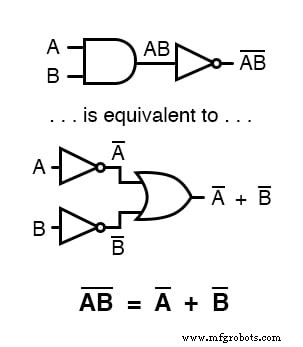
When every input to a gate is inverted, the gate’s core function flips: an OR gate with all inputs inverted behaves identically to a NAND gate, while an AND gate with inverted inputs is equivalent to a NOR gate. DeMorgan’s Theorems formalize this observation by showing that inverting a gate’s output produces the same effect as switching the gate type and inverting its inputs.
Below is a visual illustration of the core equivalence:
When a long bar is “broken” in a Boolean expression, the operation directly beneath the break reverses—addition turns into multiplication and vice versa—while the broken pieces of the bar remain over the individual variables. This subtle rule governs how expressions are simplified.
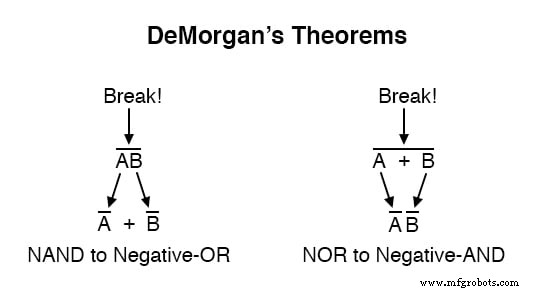
In expressions containing multiple layers of bars, the safest strategy is to break the longest, uppermost bar first. Attempting to break two bars simultaneously can lead to incorrect results.
For instance, simplifying (A + (BC)′)′ proceeds as follows:
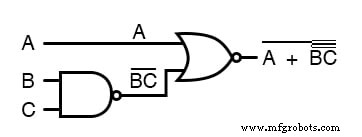
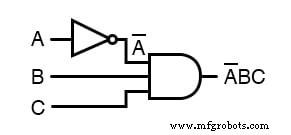
First, we break the outer bar:
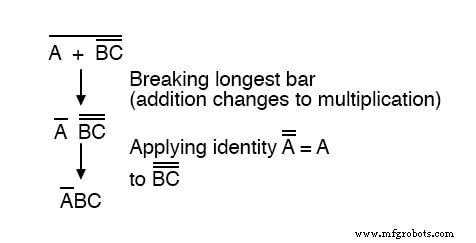
Resulting in a three‑input AND gate with the A input inverted.
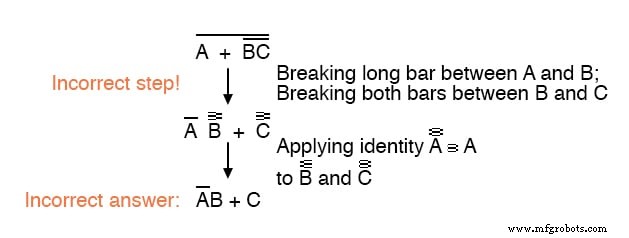
Never break more than one bar in a single step:
Instead, you could first break the shorter inner bar, but this requires an extra step:
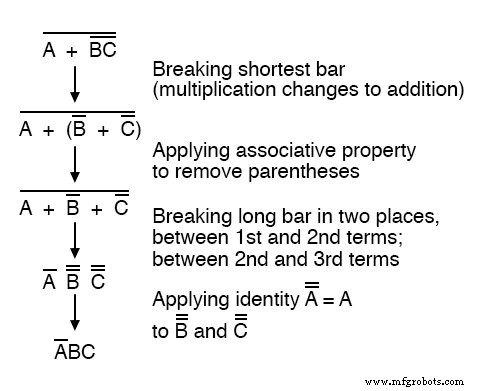
Notice that breaking a bar in multiple places within a single step is permissible; the restriction applies only to breaking multiple distinct bars simultaneously.
Parentheses play a critical role because a bar functions as a grouping symbol. After a bar is broken, the grouped terms must stay together to preserve correct operator precedence.
Consider this expression that demonstrates the importance of proper grouping:

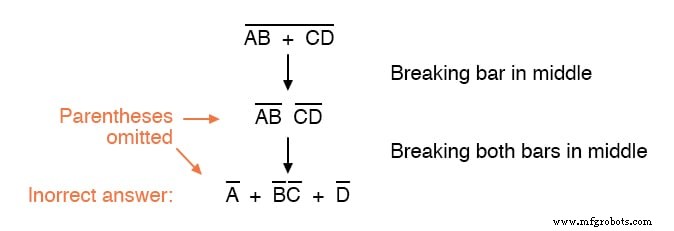
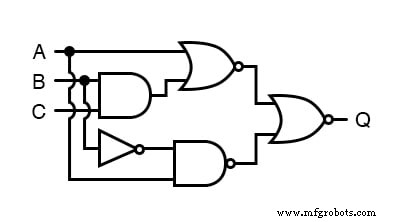
Now let’s apply DeMorgan’s Theorems to a real gate circuit. The first step is to translate the circuit into a Boolean expression by labeling the output of each gate:
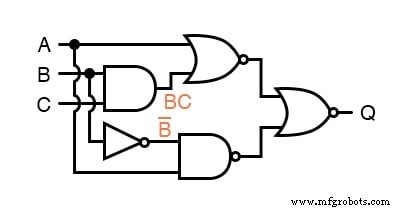
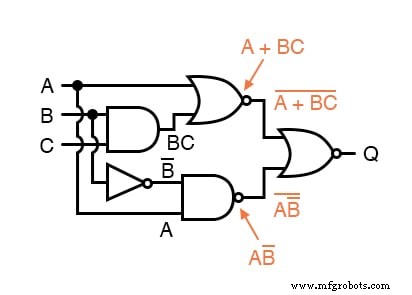
Proceeding systematically, we write the outputs of the first NOR and NAND gates, ensuring the complementing bar is not overlooked by separating the pre‑inversion expression from the final complemented output:
Finally, we express the output of the last NOR gate:
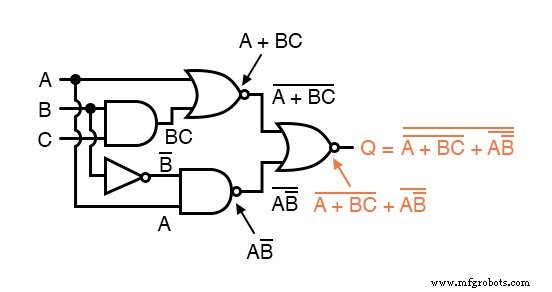
Reducing the resulting expression using Boolean identities and DeMorgan’s Theorems yields a streamlined form:
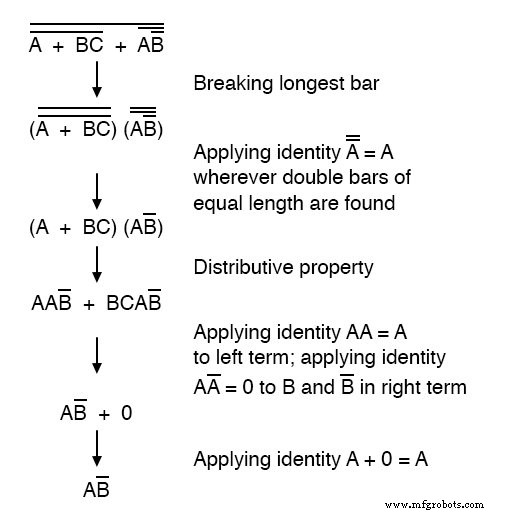
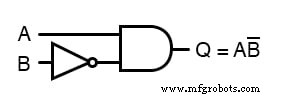
The equivalent, simplified circuit is shown below:
Key Takeaways
- DeMorgan’s Theorems reveal that inverting a gate’s output is equivalent to switching its type (AND ↔ OR) while inverting the inputs.
- Breaking a complementation bar reverses the underlying operation; the broken pieces remain above the affected variables.
- Always break the longest, uppermost bar first and never attempt to break two distinct bars in one step.
- Bars act as grouping symbols; after breaking, maintain proper grouping with parentheses to preserve precedence.
Related Worksheets
Industrial Technology
- Static Electricity Explained: How Rubbing Materials Generates Charge
- Bar Code Scanner: Technology, Design, and Future Trends
- Pathfinder: Arduino UNO Project Kit – Components & Supplies
- Romi CNC 30 G: High‑Volume Bar Cutting Machine with Hydraulic Chuck
- What Is a Bar Joist? Essential for Lightweight Floor and Roof Framing
- Impact Bars Explained: How They Protect and Support Vehicles and Conveyors
- Bar Stock Explained: Types, Sizes, and Manufacturing Applications
- Unit 3: Mastering the Sine Bar for Precise Angle Measurement
- EN AW 6082 Round Bar – Premium Aluminum Alloy for Engineering & Decorative Applications
- Alloy 52 Bar: High-Performance Nickel-Iron Steel with Superior Strength