



Analog and Digital Signals: Foundations of Industrial Instrumentation
Instrumentation is the science and practice of measuring and controlling physical processes such as pressure, temperature, flow, and chemical composition. An instrument—whether a sensor, transmitter, or actuator—captures a physical quantity and either displays or acts upon it.
A signal is any measurable quantity that carries information. Speech, light, and even a simple hand gesture are all signals that transmit meaning from one entity to another.
In this chapter we use the term signal almost exclusively to describe the electrical voltage or current that represents a physical variable for transmission and control purposes.
Analog vs. Digital
An analog signal varies smoothly and continuously, whereas a digital signal changes in discrete steps. A familiar comparison is the classic analog clock with a sweeping hand versus a digital clock that ticks in whole‑second increments. The analog clock can, in theory, display any fractional time value; the digital clock is limited by its resolution (e.g., one‑second steps).
Both forms are used throughout modern electronics, but this discussion focuses on analog signals, which tend to have simpler implementation.
For a concise introduction, watch the introductory video on analog and digital electronics (link).
Because most physical quantities—especially electrical—vary continuously, an analog signal can convey information with virtually unlimited resolution.
Industrial Instrumentation System
Historically, industrial control systems used compressed air as the signaling medium. The transmitter would modulate the air pressure in a pipe to encode a measured variable, and the receiver would interpret that pressure with a gauge or control valve.
For instance, a pneumatic level transmitter measuring water height in a tank would output low pressure when the tank was empty, medium pressure when partially full, and high pressure when full. The corresponding pressure gauge—called a level indicator (LI)—measures that pressure and displays the inferred water level.
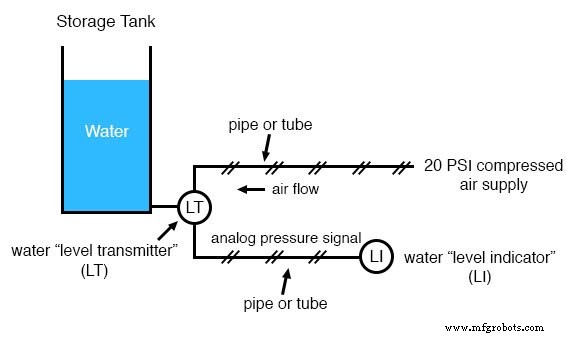
Air‑pressure signals are inherently analog: any change in the process variable translates to a proportional change in pressure. This property made pneumatic systems the backbone of early industrial control due to their simplicity, safety, and robustness.
However, practical limitations—such as dirty or wet air, tubing leaks, and the mechanical complexity of compressors—spurred a shift toward electrical signaling. Solid‑state amplifiers and precise voltage/current references enabled the use of voltage or current as analog signals over thin wires, eliminating the need for bulky compressors and extensive tubing.
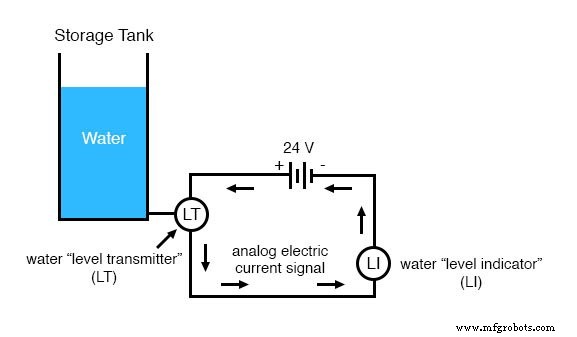
Today, analog electrical signals remain the dominant mode of communication in instrumentation, though digital communication is increasingly common in newer applications.
Live Zero
“Live zero” is a scaling convention that maps the zero‑percent state of a measurement to a non‑zero signal value. This technique provides an immediate visual cue when a system fails or loses signal.
Consider a pneumatic transmitter calibrated from 0 to 12 PSI, where 0 PSI means 0 % and 12 PSI means 100 %. If the system were to lose pressure, the indicator would read 0 %—a legitimate value indistinguishable from a true zero measurement. By shifting the scale to 3–15 PSI (3 PSI = 0 %, 15 PSI = 100 %), a loss of pressure would produce a negative reading (e.g., –25 %), clearly signalling a fault.
Many industry standards adopt live‑zero scaling—such as the widely used 4–20 mA current loop—to enhance fault detection and system reliability.
Review
- A signal is any detectable quantity used to convey information.
- An analog signal can vary continuously, enabling the representation of minute changes.
- Early industrial systems relied on pneumatic signals; modern systems predominantly use electrical voltage or current.
- A live zero scales a signal so that zero percent is represented by a non‑zero baseline, making faults immediately visible.
Industrial Technology
- Binary Signals and Logic Gates: Foundations of Digital Electronics
- Mixed‑Frequency AC Signals: Coupling, Harmonics, and Practical Insights
- Analog vs Digital Sensors: Types, Applications, and Practical Examples
- Analog vs Digital IQ Combining: Selecting the Right Approach for Your RF System
- 8 Proven Methods to Test Capacitors with Digital & Analog Multimeters
- Precise Power Measurement Using Digital and Analog Multimeters
- Accurate Voltage Measurement with Digital and Analog Multimeters – A Step-by-Step Guide
- Measuring AC and DC Current with Digital and Analog Multimeters: A Practical Guide
- Understanding Multimeters: Types, Functions, and Applications for Engineers
- Digital PCBs: The Backbone of Modern Electronic Systems