



Intel’s Stacey Shulman Highlights Edge Insights, Cloud, and AI at MWC Barcelona

Using Intel’s Edge Insights, organizations can accelerate their digital transformation using containers and AI at the Edge, getting valuable insights in near-real-time.
Intel came back to Barcelona to showcase its solutions for different industries, primarily focusing on digital transformation.
During the show, Intel announced two new Xeon D processors: the D-2700 and the D-1700. Those are Intel’s latest CPUs built for the software-defined network and Edge, with integrated AI and crypto acceleration, built-in Ethernet, support for Intel Time Coordinated Computing and Time-Sensitive Networking (TSN), and industrial-class reliability.
Furthermore, Intel showcased its Edge Insights for Industrial platform, which enables industries to leverage the power of Edge Computing to obtain real-time insights and make fast, informed decisions right on-premises.
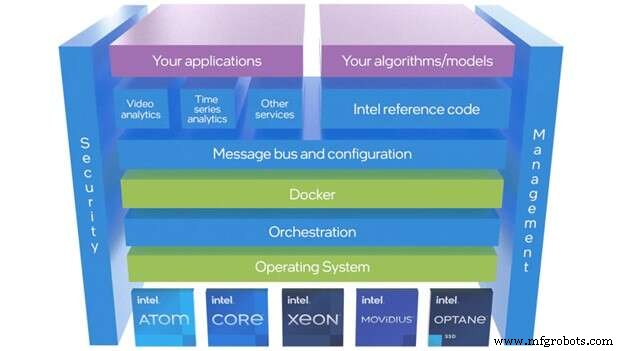
Companies can use the platform to create smart factories and achieve an Industry 4.0 level of production. One example is Audi’s collaboration with Intel on a proof of concept experiment focused on improving the quality-control process for the welds on its vehicles. Together they created algorithms for streaming analytics using the Industrial Edge Insights software. The algorithms resulted in predictive analytics and modeling that transformed factory data into valuable insights. The solution absorbs data from the welding-gun controllers and analyzes it at the Edge.
At the Mobile World Congress, we had the opportunity to talk about the Intel Edge Insights platform, cloud computing, and sustainability with Stacey Shulman, Vice President Network and Edge Computing Group at Intel.
You can watch our interview with Stacey Shulman below. A full transcript, edited for clarity, follows after the video.
IoT Times: Good morning, Stacey. Thank you for your time. I understand this is your first time at MWC.
Stacey Shulman: It is. I’m finding that it is all about network operators and then understanding new cases at the Edge.
IoT Times: Now, many industries are going through massive digital transformations. Today, what is your view about the applications in different sectors, especially for traditional ones that have just started or are moving aggressively in their digital transformation?
Stacey Shulman: I think the industry was moving everything to the cloud for a long time, and that was the focus: how do we move it from the Edge into the cloud? And now what we’re seeing is it coming back.
Still the understanding of moving the right things to the cloud, but just recognizing that there’s a place for the Edge, and there’s processing that needs to happen at the Edge.
And when we look at that, and we look at that impact, what’s going on at this show, we look at the network operator who understands how to leverage better platforms and ecosystems to deliver different types of use cases on-premise at the Edge, whether it’s on a street, on a lamppost, or in a hospital or a retail store.
Those use cases are starting to bring more compute back out to the Edge.
IoT Times: Over the years, we’ve talked to infrastructure providers and some cellular carriers about the massive increase in the amount of data transmitted over the networks.
And even with 5G right now, which is a little more power-efficient and has a lot more programmability of the network, from a sustainability point of view, it is impossible to continue transmitting everything to the cloud.
That goes around what you just said. If you can, tell me a bit of, for example, your Edge Insight software and if you have a recent example of an industrial application.
Stacey Shulman: The Edge Insights software is a platform that looks at this software trend of defined everything. So, the Edge Insights software allows other software developers to put containers onto one box, one solution, or use elasticity concepts and spread it across multiple boxes. So, we look at the problem in industrial applications as an example.
You’ve got lots of small computing devices in industrial, all of the equipment, the microcontrollers all have small compute capability. And they need control systems to be able to manage that.
Edge Insights allows for a data bus for all of that data to come off those control systems and allows the intelligence to happen in that data bus. So what it does is it speeds things along.
So, suppose you’re doing defect detection in a factory or weld detection in a factory and trying to detect a weld failure in a factory. In that case, this can happen in real-time because the processing is right there on the Edge.
Edge Insights allows for the injection of lots of data from different data points, speedy computation of that data, and insights in AI right there that can then give feedback back in real-time.
IoT Times: And, what about, for example, your collaboration with cloud providers such as Google and Amazon? Because still, you have many things going on at the Edge, but in the end, some information has to go to the cloud and back, and it has to be processed in different places.
Stacey Shulman: Yeah, so a few things are going on. Cloud service providers are our friends. We work with all of them. And we look at that partnership for a few reasons.
One, I mentioned it earlier. There’s a lot of data that can’t go straight to the cloud. It would help if you did pre-process at the Edge. So the cloud service providers see that, and they’re starting to put their solutions at the Edge, in partnership with an edge ecosystem.
The other thing is, where the developers sit typically are with the cloud service providers. So if you look at the developer ecosystem, the tools that they’ve grown up on, the tools that they’re accustomed to using, they need to be native with most of the cloud, you know, the big five, at least, of the cloud service providers.
What we want to do is we want to be able to provide solutions that allow them to bring data from the Edge to the cloud and from the cloud back to the Edge as well, and to curate the right amount of data through insights in AI to determine what needs to go to the cloud.
And we want to do that with one toolchain that is beautifully integrated and allows the developer to expedite the development.
IoT Times: What is your view about the future of edge computing in AI in the industry?
Stacey Shulman: Yeah, I think it’s increasing more, and it will continue. As we look at AI, right now, we’re at the very early stages of people trying to understand how to operationalize AI in their business. And we’re starting to see proofs of concepts move into production, whether it’s in hospitals or factories or retail establishments or schools.
We’re seeing AI being applied at the Edge. In factories, we see the equipment become digitized in Industry 4.0. We’re seeing the autonomous store start to take hold in retail establishments. And it’s beginning to scale now.
Whereas we were talking about it three years ago, we were doing proofs of concepts. We were looking to see if it would work. But now it’s starting to take off, and it’s starting to scale. We’re seeing coolers and vending machines turn into smart vending machines using AI.
So everything that was once something that you would walk past will now be infused with AI, street lights, everything. And so, I am very optimistic about the proliferation of AI and the ability to scale it out to the Edge as we coalesce the ecosystem around it.
IoT Times: Thank you again for your time today Stacey. I hope you have a good time at MWC and in Barcelona.
Industrial Technology
- Edge & Cloud Computing in IoT: A Concise Evolutionary Overview
- Edge, Endpoint, and Cloud AI: A Unified Future for Intelligent IoT
- From Edge to Cloud: Mastering IoT Data Pipelines
- Edge Computing & IoT Strategy Insights from IoT World 2019
- Accelerating Analytics: Comparing Edge, Hybrid, and Cloud Performance
- Unlocking Actionable Edge Insights with AI & ML
- Harnessing Edge Analytics: Empowering IoT Edge Architecture for Real‑Time Insight
- Overcoming Cloud & SaaS Concerns in Manufacturing: Key Insights You Need
- Richard Soley on Industrial Internet, AI, and the Future of Distributed Computing
- Optimizing PLCnext with Azure IoT Edge: Edge Analytics & Cloud Integration