



Revolutionizing Last‑Mile Delivery with IoT‑Enabled Edge Computing Robotics
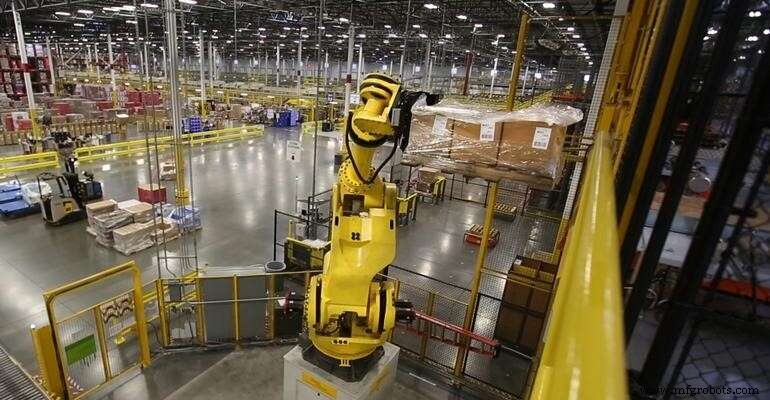
Using driverless forklift vehicles (FLVs) and driverless turret trucks, modern warehouses can automate product flow without human intervention.
Warehouse automation has been around for many years, especially for picking and storage of small and medium packages with Automated Storage and Retrieval Systems (AS/RS). According to Supply Chain Management Review: “Warehouse automation is one of the last areas where long-term costs can be significantly reduced.”
Most warehouse system look rudimentary compared with the huge, arm-whirling, automated robots present at some storage facilities or on automaker assembly lines. On an assembly line, robotics are being used to repeatedly move selected pieces to build the same final product over and over again. But the challenge for large and industrial equipment supply chain differs from the one for a factory assembly line. Moving large, heavy objects and pallets requires manually driven forklift and turret trucks.
About 99% of all the world’s cargo is palletized. Some have called the pallet one of the greatest labor-saving devices of all time.
The Occupational Safety and Health Administration (OSHA) statistics show there are about 85 forklift fatalities and 34,900 serious injuries each year in the U.S. Of those, 42 percent of the forklift fatalities are caused by the operator being crushed by a tipping forklift.
Today, with new innovations on driverless technologies and edge computing, some industries are adopting driverless forklift and turret trucks for their warehouse operations, reducing accidents, operation time, and cost.
At the ThyssenKrupp plant in Fameck/France, driverless, electrically powered forklifts glide back and forth between machines and racks almost silently, as if controlled by a magic wand. Everything flows, and they supply the employees at their workplaces with components and materials with the utmost precision.
The system is called ONE Flow AGV. AGV stands for “automated guided vehicle,” which in Fameck’s case refers to two types of vehicle: driverless forklift vehicles (FLVs), which transport goods to and from the high-bay warehouse, and driverless turret trucks — very narrow aisle trucks (VNAs) — which lift the pallets into the local high-bay racks. All of this to achieve one big goal: to automate the flow of goods over what’s called the “last mile”.
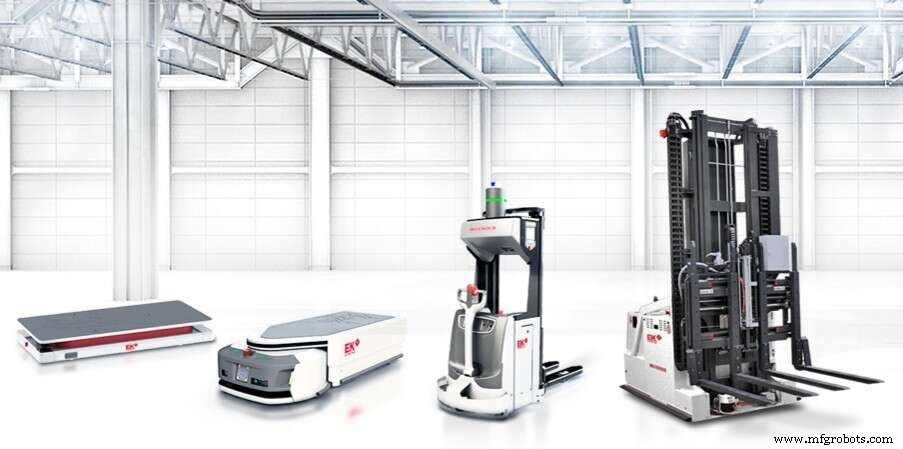
Photo courtesy of EK Automation
The autonomous robots can transport goods weighing up to one metric ton at speeds of up to six kilometers per hour.
The FLVs and VNAs navigate their way around the warehouse using laser scanners. The laser beams coming from the top of the autonomous vehicles hit reflectors distributed around the walls of the facility. Additionally, a full integrated system of gateways and wireless communications keep track of the units, sending delivery orders and monitoring operations.
Some new pallets can also communicate with each other, adding another layer of protection in critical shipments. If multiple pallets in one set need to travel together, units can communicate via Bluetooth Low Energy (BLE) and keep track of each other.
“We were able to optimize space utilization to such a degree that we can now store 50 percent more goods and materials,” says Olivier Martinelle, Supply Chain Manager responsible for Thyssenkrupp’s French plants. “The automated systems have significantly reduced costs at the sites, among other things by shortening the length of time the colleagues in production have to wait for the materials they need. Productivity has increased overall.”
As a result, the team of forklift drivers in Fameck has been cut from 40 to 6. Many of them are now supervising the automated process.
“Together with our workers, we have all acquired new skills,” says Martinelle. The result: everything keeps flowing smoothly.
Industrial Technology
- Edge & Cloud Computing in IoT: A Concise Evolutionary Overview
- IoT Edge Computing: Bridging Devices and Cloud for Real‑Time Insights
- Vecow & Blaize Unveil the ECX‑2400 Workstation‑Grade Edge AI System
- How IoT and Edge Computing Complement Each Other
- Open Source Powers the Rise of IoT and Edge Computing
- Why Edge Computing is Essential for the IoT: Unlocking Real-Time Performance
- Harnessing Edge Analytics: Empowering IoT Edge Architecture for Real‑Time Insight
- IoT, AI, and Edge Computing Revolutionize Oil Industry Operations
- Harnessing IoT Edge Computing for Real‑Time Data Analysis
- Optimizing PLCnext with Azure IoT Edge: Edge Analytics & Cloud Integration