



Resistor Color Code Calculator: Accurate 3‑Band to 6‑Band Resistor Value Estimation
3, 4, 5 and 6 Band Resistor Color Code Calculators
Resistor color codes are used to indicate the value of resistance defined by the Radio Manufacturer association in 1920 according to the International Standards IEC 60062.
Below are given calculators for different types of resistors such as 3 Band, 4 Band, 5 Band and 6 Band resistors. Explanation, formulas, solved examples and charts are added below each resistor color code calculator.
3-Stripes Resistor Color Codes
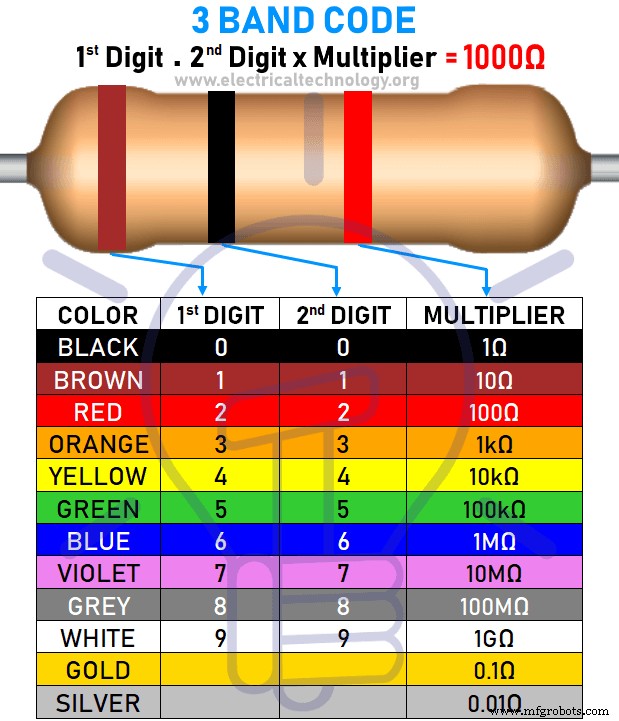
It is rarely used nowadays. To read the three stripes or color bands on a resistor, the first stripe shows the first significant figure. The second stripe shows the second significant figure and the third stripe shows the multiplier. The tolerance for three bands resistor is generally ±20% (i.e. No tolerance strip = ±20% Tolerance).
In short, If there are three color bands marked on a resistor, it means
- 1st Color Band = First Number of Value of Resistor.
- 2nd Color Band = Second Number of value of Resistor.
- 33rd Color Band = The number of Zeros (as multiplier) with the first two digits of Resistor (In numbers).
How to Calculate the Value of a Three Band Resistor Color Code?
The following formula can be used (already used in the calculator) to identify the value of resistance of a three band resistor.
1st Digit . 2nd Digit x Multiplier
Example:
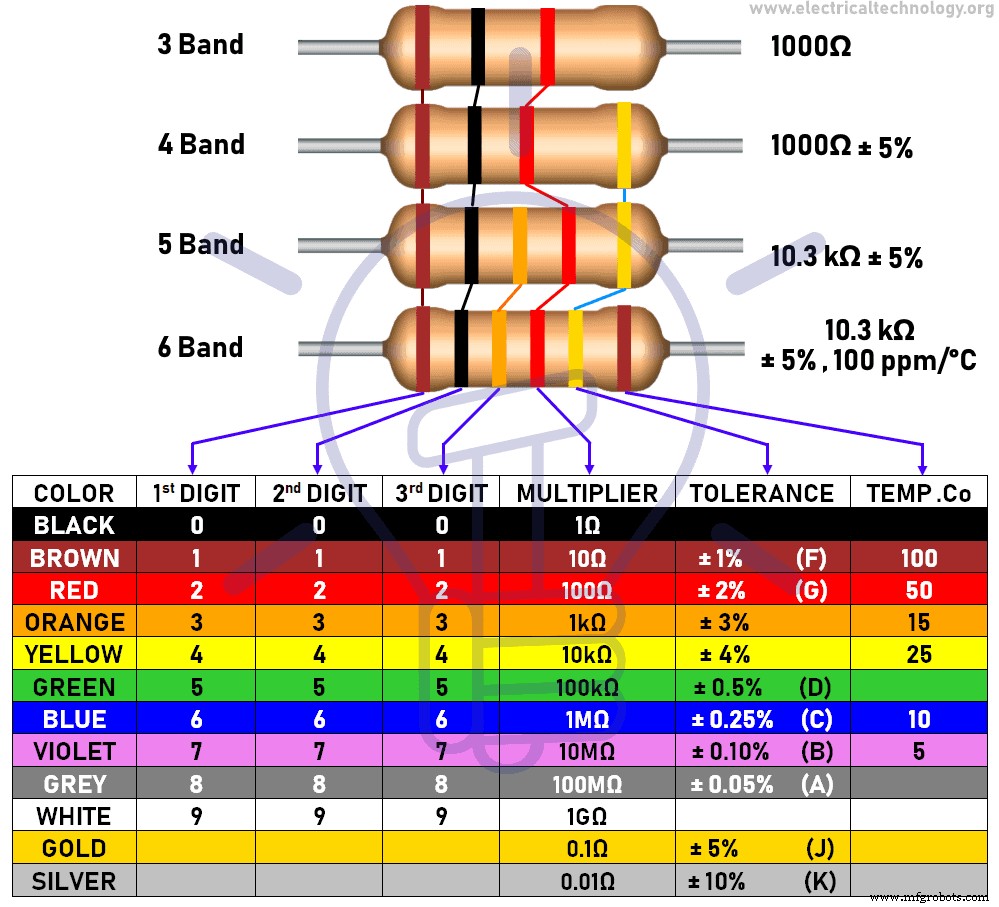
For example, the value of resistance for shown three band resistor color code (Brown, Black and Red) according to the table would be:
1 . 0 x (100) = 1000 Ω with ± 20% Tolerance.
Three Band Resistor Color Code Calculator
4-Stripes Resistor Color Code
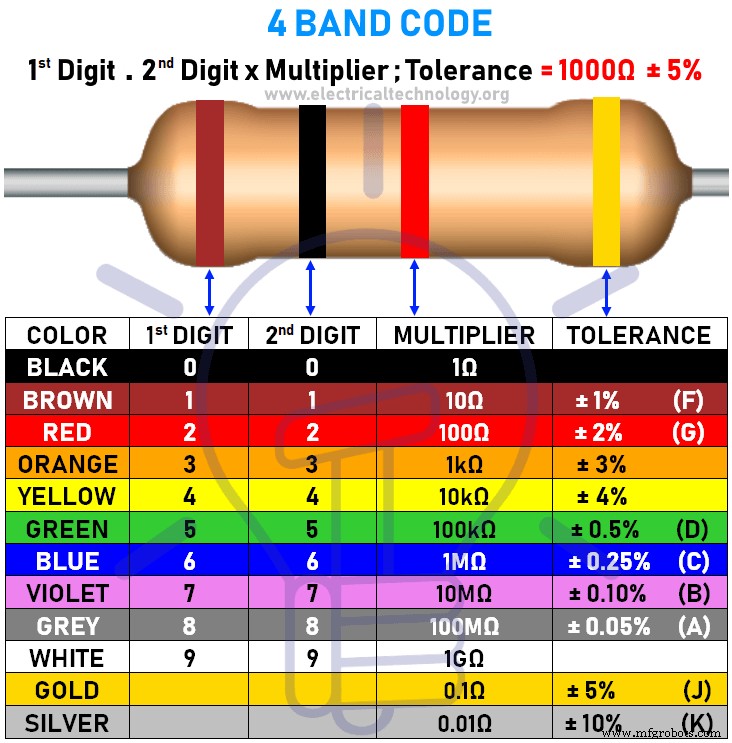
These are common types of resistors to use in electronic circuits. To determine the four stripes color codes printed on a resistor, the first band shows the first significant figure (1st Digit). The second band shows the second significant figure (2nd Digit). The third band shows the multiplier (x10). The forth band shows the ± tolerance in %.
Simply, If there are four color bands printed on an inductor, it means
- 1st Color Band = First Number of Value of resistor.
- 2nd Color Band = Second Number of value of resistor.
- 33rd Color Band = The number of Zeros (as multiplier) with the first two digits of resistor (In numbers).
- 4th Color Band = Tolerance in percentage (%).
How to Determine the Value Resistance of a Four Band Resistor Color Code?
The following formula can be used to know the value of resistance of a four band resistor.
1st Digit . 2nd Digit x Multiplier; ± Tolerance in %
Example:
For example, the value of resistance for shown 4 band resistor color code (Brown, Black, Red and Golden) according to the table would be:
1 . 0 x (100) = 1000 Ω with ± 5% Tolerance.
Four Band Resistor Color Code Calculator
5-Stripes Resistor Color Codes
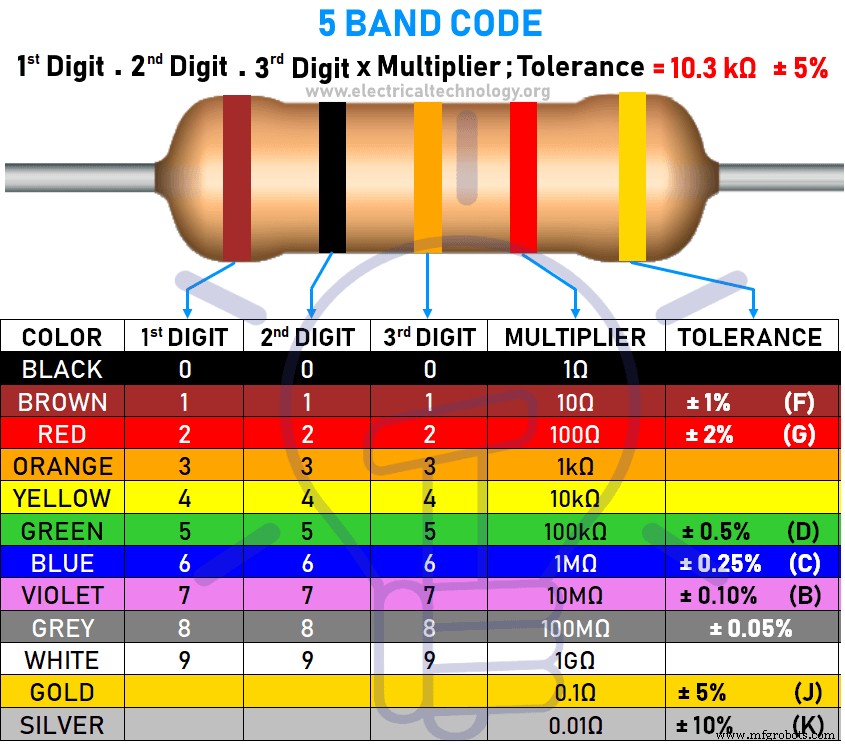
There is an additional color band as the third significant figure in the 5 band resistor color code for high accuracy. To know the value of a five stripes color coded resistor, the first, second and third stripes color codes show the first significant, second significant and third significant figures accordingly. The fourth stripe shows the multiplier and the fifth stripe shows the ± tolerance in percent (%).
So, If there are five color bands printed on a resistor, it means
- 1st Color Band = First (1st) Number of Value of resistor
- 2nd Color Band = Second (2nd) Number of value of resistor.
- 33rd Color Band = Third (3rd) Number of value of resistor.
- 4th Color Band = As multiplier (the number of zeros) with the first two digits of resistor (In numbers).
- 5th Color Band = Tolerance in %.
How to Know the Value of resistance of a Five Band Resistor Color Code?
The following formula can be used to know the value of resistance of a five band resistor.
1st Digit . 2nd Digit . 3rd Digit x Multiplier; ± Tolerance in %
Example:
For example, the value of resistance for shown 5 band resistor color code (Brown, Black, Orange, Red and Yellow) according to the table would be:
1 . 0 . 3 x (100) = 10.3 kΩ with ± 5% Tolerance.
Good to know:
There is a special scenario in the case of a 5 band resistor color code resistor where the forth strip is Gold or Silver. In this case, the first two bands show the fist two significant digits, third one is for multiplier, 4th one is for tolerance in % and 5th one is for temperature coefficient (same like in a six band resistor color code resistor). The unit of temperature coefficient is in ppm/K and more details about ppm/K can be found in 6-Band Resistor Color Code below.
Five Band Resistor Color Code Calculator
Six-Stripes Resistor Color Codes
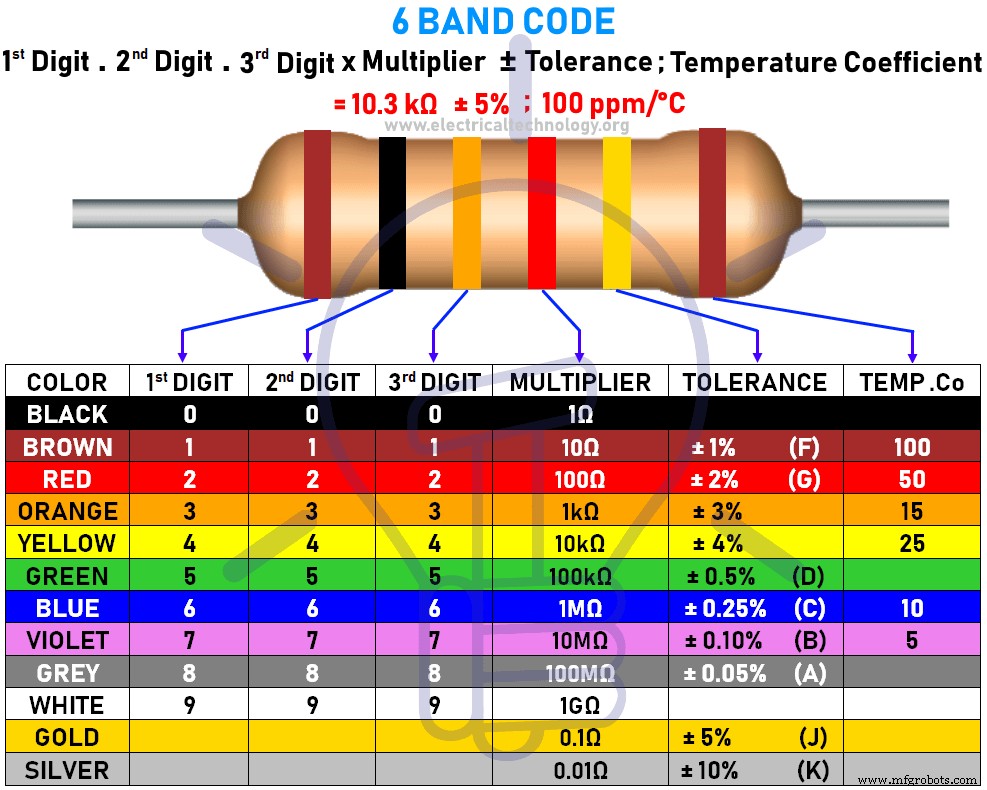
There is an additional color band as temperature coefficient in the 6 band resistor color code for high accuracy and precision. To read the six stripes color codes on a 6 band resistor, the first, second and third bands color codes show the first significant, second significant and third significant figures respectively. The fourth band shows the multiplier. The fifth band shows the ± tolerance in %. The six band shows the temperature coefficient in ppm/°K or ppm/°C.
Therefore, If there are six color bands printed on a resistor, it means
- 1st Color Band = First Digit Number of Value of resistor
- 2nd Color Band = Second Digit Number of value of resistor.
- 33rd Color Band = Third Digit Number of value of resistor.
- 4th Color Band = Multiplier (the number of zeros) with the first three digits of resistor (In numbers).
- 5th Color Band = Tolerance in %.
- 6th Color Band = Temperature Coefficient in ppm/°K or ppm/°C.
How to Find the Value of resistance of a Five Band Resistor Color Code?
The following formula can be used to know the value of resistance of a six band resistor.
1st Digit . 2nd Digit . 3rd Digit x Multiplier; ± Tolerance in % , Temp Coefficient
Example:
For example, the calculated value of resistance in ohms (converted to k-Ohms) for shown 5 band resistor color codes e.g. (Brown, Black, Orange, Red, Yellow, Brown) according to the table would be:
1 . 0 . 3 x (100) = 10.3 kΩ with ± 5% Tolerance 100 ppm/°C.
Good to know
The sixth Band used for temperature coefficient in a 6 Band Resistor Color Code. The PPM/K means “Part Per Million in Kelvin“.
For the above mentioned color code for temperature coefficient which is brown, It means, the resistance will change by 100 part per million per 1 Kelvin.
For example,
The above resistor having value of 10.3 kΩ with ± 5% Tolerance and 100 ppm/°C (Brown Color as 6th Band for temperature coefficient. And we want to know how much the value of resistance would be changed if change occurs in temperature of 10ºC.
(100 x 10ºC/106) x 10.3kΩ = ± 1.03Ω variation over 10ºC.
Six Band Resistor Color Code Calculator
Resistor Color Codes
These handy tools are designed to calculate the value of 3-Band, 4-Band, 5-Band and 6-Band resistors according to their color codes printed on it.
Meanwhile, to know how the resistor color code calculator works and how to read the printed color codes on a specific resistor to find their value, see the following tables and chart. Also, formulas and tables are also given below each calculator with a solved example.
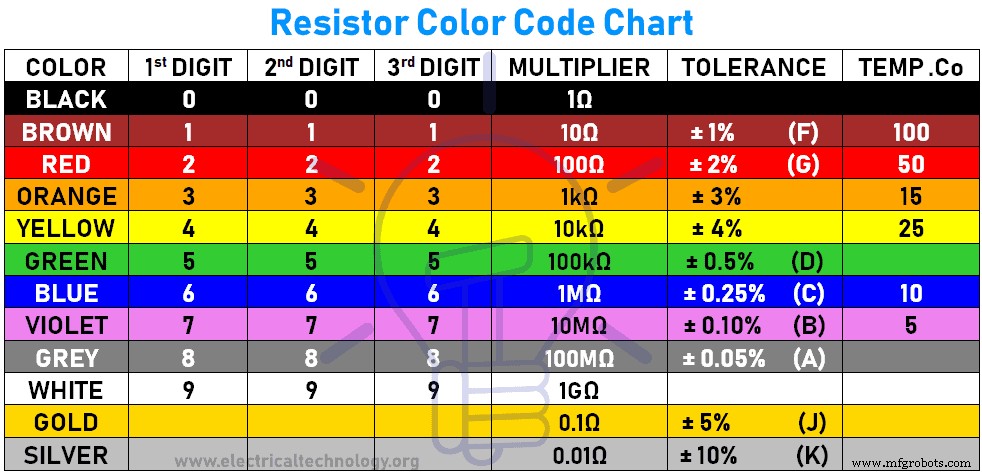
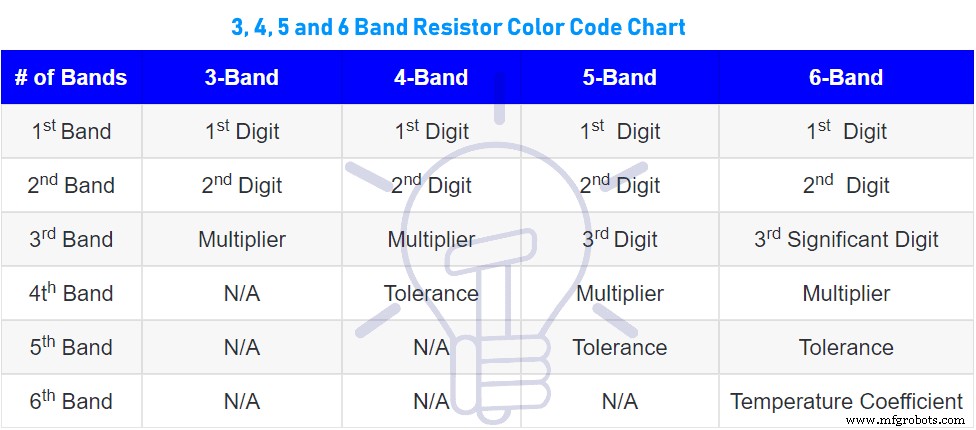
Below is a given table showing the different values for different color codes of resistors.
| # of Bands | 3-Band | 4-Band | 5-Band | 6-Band |
| 1st Band | 1st Digit | 1st Digit | 1st Digit | 1st Digit |
| 2nd Band | 2nd Digit | 2nd Digit | 2nd Digit | 2nd Digit |
| 3rd Band | Multiplier | Multiplier | 3rd Digit | 3rd Significant Digit |
| 4th Band | N/A | Tolerance | Multiplier | Multiplier |
| 5th Band | N/A | N/A | Tolerance | Tolerance |
| 6th Band | N/A | N/A | N/A | Temperature Coefficient |
Color Values for Significant Digits
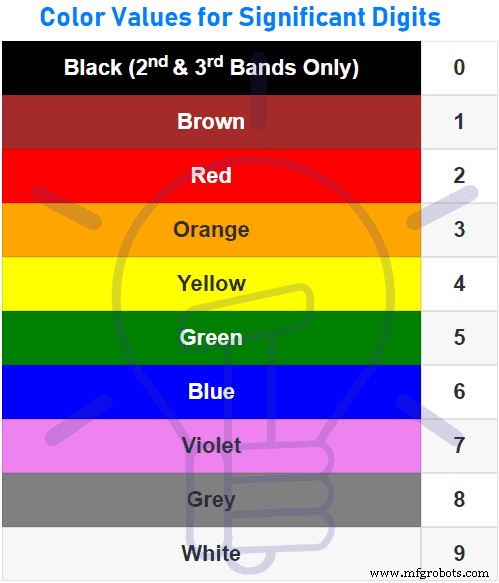
In resistor color codes, each color shows a specific value. In case of 3 bands and 4 bands resistors, the first two color bands are showing the significant figures and their values while in 5 bands and 6 bands resistors, the 1st, 2nd and 3rd color bands are showing the significant figures and related values.
| Band Color | Value |
| Black (2nd & 3rd Bands Only) | 0 |
| Brown | 1 |
| Red | 2 |
| Orange | 3 |
| Yellow | 4 |
| Green | 5 |
| Blue | 6 |
| Violet | 7 |
| Grey | 8 |
| White | 9 |
The following simple mnemonics can be memorized to remember the color code sequence for resistor color codes.
- Better Be Right Or Your Great Big Vacation goes Wrong.
- B B ROY of Great Britain had a Very Good Wife who wore Gold and Silver Necklace.
The second one is for additional colors in the multiplier column.
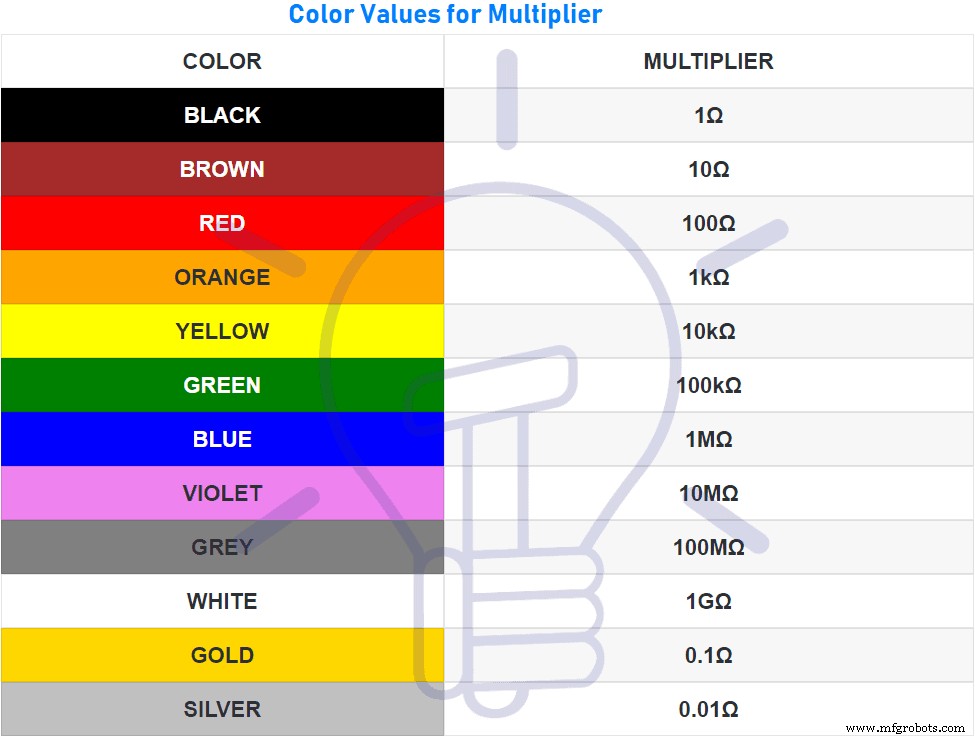
Color Values for Multiplier
The color on the third band for 3-bands resistor and 4-bands resistor or the fourth band on 5-bands and 6-bands resistor is known to be Multiplier. The following table shows the color and related values for the multiplier color band.
| COLOR | MULTIPLIER |
| BLACK | 1Ω |
| BROWN | 10Ω |
| RED | 100Ω |
| ORANGE | 1kΩ |
| YELLOW | 10kΩ |
| GREEN | 100kΩ |
| BLUE | 1MΩ |
| VIOLET | 10MΩ |
| GREY | 100MΩ |
| WHITE | 1GΩ |
| GOLD | 0.1Ω |
| SILVER | 0.01Ω |
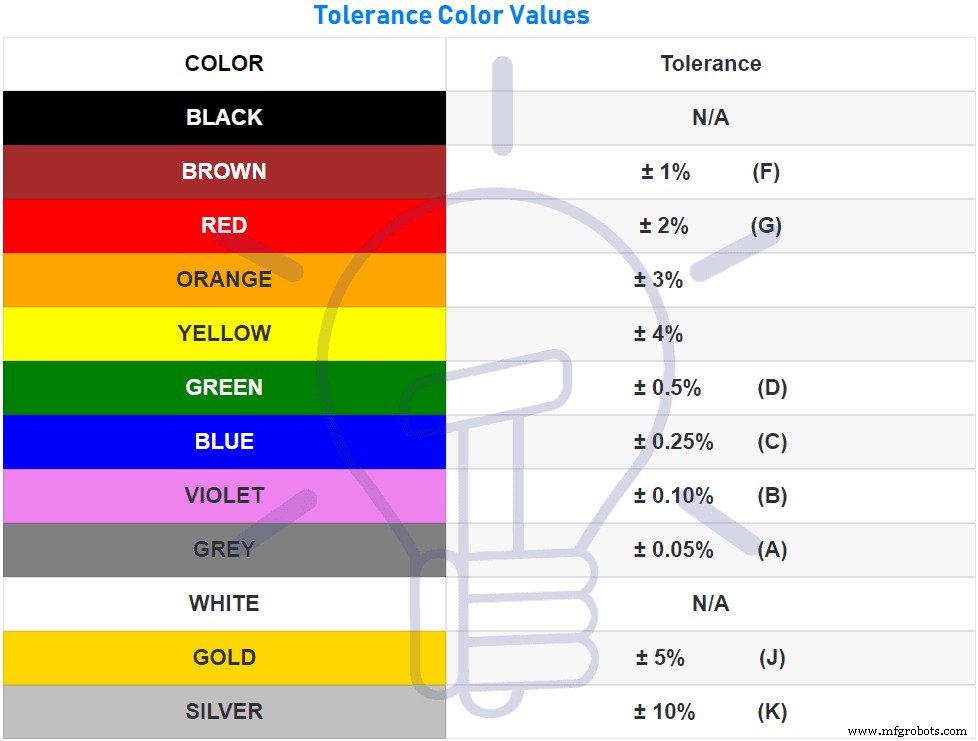
Tolerance Color Values
In three band resistor color codes, there is no tolerance band, so generally, 20% are assumed and used. The forth band in 4 band resistor color is used for tolerance value. In the case of 5 band and 6 band resistors, the 5th band code is used for tolerance in percent.
| COLOR | Tolerance |
| BLACK | N/A |
| BROWN | ± 1% (F) |
| RED | ± 2% (G) |
| ORANGE | ± 3% |
| YELLOW | ± 4% |
| GREEN | ± 0.5% (D) |
| BLUE | ± 0.25% (C) |
| VIOLET | ± 0.10% (B) |
| GREY | ± 0.05% (A) |
| WHITE | N/A |
| GOLD | ± 5% (J) |
| SILVER | ± 10% (K) |
Tolerance Letter Codes for Resistors
- A = 0.05%
- B = 0.1%
- C = 0.25 %
- D = 0.5 %
- F = 1 %
- G = 2 %
- J = 5 %
- K = 10 %
- M = 20 % (General)
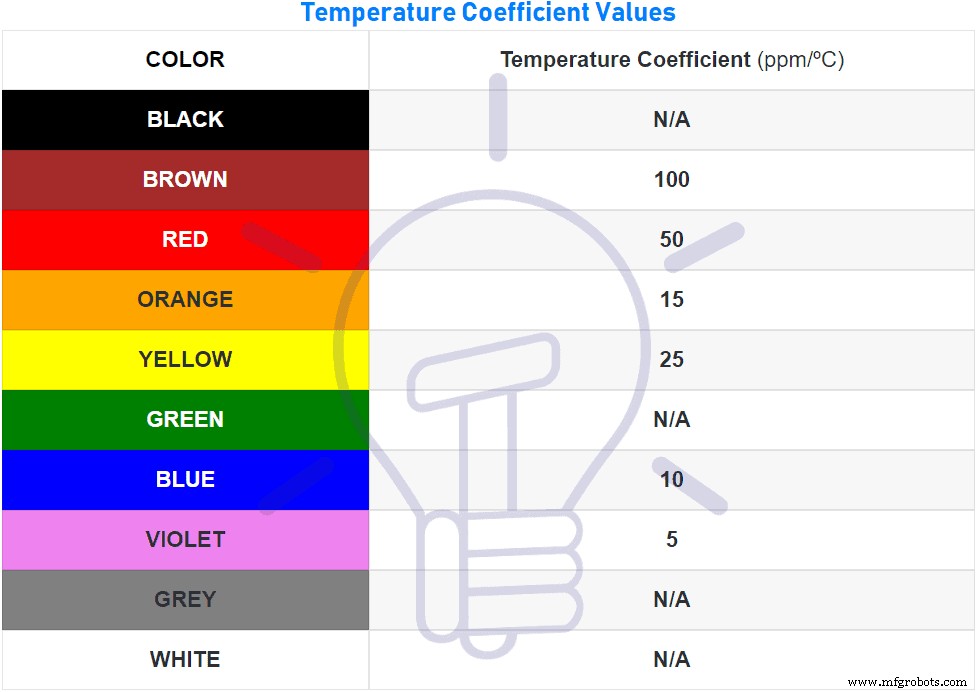
Temperature Coefficient Values
The 6th Band of a six band resistor shows the Temperature Coefficient in ppm/ºC which indicates how much the value of resistor is changed when change occurs in temperature. More details about Temperature Coefficient and ppm/ºC and ppm/K can be found below the resistor calculator for 6 bands. In short, The PPM/K means “Part Per Million in Kelvin“.
For instance,
The above 6 band resistor having value of 10.3 kΩ with ± 5% Tolerance and 100 ppm/°C (Brown Color as 6th Band for temperature coefficient. And we want to know how much the value of resistance would be changed if change occurs in temperature of 10ºC.
(100 x 10ºC/106) x 10.3kΩ = ± 1.03Ω variation over 10ºC.
| COLOR | Temperature Coefficient (ppm/ºC) |
| BLACK | N/A |
| BROWN | 100 |
| RED | 50 |
| ORANGE | 15 |
| YELLOW | 25 |
| GREEN | N/A |
| BLUE | 10 |
| VIOLET | 5 |
| GREY | N/A |
| WHITE | N/A |
Good to Know:
- In the case of a 5 band color code resistor where the forth strip is Gold or Silver. In this case, the first two bands show the fist two significant digits, third one is for multiplier, 4th one is for tolerance and 5th one is for temperature coefficient, the same is in six band resistor color code resistor. The unit of temperature coefficient is in ppm/K and more details about ppm/K can be found in 6-Band Resistor Color Code.
- The Gold and Silver band colors are replaced with Yellow and Gray colors in case of high voltage resistors to prevent particles such as metals etc from getting in the resistor coating.
- Zero Ohm resistor (Single Black Color Band) is used as a wire link in PCB (Printed Circuit Board) to connect traces.
- For highly sensitive devices (such military purposes), there is a Reliability Band which shows failure rate in % per 1000 hours of service. This band is not available in commercial resistors.
SMD Resistor Color Codes
We have already discussed a very detailed post about How to Find the value of SMD Resistors with solved examples.
Resistor Color Code Charts
Industrial Technology
- Resistor Color Codes – A Comprehensive Guide to Decoding Value, Tolerance, and E-Series Standards
- Decode SMD Resistor Codes: Quick Guide to Determining Resistance Values
- Accurate Electric Energy Cost Calculator – Estimate Daily, Monthly & Annual Bills
- Capacitor Color Codes Explained – How to Read Capacitor Values & Use the Calculator
- Master Inductor Color Codes: Quick Guide to Decode Inductance Values
- Mastering Resistor Values: Calculations, Color Codes, and Standard Series
- Master Resistor Circuit Diagrams: Expert Guide to Series, Parallel, and Hybrid Connections
- Resistor Applications: Essential Uses & Types in Electronics
- Mastering Resistor Color Codes: Quick Guide for Electronics
- Zero‑Ohm Resistors: Key Advantages and Real‑World Uses