



Understanding 2D Barcodes: Definition, History, and Capabilities
A Definition of 2D Barcodes
Two-dimensional (2D) barcodes incorporate rectangles, dots, hexagons, and other geometric patterns to form scannable squares and rectangles. The first 2D barcode was developed by David Allais at Intermed Corporation in 1987. 2D barcodes hold a great deal of information and data 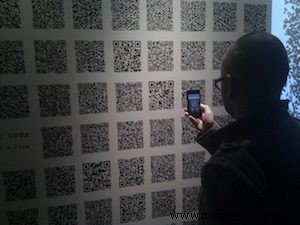 because they store information horizontally and vertically; in fact, 2D barcodes can store up to 7,089 characters, which is a much greater storage capacity than the 20-character capacity of standard barcodes. 2D barcodes are used in manufacturing, warehousing, logistics, and healthcare, and they are popular because they are legible when printed in small sizes and when etched onto a product.
Types of 2D Barcodes
2D barcodes include data matrix, QR code, and PDF417 codes. These codes all use patterns of geometric shapes to encode data, and they hold more data than 1D codes.
- Data Matrix Codes – Data matrix codes are 2D symbols laid out in square or rectangular grids. Data is encoded horizontally and vertically in a series of dark and light blocks. Data matrix codes cannot be read with laser scanners; rather, they are read with imagers, CCDs, and other camera-based products that read data contained in an area versus a line.
- QR Codes – Quick response codes, or QR codes, began in Japan as a method for tracking automobile parts. QR codes can encode URLs and be scanned by smartphones with a QR code scanning app. QR codes may include geo coordinates, text, and other data.
- PDF417 Codes – A PDF417 code is a 2d barcode that incorporates high-density symbology that encodes text, numbers, files, and data bytes. PDF417 codes securely and inexpensively store large amounts of text and data. The codes include several linear rows of stacked codewords. That’s why the PDF417 symbology is referred to as stacked linear symbology.
Benefits of 2D Barcodes
Because they allow for fast data access, 2D barcodes also are referred to as quick response codes. 2D barcodes also are scanned with smartphones because users easily photograph the barcode with the camera on their phone that is equipped with a barcode scanner or barcode reader app. These barcode readers interpret encoded URLs and direct users to relevant information on websites. That is why many organizations utilize 2D barcodes for mobile marketing.
Companies rely on 2D barcodes for inventory and asset tracking, especially because they can be used to import data from external sources such as databases and files. For this reason, 2D barcodes typically can be integrated easily with an existing tracking system and then used to improve it.
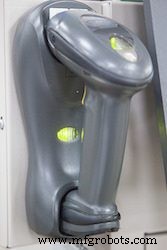 Businesses of all sizes benefit from barcoding systems because they enable companies to operate more efficiently. 2D barcodes and scanners reduce errors, especially when compared to manual data entry methods; by some accounts, barcode systems only result in one error for every 10,000 scans, but manual data entry results in ten errors for every 1,000 keystrokes. 2D barcodes and scanners also decrease the time spent by employees entering and changing data or tracking assets and inventory once data has been entered.
Organizations also choose 2D barcodes because they are capable of storing enough information that users do not need to refer to a database. Organizations can store all of the most pertinent information directly in the barcode, which makes 2D barcodes a top choice when tracking and auditing product batches remotely or in large facilities is a common practice.
Overall, 2D barcodes such as data matrix codes, QR codes, and PDF417 codes are becoming more common, especially for businesses and organizations that need to store more data than standard 1D barcodes allow.
Recommended Reading on 2D Barcodes:
For more information on 2D barcodes, visit the following articles:
- Guide to Barcode Types and Standards: 1D, 2D Barcode Symbologies, Requirements, and Standards-Issuing Entities
- Top 31 Barcode Scanner and Inventory Apps for iOS and Android
- 50 Top Automatic Identification Systems and Technology Tools for Data Capture
- Data Matrix Codes vs. QR Codes
Images via Flickr by noii’s and perspec_photo88
Industrial Technology
- Understanding Meter Design: From Classic Galvanometers to Modern Digital Displays
- Understanding the Oxygen (O2) Sensor: Role, Placement, and Failure Signs
- Understanding AS9100: The Aerospace Quality Management Standard
- What Is A2 Steel? A Versatile, Cost‑Effective Tool‑Steel Grade for Industrial and Woodworking Applications
- Why Barcoding Is Essential for Pharmaceutical Product Integrity
- Understanding Metal Casting: Process, Benefits, and Applications
- Warehouse Barcode Implementation: A Proven Step‑by‑Step Blueprint
- Essential Guide to Choosing the Right Barcode Labels
- Demystifying 3D Printing: A Clear Guide for Innovators
- Decoding 'N' in Pump Calculations: Its Role and Significance