



Safeguarding Alternators: Comprehensive Fault Protection Strategies
Alternators Protection
As we have discussed in the previous articles about the protection of transformers and transmission lines. Nowadays the modern electric power systems consist of several parts e.g. alternators, transformers, station bus bars, transmission lines and other equipment. It is become necessary to protect every and each part of the electric power system from the faults which may occur sooner or later. It is very profitable by using protective relays for the improper behavior of the system. Which can be detected by the sensitive relays easily. The most serious faults on the alternators which require attention on the immediate basis are the stator winding faults. The basic system for the protection of alternators is the differential relay scheme because the differential nature of measurement makes the system much more sensitive and reliable than other protective systems.
The generating units, especially the larger ones are very few in numbers but high in individual cost and most other equipment. Therefore it is desirable to keep all these equipment safe and protected from damaging faults. Here we are going to discuss some faults which may occur in the alternators.
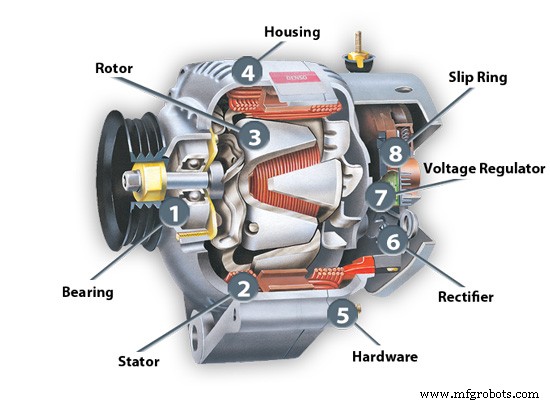
Failure of prime-mover:
When the input to the prime mover fails, the alternator runs as a synchronous motor and draws some currents from the provided supply. This condition is called “inverted running”.
Failure of a field:
The chances of field failure are very undoubtedly very rare. But if it occurs it cannot damage the alternator.if the alternator runs without providing field supply. The faulty alternator can be easily separated manually and not provide automatic system from separation.
Overcurrent:
This type of fault occurs mainly due to the partial breakdown of the winding insulation or due to overload on the supply system. Sometimes overcurrent protection for alternators is unnecessary due to the following reasons.
1) In the modern days, the alternator windings are with high impedance so they stand a complete short circuit at their terminals for sufficient time and then It can be easily separated manually.
2) The disadvantage of using overload relay for protection of alternators is that such a protection might disconnect the alternators from the bus bars on momentary troubles outside, it disturbs the continuity of power supply to the consumers.
Over Speed:
The main cause of over speed is a sudden loss of the high amount of load disconnecting from an alternator. So for that purpose, a mechanical centrifugal device is mounted on the driving shaft to trip the main valve of the prime mover when dangerous over speed occurs.
Over Voltage:
The field excitation system is very well designed nowadays so that it cannot provide overvoltage but overvoltage may occur due to over speeding of a prime mover. Overspeeding of alternators reason is a sudden loss of a huge amount of load disconnection. If some mechanical system is installed on the moving shaft of the alternator then It can be controlled easily.
Unbalanced loading:
Unbalanced loading means different phase current in the alternator. The different current condition occurs in alternator due to earth or fault between phases. Unbalanced loading if it is allowed to persist it can burn the windings or may damage the mechanical fixings.
Industrial Technology
- Protecting Aluminum Against Corrosion: Expert Strategies for Long‑Lasting Durability
- Automotive Alternator: Building a Three‑Phase Generator for Hands‑On Learning
- Protect Your Business: Expert Cybersecurity Strategies for Manufacturers
- Master Cable Duct Installation in Electrical Panels Using E3.series
- Unlocking ROI Through Superior Engineering Design
- Maximize ROI from Your Lead Generation Investment
- Prevent Breakage of CNC Plastic Tool Holder Clips: Proven Protection Tips
- Professional Electrical & Electronics Engineering Tutorials: Master Testing & Calculations
- Protecting Industrial Cloud Infrastructure: Strategies Against Cyber Attacks
- Secure Your Heavy Equipment: Proven Strategies to Prevent Theft